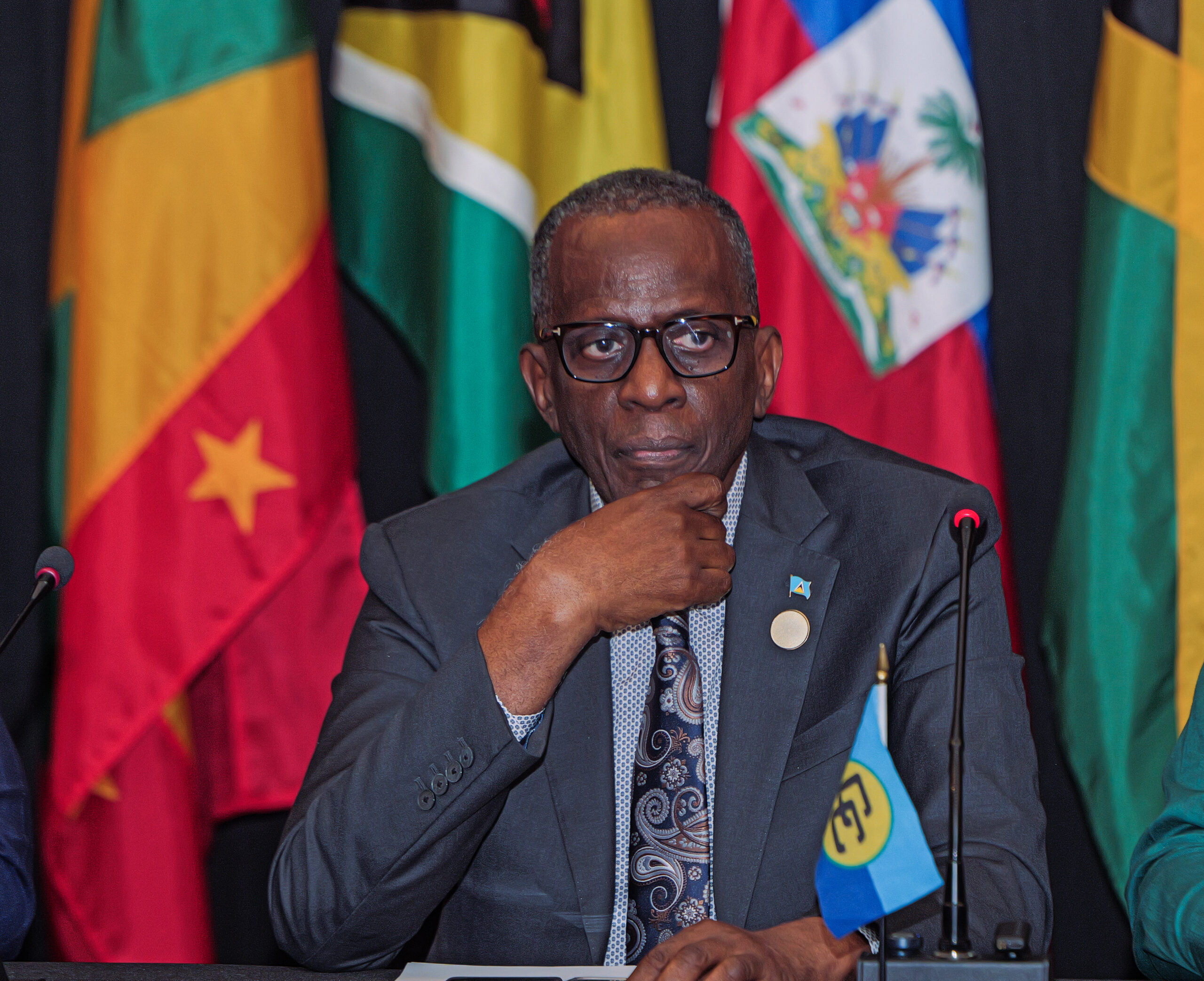
As the sitting Chair of the Caribbean Community (CARICOM) and Prime Minister of Saint Lucia, Philip J. Pierre has formally restated the regional bloc’s long-held stance that reparatory justice must be a core, non-negotiable component of any structured bilateral dialogue with the United Kingdom addressing the enduring legacy of transatlantic chattel slavery.
Pierre laid out CARICOM’s official position in a public statement released Saturday, timed ahead of the upcoming Commonwealth Heads of Government Meeting hosted in Antigua and Barbuda. The statement responds directly to recent public remarks from UK Prime Minister Andy Burnham, in which Burnham voiced personal sorrow and regret for the intergenerational harm inflicted by Britain’s role in the transatlantic trafficking and systematic enslavement of African peoples, signaled openness to issuing a formal, official state apology, and extended an offer to launch formal, structured dialogue with communities impacted by that historical exploitation.
Pierre framed Burnham’s public positioning as a landmark, unprecedented development, noting that no prior UK prime minister had ever articulated a stance on the slavery legacy that extended as far as Burnham’s acknowledgment and dialogue proposal. He confirmed that CARICOM formally welcomes the long-awaited offer of structured engagement, which the regional body has been advocating for over 10 consecutive years, and stated flatly, “We are ready to engage.”
But the CARICOM chair drew a clear line of divergence from Burnham’s accompanying public remark that formal reparations were “not the right answer” to addressing historical harms. Pierre emphasized that reparatory justice frameworks do not seek to assign personal, individual guilt to contemporary British citizens, but rather to formally recognize the legal and moral responsibility of successive British state institutions for the crimes of slavery, and the cascading, unaddressed harms those crimes continue to generate for Caribbean populations today.
He cited well-documented historical facts to contextualize that responsibility: successive British governments not only legislated to entrench chattel slavery across its colonial territories, but actively protected the institution and extracted massive national wealth from enslaved labor. Following emancipation in the 19th century, British authorities paid generous, state-funded financial compensation exclusively to former enslavers, while the millions of formerly enslaved people who had built the colonial economy received no land, wealth, or material redress of any kind. Pierre further noted that the public loan the UK government took on to fund those enslaver payouts was not fully paid off by British taxpayers until as recently as February 2015.
Across the Caribbean region, Pierre outlined, the cascading harms of that unaddressed history remain starkly visible: they are linked to persistently high rates of chronic disease, systemic gaps in educational access and attainment, deep structural economic inequities, fragile colonial-era extractive economic systems, and crippling levels of national public debt. While a formal, unreserved UK state apology would mark a meaningful, historically significant milestone, Pierre stressed that it would be an empty gesture without concrete, actionable measures to redress the tangible damage inflicted by centuries of exploitation. “An apology without repair is incomplete,” he stated categorically.
To that end, Pierre called for all upcoming UK-CARICOM discussions to fully incorporate every component of CARICOM’s established Ten-Point Plan for Reparatory Justice. That comprehensive framework outlines targeted, practical measures ranging from a formal state apology, expanded public health and education investment, cultural heritage restitution, and psychological rehabilitation programs, to targeted technology and entrepreneurship support, broad debt cancellation, formal monetary compensation for harms, and full decolonization of remaining institutional and cultural structures. He further specified that the dialogue must also extend beyond the legacy of transatlantic chattel slavery to address the historical genocide of Indigenous Caribbean populations, and the systemic harm inflicted on indentured laborer communities brought to the region from India and China to prop up colonial economic systems.
Pierre also acknowledged a separate new UK policy initiative, set to be led by former British Prime Minister Gordon Brown, that aims to restructure sovereign debt for the world’s poorest Commonwealth nations. He confirmed CARICOM will conduct a thorough, good-faith review of the proposal, but issued a critical caveat: a large share of CARICOM member states are currently locked out of access to concessional debt relief programs, because global classification systems label them as middle- or high-income economies, even though they face extreme, disproportionate vulnerability to catastrophic climate shocks and volatile global economic disruptions. “Any initiative that is to be meaningful for our region must measure vulnerability, not income alone,” he emphasized, adding that even well-designed debt relief measures cannot serve as a substitute for the full scope of reparatory justice the region is demanding.
Pierre confirmed that CARICOM’s existing Prime Ministerial Sub-Committee on Reparations, led by Barbados Prime Minister Mia Mottley, and the independent CARICOM Reparations Commission chaired by Sir Hilary Beckles, are fully prepared to collaborate with the UK government to co-develop fair terms, a detailed agenda, and a clear timetable for the upcoming structured negotiations. He noted he is looking forward to meeting face-to-face with Prime Minister Burnham in St John’s, Antigua, during the upcoming Commonwealth Heads of Government Meeting, and reaffirmed that the region has an intergenerational responsibility to pursue full justice for the communities that suffered under slavery, and for all future generations of Caribbean citizens. That work, he concluded, must move forward “with dignity, with patience, and with resolve.”
Pierre says reparations must remain central to dialogue with United Kingdom