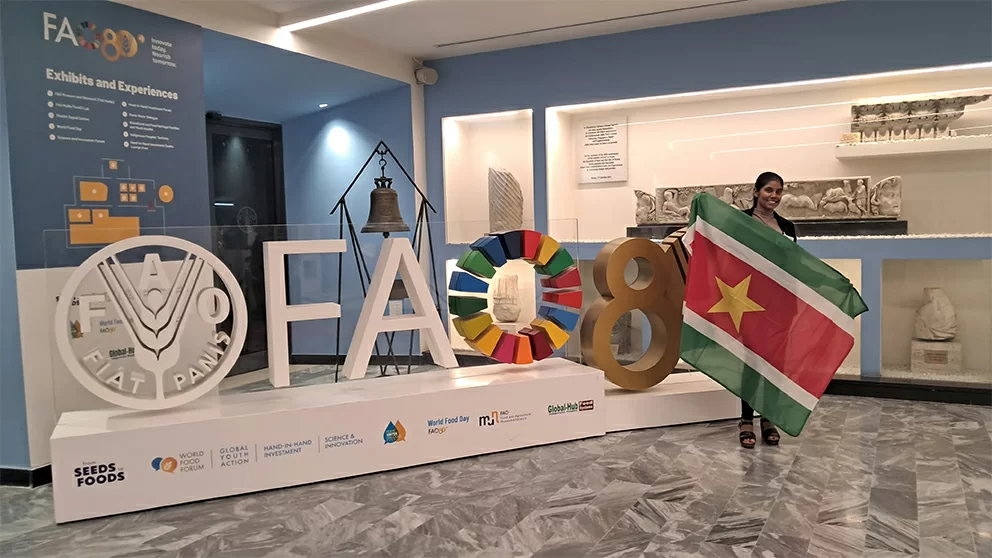
A four-member student team from Anton de Kom University of Suriname (AdeKUS) is set to showcase their groundbreaking sustainable agriculture innovation at the 2026 World Food Forum, hosted at the headquarters of the United Nations Food and Agriculture Organization (FAO) in Rome, Italy from October 11 to 17.
Operating under the project name Waste2Wonders, the team – made up of Shanisha Badrie, Ezra Gron, Stefany Wijngaarde and Wiraisha Gauri, all majoring in Agricultural Production – has developed fully biodegradable seedling pots crafted from three locally sourced organic waste materials: rice husks, cocopeat and vermicompost. The core goal of the project is twofold: cut down the heavy reliance on single-use plastic in small-scale and commercial agriculture, and repurpose agricultural residual waste streams that would otherwise go unused or contribute to environmental degradation.
Unlike traditional plastic seed trays and pots that require farmers to remove seedlings before transplanting – a process that often damages fragile root systems and reduces crop survival rates – the Waste2Wonders pots allow entire seedlings to be planted directly into soil, pot and all. As the pot breaks down naturally over time, it also adds organic matter to the soil, delivering secondary benefits for soil health that plastic alternatives cannot match.
Beyond addressing plastic pollution and transplant stress, the project prioritizes accessibility for local farming communities. By using raw materials that are readily available across Suriname’s agricultural regions, the team aims to produce the pots at an affordable price point that fits within the budgets of smallholder farmers. In doing so, they hope to not only advance more sustainable farming practices across the country but also stimulate local economic activity by building a domestic production ecosystem that relies on regional agricultural supply chains.
This is not the first international recognition the student-led initiative has earned. In 2025, the project secured a top-three spot in the global Food Systems Innovation Challenge held in Wageningen, the Netherlands. Between April and August 2026, the team participated in FAO’s global Youth Incubation Program, where they received tailored training and mentorship to refine both their product design and business model ahead of the World Food Forum.
Team members note that the opportunity to present at the UN-led forum is a major milestone that will open doors for knowledge sharing with global experts, and for building connections with potential partnership organizations and impact investors. For Waste2Wonders, the next phase of work will focus on further product optimization and large-scale field testing to validate the pots’ performance across different crop types and farming conditions.
The project stands as a compelling example of how circular economy principles can be applied to the agricultural sector, turning everyday waste streams into solutions for pressing environmental and food system challenges. While questions remain around scaling up production to reach wider markets and keeping costs competitive with conventional plastic alternatives, the team’s early success has already demonstrated the potential for youth-led innovation to drive meaningful change in global food systems.