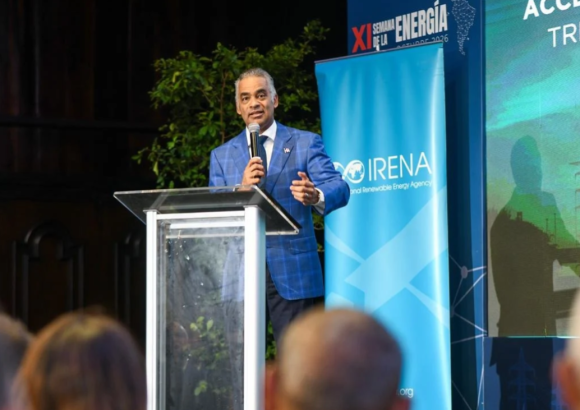
At the closing ceremony of the High-Level Global Forum on Energy Transition, a landmark initiative has been launched to tackle one of the Caribbean’s most pressing transboundary environmental challenges. Hosted as a core event of the 11th Santo Domingo Energy Week, the Dominican Republic formally presented the Santo Domingo Ministerial Declaration on the Sustainable Valorization of Sargassum, reaffirming the nation’s dedication to cross-border innovation and regional collaboration to address massive, widespread sargassum inundations.
Massive accumulations of the brown macroalgae have plagued coastal regions across the Caribbean for years, disrupting fragile marine ecosystems, devastating tourism-reliant coastal communities, and dragging down cross-border economic activity. Energy and Mines Minister Joel Santos emphasized that this shared threat cannot be addressed by individual nations acting alone, making coordinated regional action non-negotiable.
Santos pointed to an unexpected opportunity hidden within the crisis: rather than treating sargassum solely as environmental waste to be disposed of, it can be reimagined as a valuable resource for the circular economy. The declaration outlines a framework for developing approaches to sargassum management and utilization that are grounded in solid science, feasible from an economic perspective, and protective of natural ecosystems, with promising potential applications including energy generation.
Foreign Minister Víctor “Ito” Bisonó explained that the declaration moves beyond symbolic political commitments, aiming to translate pledges into tangible, on-the-ground action through targeted regional coordination, expanded scientific research, collaborative project development, and targeted investment attraction. The framework brings together a multi-stakeholder coalition spanning national governments, academic research institutions, private sector enterprises, and civil society organizations, all working together to upgrade every link of the sargassum value chain — from real-time monitoring and large-scale collection to industrial processing to final valorization.
To advance these goals, the Dominican Republic is already exploring a wide range of potential agricultural, industrial, and materials science applications for processed sargassum, alongside continued investigation of its utility for energy production. All potential uses are required to meet strict technical, environmental, public health, and economic performance standards before being scaled up.
A critical step to boost industry growth is the recently secured $6.3 million financing package, developed through a partnership between the European Investment Bank, the European Union, and Adopem Savings and Credit Bank. This funding will provide both accessible financing and targeted technical assistance to micro, small, and medium-sized Dominican enterprises that operate along the sargassum value chain, helping to build a robust, inclusive local industry.
Ultimately, the declaration calls for deeper, more structured collaboration across all key stakeholders: national governments, academic research centers, multilateral development banks, private businesses, and international organizations. The coordinated effort will align scientific research progress, sustainable harvesting practices, enabling public policies, accessible financing channels, and expanded market access, all while upholding strict environmental protection standards to guard against unintended harm to ecosystems.