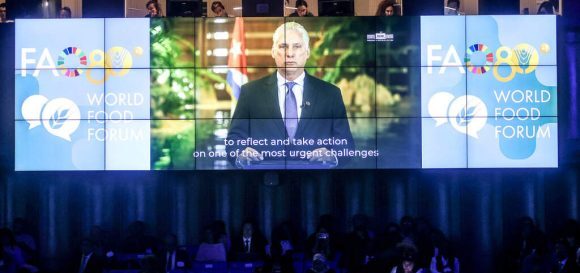
Speaking via pre-recorded video address at the 2026 World Food Forum, hosted at the Food and Agriculture Organization (FAO) headquarters in Rome between October 8 and 16, Cuban President Miguel Díaz-Canel has pointed to more than 60 years of U.S. economic restrictions as a core driver of the Caribbean nation’s persistent food production and distribution struggles, while issuing a global call for amplified collective action to end widespread hunger.
Díaz-Canel emphasized that Cuba’s food shortages cannot be explained solely by adverse environmental conditions or shifting market dynamics. The over six-decade-long economic, commercial and financial embargo imposed by the United States has systematically blocked Cuba’s ability to access critical global resources, he explained, cutting off the country from international markets, vital development financing, modern agricultural technology, key farming inputs and affordable fuel supplies.
He specifically called out the stricter enforcement of existing restrictions rolled out by the Trump administration earlier this year, noting that the amplified measures have disrupted every link of Cuba’s domestic food supply chain — from on-farm planting and industrial processing to ground transportation and end-consumer distribution.
Beyond addressing Cuba’s domestic challenges, the Cuban president warned that overlapping global crises are hitting low- and middle-income developing nations far harder than wealthy economies. “Armed conflicts, the accelerating climate crisis, and global economic turmoil disproportionately harm developing countries, where more than 640 million people already live with extreme hunger,” he stated.
According to an official press release published by the Embassy of the Republic of Cuba in Dominica, the Cuban government has already implemented a series of domestic policy adjustments to build greater food sovereignty: it has decentralized agricultural management, invested in homegrown scientific innovation for farming, and expanded the use of renewable energy to cut reliance on imported production inputs.
Díaz-Canel expressed public gratitude to the FAO for its longstanding support of Cuba’s agricultural and food sectors, noting that the UN agency has mobilized nearly $100 million in combined resources, technical assistance and workforce training to boost Cuban productive capacities. He also used the forum platform to announce Cuba’s formal accession to the Global Alliance Against Hunger and Poverty, alongside the rollout of two new national plans designed to strengthen social protection for food-insecure vulnerable populations.
On the sidelines of the forum, Cuba also presented two targeted development projects focused on scaling up sustainable coffee and honey production. Both initiatives center on creating new formal employment opportunities for rural communities, advancing environmental conservation goals, and expanding the country’s ethical export capacity.
In his closing statement, Díaz-Canel reaffirmed his call for global solidarity: “We call for strengthening international cooperation and defending the right to food as a fundamental human right.” The Cuban government wrapped up its presentation with a clear summary of its core position: “Cuba is not a threat; the blockade is.”