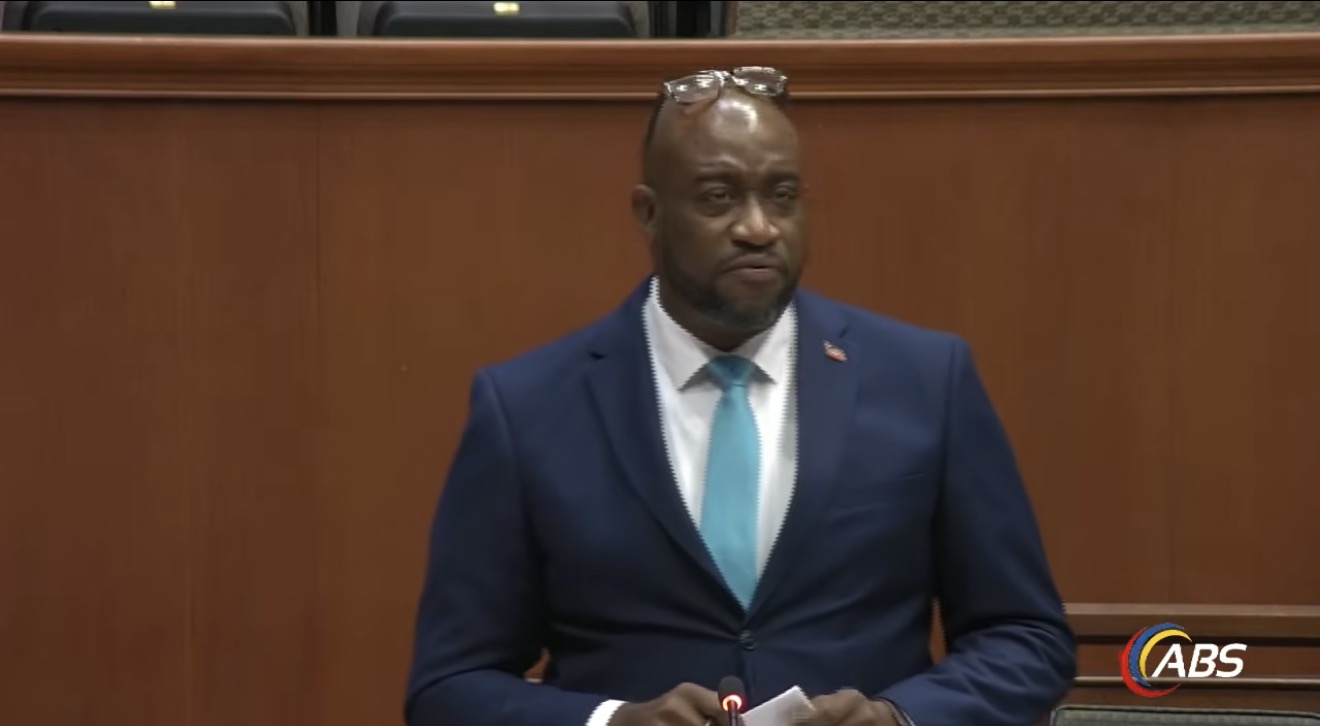
As the Antigua and Barbuda Senate debated the 2026 Firearms Amendment Bill, opposition Senator Ashworth Azille has delivered a forceful critique of the government’s narrow focus on harsher, mandatory prison sentences as a solution to rising gun violence. While he acknowledges the legislation’s timeliness and supports tough penalties for illegal firearms possession, trafficking, and gun-related harm, Azille argues that policy makers are treating the bill as a silver bullet that cannot resolve the nation’s deepening public safety crisis.
Azille opened his remarks by grounding the debate in the lived reality of Antigua and Barbuda’s residents, who he says are currently living in a constant state of fear. With communities asking what leaders will do to restore safety to their neighborhoods, empty political promises and quick sound bites no longer suffice to calm public anxiety, he said. The core question facing lawmakers, he emphasized, is whether stiffer mandatory sentences alone can reverse the growing proliferation of gun crime across the country.
Citing a rising tide of brutal, increasingly bold violence recorded between January and September, Azille outlined how perpetrators have shifted their patterns: once targeting property alone, today’s gun attackers now rob and kill in broad daylight, with teenagers and young people overrepresented among both victims and offenders. He called out the impulse to reduce deadly violence to dry statistics, highlighting the personal grief behind case numbers by naming three recent victims – Omari Lewis, Brianna Clark and Sequania Anthony – each of whom left behind grieving families coping with irreversible loss.
Azille also raised pointed unanswered questions about the flow of illegal weapons into the country, noting reports of increasingly large firearms being used in armed robberies at local service stations. He demanded to know where these weapons are originating, and what concrete steps the government is taking to cut off the supply that keeps illegal guns accessible to unlicensed criminals on Antigua and Barbuda’s streets.
Beyond addressing the root causes of violence, Azille called for greater transparency from law enforcement. He argued that police should release more regular public updates on active gun crime investigations, arrest progress, and conviction rates, without compromising the integrity of ongoing cases. A senior Criminal Investigations Department officer has already acknowledged that the force could improve its public communication, he noted, and greater transparency would prevent the perception of stalled progress that erodes public trust and emboldens would-be offenders.
Azille questioned the core assumption that longer mandatory sentences act as an effective deterrent, pointing out that the threat of imprisonment has failed to stop repeat offenders or those motivated by revenge. He also rejected the common tendency to pin the entire blame for gun crime on single groups, such as parents or schools, arguing that violence is a complex systemic social issue that demands shared accountability across all major national institutions. Families, schools, churches, youth organizations, and government agencies must all work collaboratively to steer young people away from violent paths, he said.
As an educator with on-the-ground experience working with young people, Azille highlighted the proven impact of targeted youth engagement programs that build creativity, communication skills, and conflict resolution competencies. He criticized the nation’s habit of launching half-baked youth initiatives without clear goals or mechanisms to measure impact, calling for structured, outcome-driven programs that deliver real results. He also pushed back against harmful narratives that paint an entire generation of young people as inherently criminal, noting that even one young person drawn into violence is too many, but broad condemnation only alienates the youth the country needs to support.
Azille closed his remarks with a broader critique of the government’s approach to social policy, arguing that leaders too often rely on reactive, piecemeal “knee-jerk” solutions instead of developing comprehensive, long-term strategies. While he supported the installation of new surveillance cameras ahead of the upcoming Commonwealth Heads of Government Meeting, he emphasized that public safety improvements should be centered on the needs of permanent residents rather than being deployed only to burnish the nation’s international image for visiting delegates. “I am a proponent for fixing it for those of us who must live here way beyond the conference,” he said.
Finally, Azille called for sustained long-term funding for evidence-based crime prevention initiatives, and urged political leaders to set aside partisan gain to acknowledge policy failures when they occur. “We cannot view everything through political eyes,” he said, arguing that the crisis of gun violence demands a unified, multi-pronged response rather than politically expedient half-measures.