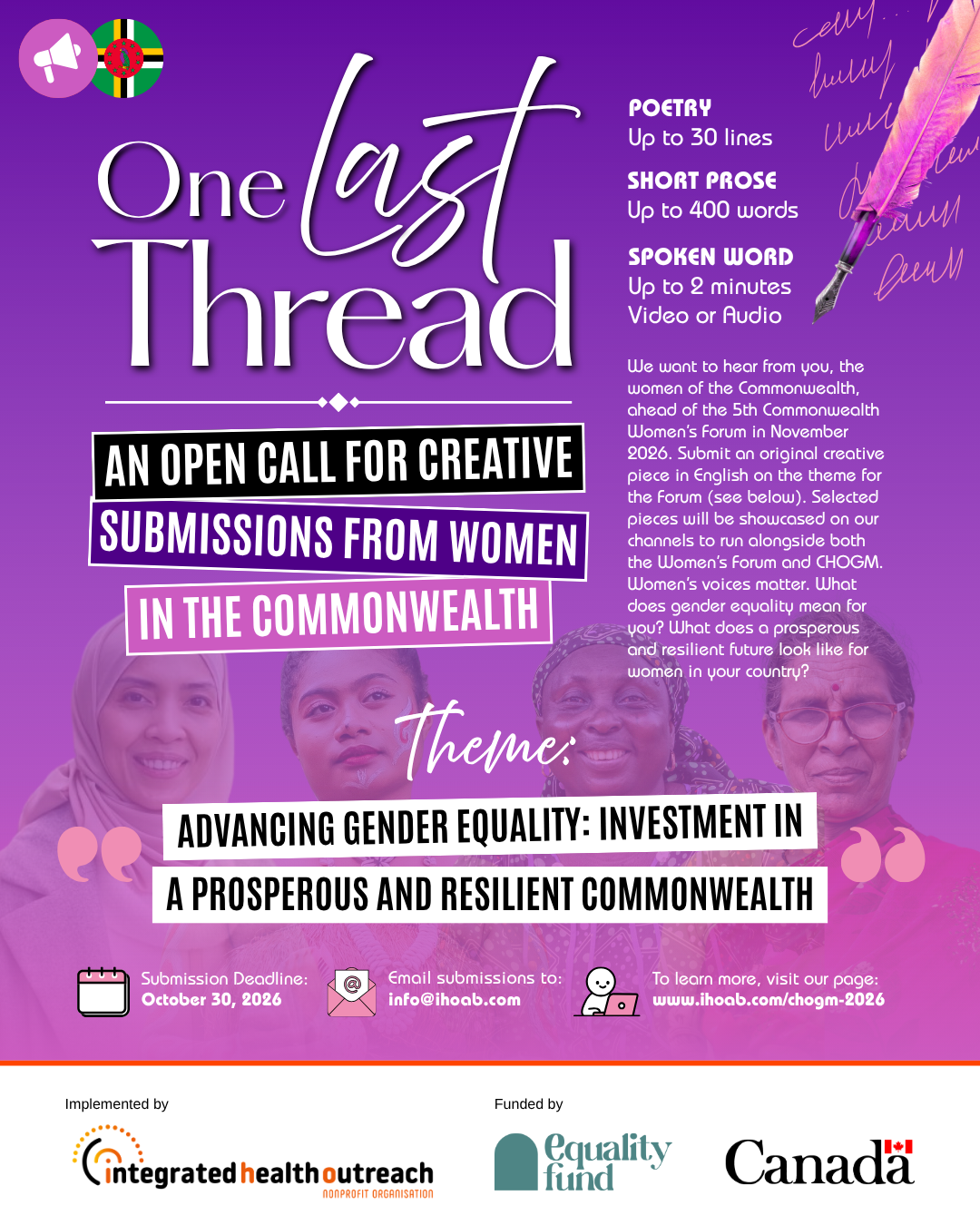
As the 2026 Commonwealth Women’s Forum (CWF) approaches, an Antigua and Barbuda-based non-profit focused on gender, climate and health justice has launched a landmark global creative advocacy initiative to center women’s lived experiences in high-level policy discussions ahead of the November Commonwealth Heads of Government Meeting (CHOGM).
Integrated Health Outreach (IHO) officially announced the launch of “One Last Thread”, an open call that invites women from all 56 Commonwealth member states—including Dominica—to submit original creative works aligned with the 2026 CWF official theme: “Advancing Gender Equality: Investment in a Prosperous and Resilient Commonwealth”. Accepted works include original poetry, short prose, and spoken word audio or video recordings that reflect women’s personal experiences with gender equality and inequality across the bloc.
Unlike many top-level policy engagement efforts that leave grassroots communities on the margins, this campaign is designed to create an accessible, direct channel for women across the Commonwealth to shape the social priorities of both the CWF and the broader week-long CHOGM, which will bring heads of government and senior policymakers from across the bloc to Antigua in November. For IHO Executive Director Dr. Nicola Bird, meaningful progress on gender equity cannot be captured or advanced through economic metrics and official data alone.
“Prosperity and resilience cannot be measured only by data points and financial metrics. Vibrant grassroots participation is indispensable. And listening to the perspectives of women and girls is what should inform policymakers whether their actions are having an impact or not, and what needs to change,” Dr. Bird explained. She emphasized that the campaign acts as a global megaphone for unfiltered, authentic women’s experiences, pushing all stakeholders—from national governments and international bodies to civil society groups and private sector actors—to deliver tangible change rather than empty rhetoric at the 28th CHOGM.
“Through One Last Thread we are providing a global megaphone for the authentic and unedited realities of women across the Commonwealth as one more way of trying to ensure that all of us, from government, to civil society, to the business sector, to international organisations, remember that real people are counting on us to use platforms like CHOGM to achieve something tangible and meaningful, and not just empty talk,” Dr. Bird added.
The campaign accepts submissions in three specified formats, with clear content limits to encourage broad participation. Poetry submissions may not exceed 30 lines, short prose pieces are capped at 400 words, and spoken word submissions (video or audio, with video strongly encouraged) must run no longer than two minutes. All submissions must be written or recorded in English, and must be sent via email to [email protected] by 11:59 p.m. Atlantic Standard Time on October 30, 2026. Full submission guidelines are available on IHO’s official website at www.ihoab.com/chogm-2026.
Selected submissions will not be limited to circulation on social media: IHO plans to feature the chosen works across its official website, social media channels, and public side events during CHOGM week, when thousands of delegates and observers will gather in Antigua for the summit.
Founded and based in Antigua and Barbuda, IHO is a non-profit organization focused on advancing gender justice, climate justice, and health equity. Its core mission centers on empowering vulnerable populations, upholding universal human rights, and ensuring that grassroots civil society perspectives are embedded into national and international policy processes. The “One Last Thread” campaign is supported by The Equality Fund and Global Affairs Canada.
The CWF is a pre-summit official stakeholder gathering that runs alongside the biennial CHOGM, which is being hosted by Antigua and Barbuda this year. Across the 56-nation Commonwealth, advancing gender equity is recognized not just as a standalone social goal, but as a foundational pillar of sustainable development and democratic resilience. With women and girls accounting for more than half of the Commonwealth’s 2.7 billion total population, addressing long-standing systemic barriers including gender-based violence, economic exclusion, and structural inequality requires coordinated, intentional collaboration between governments and grassroots civil society organizations to deliver meaningful, inclusive progress.