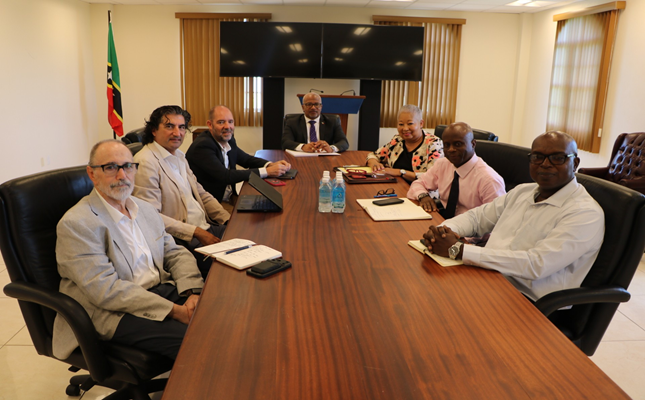
In a high-level diplomatic meeting held on Nevis in late September 2026, senior European Union officials have formally committed to partnering with the Nevis Island Administration (NIA) to advance the Caribbean island’s landmark geothermal energy initiative, bringing both specialized technical expertise and potential multi-modal financial support to the table.
The three-person EU delegation, led by David Mogollón — Head of EU Cooperation for Trinidad and Tobago, Barbados and the Eastern Caribbean States — included Martino Vinci, EU Policy Officer for St. Kitts and Nevis, and Federico Fische from the EU Global Technical Assistance Facility for Sustainable Energy (EU GTAF). They held in-depth talks with NIA stakeholders at the administration’s Cabinet Room in Charlestown, with the NIA team headed by then-Acting Premier Spencer Brand, alongside senior legal advisor Helene Lewis, Permanent Secretary Wakely Daniel, and NIA energy consultant Dr. Ernie Stapleton.
Addressing attendees after the discussions, Mogollón emphasized that the Nevis geothermal project carries far-reaching importance beyond the island’s borders. Beyond delivering tangible benefits to Nevis and the broader Federation of St. Kitts and Nevis, he noted, the initiative could serve as a catalyst for sustainable energy development across the entire Eastern Caribbean, allowing neighboring island nations to tap into Nevis’ clean geothermal output.
“The European Union stands ready to partner and support this initiative, and we are currently coordinating with all relevant stakeholders to move forward,” Mogollón stated. “The EU has built deep, specialized expertise across every stage of geothermal energy development, from resource assessment and engineering to generation and transmission infrastructure. We are prepared to bring that know-how to this project to ensure rigorous analysis, accurate data, and comprehensive planning that sets this initiative up for successful execution.”
Beyond technical support, Mogollón confirmed that the bloc is prepared to mobilize targeted financial backing for the project. “We are currently finalizing the specific partnership framework to unlock this funding, and multiple financing modalities are on the table, including concessional loans and investment grants,” he added. The EU also has established connections with experienced industrial partners and private firms specializing in geothermal development, cross-border energy transmission, and inter-island energy connectivity, all of which can be leveraged to support project delivery.
Mogollón closed his remarks by praising the productive collaboration with the NIA, reaffirming that the EU’s core priority is advancing outcomes that deliver long-term benefits to the people of Nevis and the wider federation.
Nevis Premier and Minister of Energy Mark Brantley welcomed the EU’s engagement in the high-stakes renewable energy project during his monthly press briefing on September 29. Brantley explained that the EU’s involvement centers on substantial financing that would support both the local Nevis project and a broader sub-regional energy connectivity initiative.
Under the EU’s proposed framework, the project would eventually connect Nevis’ geothermal plant to St. Kitts, Dutch Caribbean islands including Saba, Sint Eustatius, and Sint Maarten, French territories St. Barths and St. Martin, with potential future expansion to Antigua and other Eastern Caribbean nations. Brantley noted that EU officials have already held high-level talks with St. Kitts and Nevis Prime Minister Dr. Terrance Drew, including discussions held in Brussels, before sending the on-the-ground delegation to coordinate with NIA stakeholders.
“The EU is working to build a partnership with us around this transformative sub-regional project that will boost geothermal development and strengthen overall energy security for the entire Eastern Caribbean,” Brantley said. He added that the NIA will continue conducting a thorough assessment of the EU’s proposal, noting that multiple global partners — including the government of the United States — have also expressed interest in collaborating on the Nevis geothermal initiative.
“What we are seeing now is that the transformative potential of this project is drawing interest and partnership offers from major governments and international agencies,” Brantley noted. “These actors recognize exactly how impactful successful geothermal development on Nevis will be for the entire region, and we are moving forward carefully to explore all opportunities.”
Currently, the NIA, working through the Nevis Electricity Company Limited (NEVLEC), is advancing pre-development preparations for the next phase of work at the Hamilton geothermal site. The core of the project is a planned 30-megawatt geothermal power plant, which will deliver a consistent supply of clean, renewable electricity to Nevis. Once operational, the plant is expected to cut the island’s heavy reliance on imported fossil fuels, lower and stabilize household and commercial energy costs, strengthen local energy security, and create opportunities to export surplus clean energy to neighboring islands through the proposed regional interconnection network.