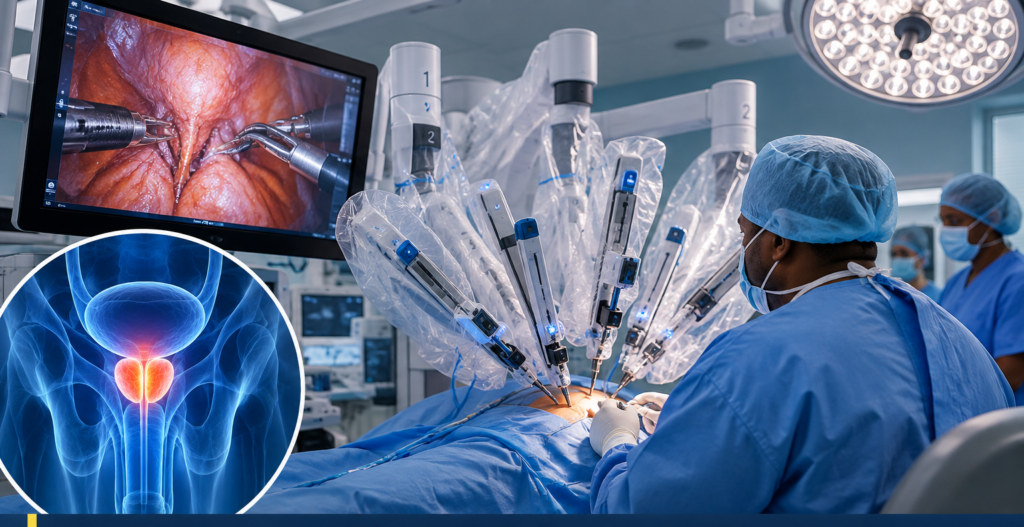
The twin-island nation of Antigua and Barbuda is advancing an ambitious plan to bring cutting-edge robotic surgical technology to its main public hospital, but the initiative will move forward only after the country upgrades its national telecommunications infrastructure to 5G, Prime Minister Gaston Browne has confirmed. Speaking in a recent appearance on the local *Browne and Browne Show* on Saturday, Browne outlined that government officials have already entered early preliminary discussions to acquire the precision surgical system, which would expand care options for patients needing common procedures ranging from prostatectomies to hysterectomies.
Browne’s public announcement came one week after his Cabinet received a formal presentation outlining a proposal for a dedicated robotic prostate surgery program, developed by Dr. David Samadi, a board-certified urologic oncologist and experienced robotic surgeon. Following the presentation, ministers requested a full, detailed proposal that outlines all core components of the plan, including technical specifications for equipment, required infrastructure upgrades, total project costs, staff training frameworks, and long-term operational protocols.
Per the Prime Minister, the rollout of 5G services across the country is projected to be completed within the next six months, a timeline that has been communicated to the government by local telecommunications providers. Browne specifically named the Antigua Public Utilities Authority (APUA) as one of the providers on track to launch 5G coverage, noting that another major industry player, Cable & Wireless, had previously committed to rolling out the high-speed network and he expects the company to deliver on that promise in the near term.
The link between 5G infrastructure and robotic surgery is clear, Browne explained: the ultra-low latency and high reliability of 5G networks are required to enable one of robotic surgery’s most transformative benefits – the ability for skilled surgeons to perform procedures remotely. Beyond enabling remote care, Browne highlighted that robotic systems offer inherent clinical advantages over traditional open surgery, including far greater precision during procedures, which minimizes damage to surrounding healthy tissue and supports faster, less complicated recovery for patients. While initial estimates place the cost of a single surgical robotic system at approximately $2 million, full details of total project expenditure remain unclear as the proposal is still being finalized.
This robotic surgery initiative is just one component of a broader government push to modernize the country’s entire healthcare system, Browne emphasized. The administration has already approved immediate equipment upgrades for Sir Lester Bird Medical Centre – previously known as Mount St. John Medical Centre – the nation’s main public acute care facility. The long-term strategic goal of the modernization effort is to position the hospital as a regional center of excellence for advanced medical care, able to deliver world-class services first and foremost to Antigua and Barbuda’s own population, with the added potential to attract medical tourists from across the Caribbean and turn advanced healthcare into an exportable service for the region.
As of the most recent post-Cabinet briefing, the robotic surgery program remains in the proposal stage, with no final decision, confirmed cost, or official implementation date announced. Even so, Browne confirmed that preliminary negotiations for the acquisition of robotic systems are already underway, and the government views the completion of 5G infrastructure as the critical prerequisite to launching the transformative investment, repeating that “as soon as we get 5G, we will be investing in robotic surgeries.”