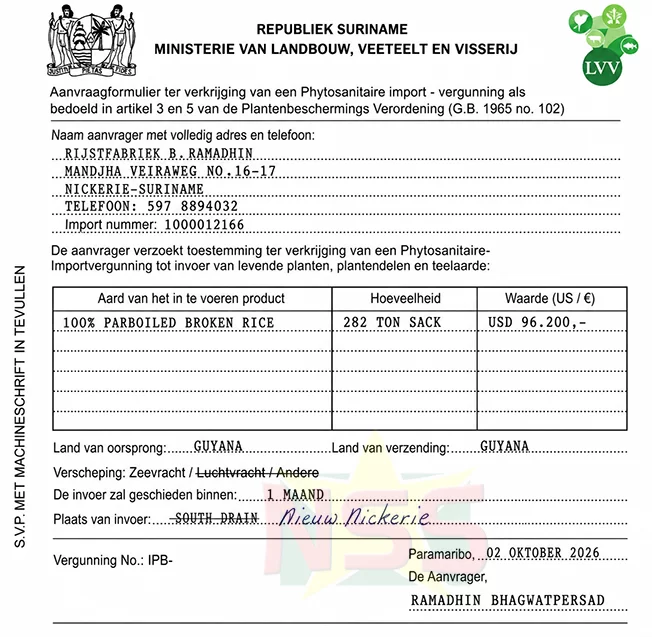
In a recent development that underscores the importance of strict agricultural import regulation, Suriname’s Ministry of Agriculture, Livestock and Fisheries (LVV) has intercepted an unapproved shipment of 384.8 tonnes of rice imported from Guyana, with minister Mike Noersalim announcing enforcement action against the importing firm over deceptive practices.
The cargo, transported aboard the vessel MV Falk from Guyana, was destined for Rijstfabriek B. Ramadhin, a rice processing plant located in Suriname’s Nickerie district. Official documentation from Guyana’s National Plant Protection Organisation (NPPO), issued September 29, 2026, confirms the shipment’s total weight and origin. Alongside the rice, the same vessel also carried 600 tonnes of urea, also bound for the same company, with an invoiced value of $600,000.
Minister Noersalim explained in an interview with local outlet Starnieuws that the shipment violated Suriname’s mandatory phytosanitary import protocols for agricultural goods. While the shipment included a valid phytosanitary certificate issued by Guyanese authorities, this alone does not meet Suriname’s entry requirements. Under local law, importers must obtain prior approval from Suriname’s own NPPO, submit all required documentation including the product invoice and export country phytosanitary certificate for inspection and validation before the cargo arrives, and complete an on-arrival inspection by LVV officials before the shipment can leave the port.
In a disturbing breach of these rules, part of the rice cargo had already cleared customs and been removed from the port before LVV detected the missing required approval. After the violation was uncovered, all released rice was ordered back to port custody. The importer only submitted an application for retroactively approval after the shipment had already entered Suriname, a practice Noersalim calls intentional deception.
For the urea shipment accompanying the rice, the situation follows a similar pattern: the importer only provided the required commercial invoice after the cargo arrived in Suriname, which the ministry has also classified as deceptive conduct. LVV is currently conducting a full review of all documentation for the urea shipment to determine next steps.
Minister Noersalim confirmed that the entire rice shipment will be sent back to Guyana at the importer’s expense, in line with Suriname’s plant protection legislation, which also allows for outright destruction of unapproved agricultural imports. The importer will also face a financial penalty, with Noersalim classifying the violation as an economic offense. He has also launched an inter-agency review to investigate how the partially shipment cleared customs without the required LVV approval, and is holding consultations with all relevant authorities to close any regulatory gaps.
Beyond the immediate enforcement action, the minister highlighted broader risks to Suriname’s domestic rice industry, a key sector of the country’s agricultural economy. Currently, local paddy is priced at around 700 Surinamese dollars per bale. The imported parboiled rice, which can be sold as animal feed, has lower nutritional value than broken white rice produced by local paddy farmers. Noersalim warned that unregulated cheap imports of this type undercut local producers, as buyers would likely reduce their purchases of domestically produced broken rice if cheaper imported alternatives enter the market illegally.
Stressing that enforcement will be impartial and consistent with the rule of law, Noersalim rejected any possibility of leniency. “Nobody should call me to negotiate over violations of the law,” he said, adding that regulations will be applied strictly and these illegal practices will not be allowed to continue in Suriname.