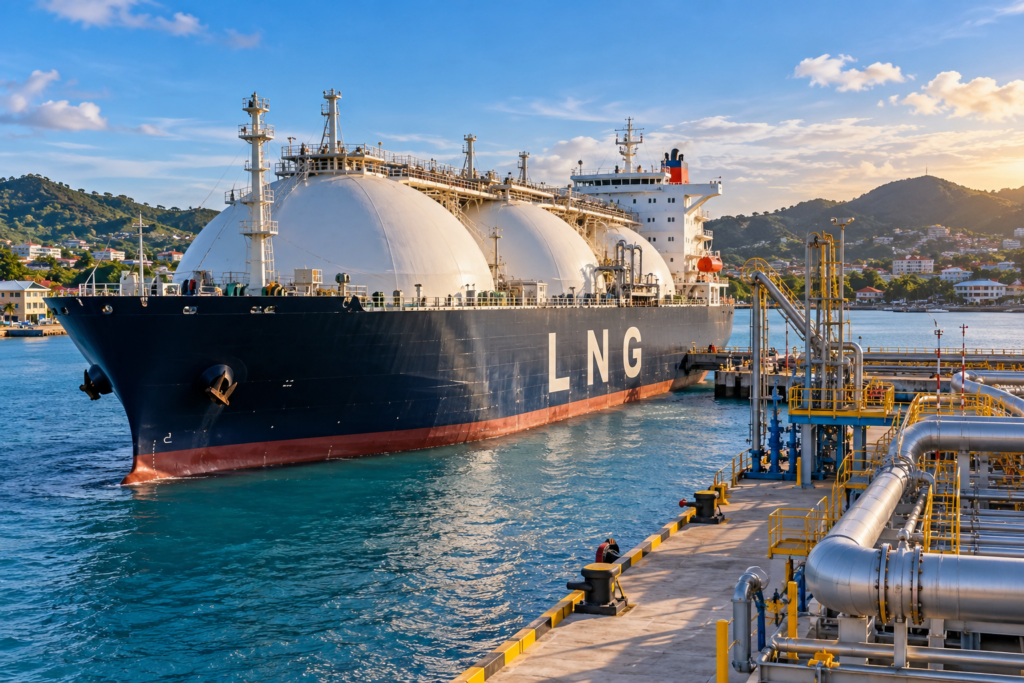
During a recent appearance on the *Browne and Browne Show*, Prime Minister Gaston Browne of Antigua and Barbuda delivered a long-awaited update on the country’s liquefied natural gas (LNG) import project, confirming that one of the most critical infrastructure barriers has been fully resolved.
After months of dredging operations, St. John’s harbour has been deepened to the exact depth required to safely accommodate large LNG carrier vessels, removing all physical obstacles to incoming fuel deliveries. Browne emphasized that any remaining delays to the launch of supplies are not tied to local port infrastructure, but instead stem from unresolved logistical challenges on the supplier’s end.
The prime minister expressed clear confidence that these outstanding issues will be sorted out in a timely manner, confirming that the government’s official timeline projects the first LNG cargo will arrive in the country before the close of 2026. Browne did not, however, disclose specific details about the nature of the supplier’s logistical hurdles, nor did he share an exact date for the maiden shipment, projected volume of LNG imports, or planned frequency of vessel calls at St. John’s port.
Beyond the LNG project update, Browne used the public appearance to outline cost-saving innovations implemented during the latest dredging campaign. Traditionally, sediment removed during harbour deepening is transported offshore for open-sea disposal, a process that carries steep operational costs. This time around, the government redirected a portion of the dredged material to shoreline construction near Barnacle Point, a strategic shift that saved taxpayers millions of dollars in disposal fees, according to the prime minister.
Browne also noted that consistent dredging and depth maintenance is a longstanding priority for Antigua and Barbuda’s maritime sector, pointing out that previous national administrations have also undertaken similar work to keep port channels accessible for larger commercial vessels. As a small island developing state heavily reliant on maritime trade and tourism, reliable access for deep-draft vessels is core to the country’s economic competitiveness. The completion of dredging for LNG delivery marks a key milestone in the government’s broader push to modernize national port infrastructure, which has been a central focus of its infrastructure investment agenda.