Antigua and Barbuda’s Prime Minister Gaston Browne is facing mounting public scrutiny over a decision by his administration to deposit dredged material from St. John’s Harbour maintenance work along the Peace Beach coastline adjacent to Barnacle Point, property that has been privately owned by Browne’s son for nearly a decade. Speaking during his regular weekly broadcast, the *Browne and Browne Show*, on Saturday, the prime forcefully pushed back against accusations of nepotism and improper preferential treatment, framing the policy choice as a fiscally responsible move that saved public coffers millions of dollars in avoidable waste disposal costs.
For generations, dredge spoil generated from routine harbour upkeep in St. John’s was loaded onto vessels and transported dozens of miles offshore for open-ocean dumping, a logistically complex process that Browne confirmed came with a seven-figure price tag for the government. When the most recent dredging project got underway, the proximity of his son’s Barnacle Point parcel to the harbour work zone created a unique low-cost alternative, the prime minister explained. Instead of incurring massive transport costs, crews simply ran a slurry pipeline directly from the dredging site to the empty coastline, pumping the sand and sediment onshore in a single step that cut disposal costs by millions, according to Browne.
Critics have pointed to the conflict of interest inherent in placing public project waste that doubles as valuable land-building material on private property owned by the prime minister’s close family. But Browne rejected these claims, arguing that the dredge spoil, which would otherwise be discarded as worthless waste, was put to productive public use. He emphasized that the 300-foot-long beach created by the deposited material remains open to the public as a public recreational space, even as the adjoining one-acre plot of land behind it remains in private hands. He added that his family has invested its own private capital and heavy equipment – including excavators, backhoes, bulldozers and trucks – to grade, level and landscape the site, planting more than 40 coconut trees and a variety of native flowering plants and greenery to restore the coastal habitat. Browne also noted that his administration has allocated dredge spoil to other public entities and private landowners in the past, meaning his son’s case was not an exception to existing policy.
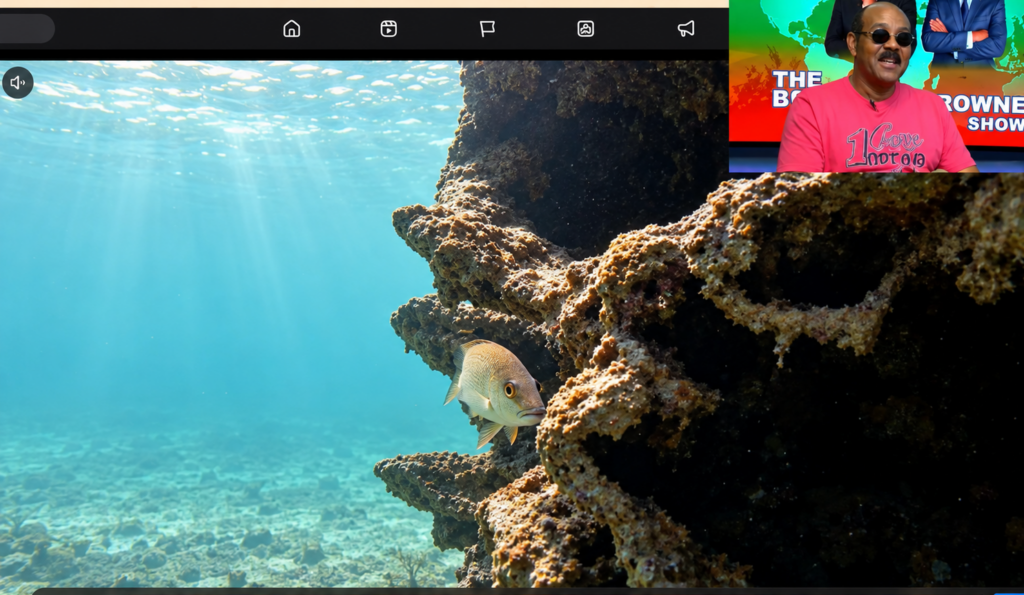
Beyond the controversial beach expansion, Browne used Saturday’s broadcast to share an early, promising update on a companion environmental project: a new artificial reef installed just offshore from Peace Beach, the first purpose-built artificial reef deployed in Antigua and the second across the twin-island nation, following an earlier installation in Barbuda. Browne told listeners that marine life began colonizing the 24 artificial reef modules less than 24 hours after they were lowered into the seabed, with underwater footage already showing dozens of fish species using the concrete structures as shelter and habitat.
The project was developed with technical guidance from marine scientist Dr. Deborah Brosnan, with ongoing oversight from Antigua and Barbuda’s Department of Environment. According to Browne, coral fragments will be planted on the modules in the coming months to further transform the site into a functional artificial coral reef ecosystem. The government also plans to deploy artificial intelligence-powered monitoring technology to track marine life activity around the reef, documenting species migration patterns, movement and breeding behaviour to measure the project’s long-term ecological impact.
Browne issued a plea to recreational users and local fishers to avoid damaging the reef structures with spearguns or fishing gear that could dislodge the modules. He argued that the initiative carries benefits that extend far beyond recreational diving and coastal conservation, framing expanded artificial reef networks as a key component of the country’s long-term food security strategy. By providing additional breeding and nursery habitat for commercially important species including snapper, lobster and octopus, Browne predicted the reefs will eventually boost local fish populations and increase catch volumes for small-scale domestic fishers.
Buoyed by the early success of the Peace Beach reef, Browne announced plans to expand the artificial reef program across Antigua and Barbuda, with Fort James Beach and Ffryes Beach identified as the next high-priority locations for new installations. Long Bay, which already supports a healthy natural reef system, is considered a lower priority for new construction, he noted. The prime minister said he will add the expansion proposal to the Cabinet agenda within the next several weeks to secure budget allocation for additional projects, making artificial reef expansion a core pillar of the government’s broader coastal management and environmental protection strategy. While long-term monitoring will be required to confirm whether the reefs deliver measurable increases in fish populations and catches, Browne said the rapid colonization of the Peace Beach reef by marine life is an encouraging early indicator that the model works, and showcases how waste material from public infrastructure projects can be repurposed to deliver ecological and economic value.