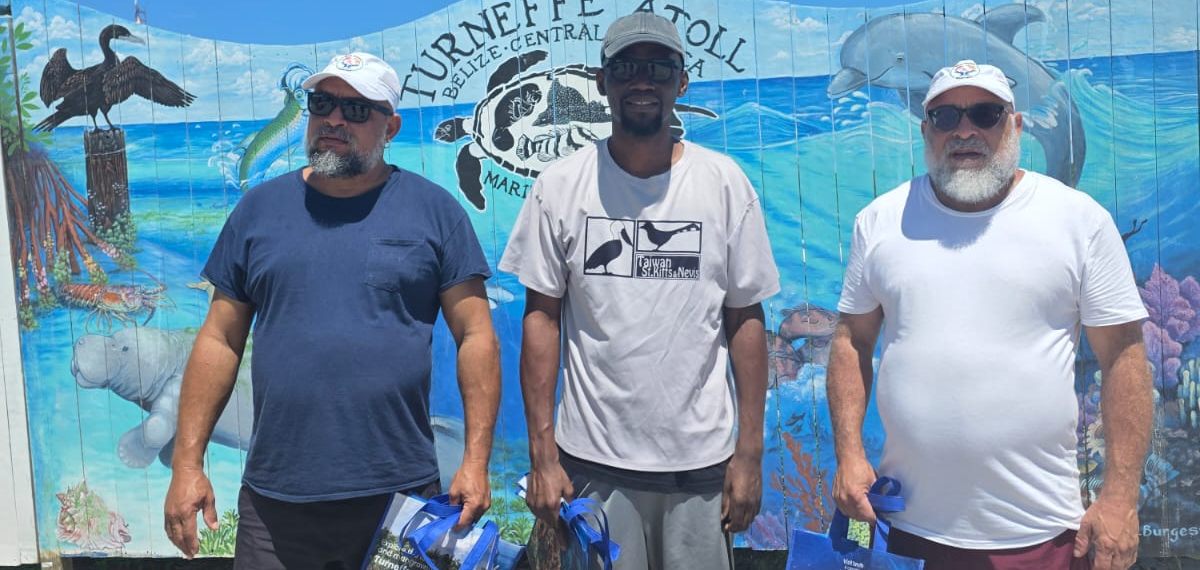
A five-day knowledge-sharing and trade-focused exchange hosted in Belize has opened new doors for expanded seafood commerce across the Caribbean, after a small delegation of fishers and seafood industry representatives from the Eastern Caribbean wrapped up an immersive study tour of Belize’s well-regarded lobster sector. Held from September 15 to 19, 2026, the trip brought three industry professionals — Jack Spencer and Marcus Spencer from St. Kitts and Nevis, and Calvin Josiah from St. Martin — to Belize to examine the country’s fisheries management systems and explore untapped trade opportunities for fish and fish products between Belize and Eastern Caribbean markets. The initiative was jointly coordinated by the Caribbean Regional Fisheries Mechanism (CRFM) and the Caribbean Network of Fisherfolk Organisations (CNFO), with wide-ranging support from Belizean government bodies, local fishing cooperatives, environmental conservation groups, and independent community fishers. The onshore portion of the program gave delegates hands-on access to three major fishing cooperative entities across Belize: the Belize Fishermen Cooperative Association, the National Fishermen Producers Cooperative Society, and the Northern Fishermen Cooperative Society. During these visits, participants observed every step of the lobster supply chain, from initial catch reception and post-harvest handling to processing and final distribution preparation for domestic and international markets. The schedule also included formal working sessions with leaders from Belize’s Ministry of the Blue Economy and the Belize Fisheries Department. Discussions covered critical industry topics including sustainable lobster fishery growth, regulatory frameworks, resource management protocols, cross-border trade compliance standards, and enforcement practices for industry regulations. To give delegates a first-hand look at inshore fishing operations and sustainable marine resource management, the tour moved offshore for a field visit to Turneffe Atoll, organized by the Turneffe Atoll Sustainability Association (TASA) with additional backing from the Belize Fisheries Department, CRFM, and local fisher Jason Young. At Young’s active lobster fishing camp on the atoll, visiting industry stakeholders learned about lobster trap design and deployment strategies, pre-fishing season preparation protocols, and the on-the-ground challenges that shape small-scale commercial fishing operations. The offshore tour also included stops at two co-managed conservation sites within the Turneffe Atoll Marine Reserve: Caye Bokel and Calabash Caye. Throughout the experience, participants emphasized a key takeaway: that collaborative partnerships between commercial fishers, government regulators, and non-profit conservation organizations are foundational to effective, long-term management of finite fishery resources. Marcus Spencer, one of the delegates from St. Kitts and Nevis, shared that he left the exchange deeply impressed by Belize’s approach to the sector. “The fisheries in Belize are well managed, and I would love for other fishers in the Caribbean to have similar experiences,” he told organizers. Calvin Josiah of St. Martin echoed enthusiasm for the potential of expanded bilateral trade, while also noting that solving gaps in regional transportation and logistics infrastructure will be critical to converting preliminary commercial interest into long-term, sustainable trade flows. By the end of the tour, the full delegation expressed collective hope that the exchange would be the first step toward deeper, long-term collaborative relationships between Belize’s fisheries sector and stakeholders in St. Kitts and Nevis, St. Martin, and the broader Caribbean region. In a post-visit public statement, the CRFM underscored the value of this people-centered exchange model, noting that direct peer-to-peer engagement between fishers, cooperative leaders, and business owners helps strengthen regional fisheries enterprises, unlock new opportunities for value-added seafood production, and connect small-scale producers to expanded markets across the entire Caribbean basin.