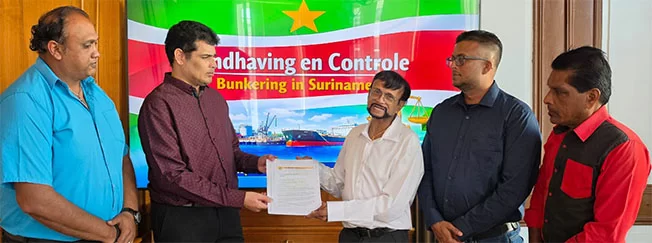
On October 3, Suriname’s political party De Nieuwe Leeuw (DNL) took a major step toward strengthening governance of the country’s natural resource revenues, formally submitting two landmark draft pieces of legislation to the National Assembly (DNA) aimed at curbing corruption, preventing tax avoidance, and shielding public income from political interference. DNL Chair Dharm Mungra personally handed over the draft bills to DNA President Ashwin Adhin, who will circulate the proposals to all sitting members of parliament; the Sovereign Wealth Fund bill was previously shared with Suriname President Jennifer Simons one week ahead of the formal submission.
The first proposal, the Bunkering and Fiscal Transparency Act, seeks to establish a comprehensive, standardized legal framework for the country’s growing bunkering sector, covering core areas from permitting to environmental protection to tax compliance. To crack down on artificial profit shifting that erodes tax revenues, the bill mandates ringfencing of income for each individual operating permit, preventing companies from offsetting profits with artificially generated losses across different operations. It also enshrines transfer pricing rules aligned with Organisation for Economic Co-operation and Development (OECD) global standards to block common tax avoidance schemes.
In line with global tax reform efforts, the draft incorporates the OECD’s Pillar Two rule, which requires a 15% minimum effective corporate tax rate for large multinational enterprises operating in Suriname. Mandatory customer due diligence checks and suspicious transaction reporting requirements are also included to bolster the country’s anti-money laundering and anti-corruption frameworks. For environmental governance, the bill introduces a ban on the discharge of untreated scrubber washwater from vessels and mandates that all operators hold valid Protection and Indemnity (P&I) insurance to cover potential environmental damages.
The second draft legislation, the Sovereign Wealth Fund Act, targets long-term management of natural resource revenues, addressing gaps that DNL argues exist in Suriname’s current Stabilization and Future Generations Fund (SSFS) legal framework. While the existing legislation includes basic safeguards, DNL emphasizes that it fails to block undue political influence over fund management, highlighting ongoing risks around political control over executive appointments and dismissals, unaddressed conflicts of interest, and limited enforceable oversight powers for the National Assembly, the Court of Audit, and the Advisory Board of the State Debt and Development Plan CLAD.
Without independent implementation and strict enforcement of governance rules, DNL argues that the current system leaves openings for corruption and nepotism that divert public wealth for private gain. The new draft builds in explicit “firewall” provisions designed to limit arbitrary political interference in fund operations. It also requires public reporting aligned with the Extractive Industries Transparency Initiative (EITI) global standards, and mandates that fund assets be invested in long-term sustainable assets that can generate steady income for future generations of Surinamese.
Speaking on the purpose of the two proposals, Mungra emphasized that Suriname must put in place strong legal foundations now to responsibly manage future natural resource revenues. “Our natural wealth is a blessing, but it also comes with profound responsibility,” Mungra stated. “Only through strict legislation, independent oversight, and transparent management can we ensure that today’s revenue is not lost to corruption or mismanagement, but instead becomes the solid foundation for the shared prosperity of future generations.”