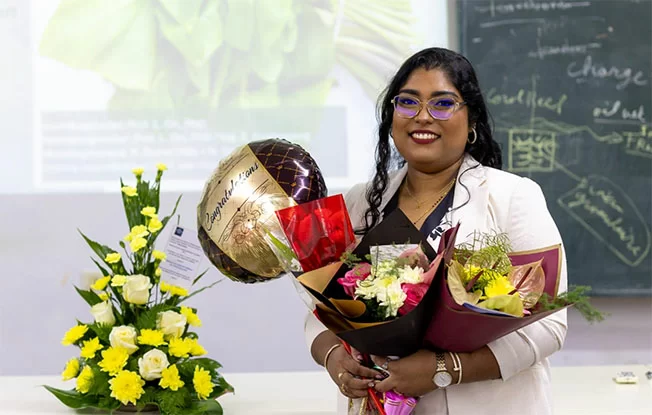
A recent graduating student’s research at Suriname’s Anton de Kom University (AdeKUS) has uncovered a simple heat treatment that could drastically cut food waste for one of the country’s most popular leafy vegetables, tayer leaf (Xanthosoma sagittifolium (L.) Schott). Madhurie Gadjradj, who completed her degree in Agroprocessing under the Faculty of Technological Sciences’ Agricultural Production program, found that a 4-minute blanching treatment at 90°C delivers exceptional improvements to tayer leaf’s color, microbial safety, flavor, and texture during frozen storage.
Tayer leaf is a staple ingredient across Suriname, widely used in both home cooking and the local food supply chain. However, its biggest industrial and consumer challenge is its extremely short shelf life after harvest. Without effective preservation, significant quality degradation occurs before the product reaches consumers or retailers, resulting in substantial food loss and economic waste for producers. Extending the shelf life of locally grown vegetable crops is a critical step toward reducing national food waste and maximizing the output of Suriname’s agricultural sector, and blanching – a short pre-freezing heat treatment – has emerged as a low-cost potential solution. Prior to Gadjradj’s work, there was very little localized research on how blanching impacts tayer leaf quality, creating a gap in practical knowledge for local producers and food processors.
Gadjradj designed her study to compare four different blanching regimens against unblanched control samples of tayer leaf. All treated samples were frozen and monitored over a 4-week storage period, with researchers testing for a range of key quality metrics: chlorophyll content, moisture content, vitamin C levels, β-carotene, iron content, microbial safety, and sensory attributes including color, aroma, flavor, and texture.
The study’s results revealed clear trends: higher blanching temperatures combined with longer treatment durations produced the best preservation outcomes. After 4 weeks of frozen storage, the 90°C 4-minute treatment retained the highest chlorophyll content, indicating the vibrant green color that consumers prefer was better preserved. All blanched samples also outperformed unblanched controls in microbial safety tests, lowering the risk of spoilage and foodborne illness. The 90°C 4-minute regimen also earned the highest average sensory ratings across all tested attributes after the 4-week storage period.
Not all nutrients responded identically to blanching and frozen storage, however. The study found that vitamin C levels declined gradually over storage regardless of treatment, while iron and β-carotene remained relatively stable. This finding highlights an important consideration for food processors: when selecting a preservation method, it is necessary to evaluate impacts across multiple quality and nutritional parameters, rather than focusing solely on shelf life extension.
Beyond its scientific contribution, the research carries meaningful practical and economic benefits for Suriname’s agricultural sector. By adding one simple pre-processing step, producers, vendors, and consumers can all reduce avoidable food loss, allowing a larger share of harvested tayer leaf to reach markets and be utilized. Furthermore, extending tayer leaf’s shelf life opens new opportunities to develop and market frozen packaged tayer leaf products as a local specialty, adding value to a traditional Surinamese agricultural commodity and creating new market channels for smallholder farmers and small-scale food processors.
Gadjradj’s work demonstrates that low-cost, accessible processing techniques can significantly improve the shelf life, quality, and economic value of locally grown vegetable crops. The research team notes that follow-up large-scale studies will be needed to assess how this method can be implemented practically and cost-effectively across Suriname’s entire food supply chain. Gadjradj’s thesis was evaluated by a committee led by chair R. Somai, MSc, lead supervisor Prof. L. Ori, PhD, industry supervisor Ir. S. Krishnasing, co-supervisor N. Gajadin, MSc, and external reviewer Dr. F. van Genderen.