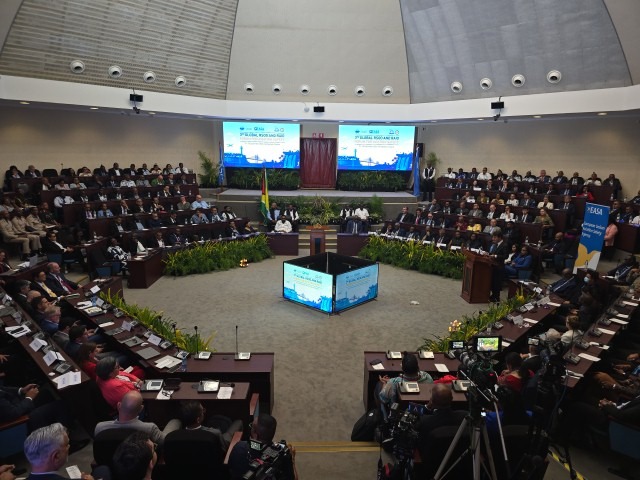
On Tuesday, September 29, 2026, the joint International Civil Aviation Organisation (ICAO) and European Union Aviation Safety Agency (EASA) aviation safety conference kicked off at the Arthur Chung Conference Centre in Liliendaal, located on the outskirts of Georgetown, Guyana. During his opening address to attending delegates, Guyanese President Irfaan Ali revealed a major upcoming development for the South American nation’s regional security cooperation.
President Ali confirmed that Guyana will join a Caribbean-wide integrated monitoring mechanism in the near future, which leverages cutting-edge digital technology to conduct comprehensive surveillance of the country’s national airspace and its full Exclusive Economic Zone (EEZ). “In the coming weeks, we will roll out this new technology to upgrade our national security infrastructure and framework, covering our aerial domains and our EEZ,” Ali told conference attendees. “This new monitoring capability brings with it a clear set of updated aviation safety protocols that we must implement promptly, and this coordinated approach will be adopted across the entire Caribbean region.”
The announcement builds on existing close security collaboration between Guyana and the United States, with the two nations already partnering extensively on cross-border domain awareness initiatives that strengthen regional maritime and aerial oversight. According to President Ali, this new regional monitoring project aligns with the Caribbean’s broader goal of building a cohesive institutional ecosystem to strengthen regulatory and governance capacity both across the bloc and on the global stage.
Immediately following his announcement of the monitoring initiative, President Ali put forward a key policy recommendation for conference delegates: he urged the joint ICAO-EASA forum to add the rising impact of artificial intelligence on aviation to its formal working agenda. He specifically called for the two global aviation bodies to quickly convene a dedicated expert working group to conduct a thorough assessment of AI’s opportunities, risks, and regulatory implications for the global aviation sector, as the technology continues to reshape operations across the industry.