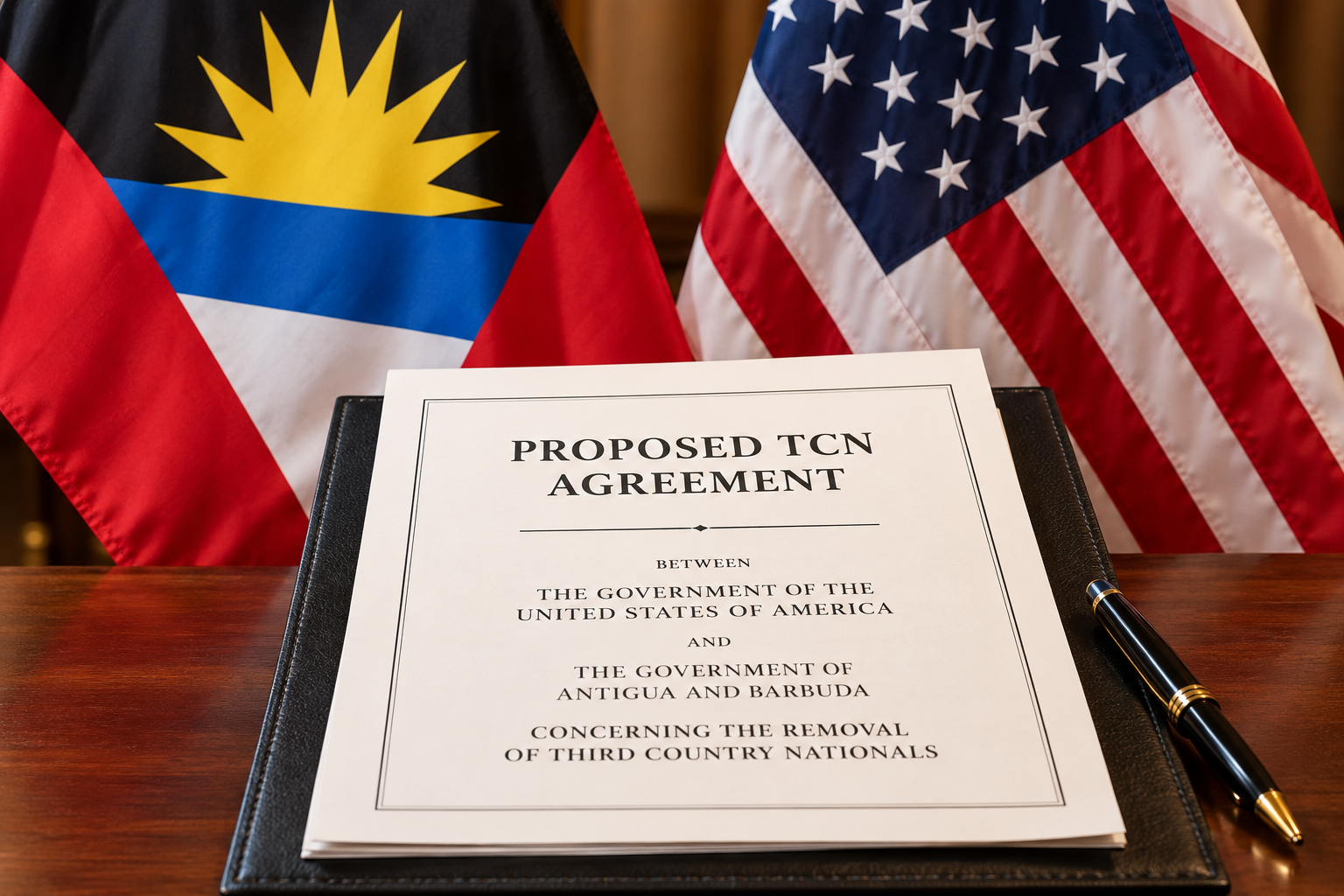
In a move aligned with its core commitment to governmental transparency, the Government of Antigua and Barbuda has publicly released both the United States’ proposed operating procedures for potential transfers of third-country nationals removed from U.S. territory and Antigua and Barbuda’s formal counter-proposal, ahead of tabling both documents before the nation’s House of Representatives. Attorney General and Minister of Legal Affairs Sir Steadroy Benjamin will officially lay the two texts before parliament, opening the process to full public and legislative oversight.
This ongoing discussion forms part of a broader diplomatic push by the United States to negotiate similar transfer arrangements with nations across the globe, including multiple member states of the Caribbean Community (CARICOM). To date, some CARICOM nations have finalized such agreements, while others remain in active discussion like Antigua and Barbuda, which is approaching the talks with a strict focus on protecting its national sovereignty, public security, domestic legal framework, public finances, and core national interests. As of the public announcement, no final agreement has been reached between the two governments, with negotiations continuing in line with Antigua and Barbuda’s stated terms.
The United States’ original proposal outlines a framework for transfers under a planned 2025 Memorandum of Understanding (MOU), setting eligibility criteria that excludes unaccompanied minors under 18, citizens of Antigua and Barbuda, and individuals with criminal records beyond U.S. immigration violations. The U.S. draft proposes a monthly transfer cap of 7 individuals, notes that neither government is obligated to commit financial resources to the initiative, but states the U.S. will explore available foreign assistance funds and plans to compensate a competent international organization for support services, with no costs to fall on Antigua and Barbuda. The proposal also requires a 5-day advance notice of transfers with full biometric, medical, and background information for all proposed individuals, and designates V.C. Bird International Airport as the reception point.
In contrast, Antigua and Barbuda’s counter-proposal builds in layered safeguards to prioritize national control and protect public interests, starting with a non-binding framework that explicitly confirms no final transfer may proceed without the prior, express written approval of Antigua and Barbuda’s government for every individual case. The counter-proposal tightens eligibility restrictions, barring all individuals under 18 (not just unaccompanied minors), restricting eligible nationalities primarily to CARICOM member states excluding Haiti, plus Brazil and Colombia, and requiring all proposed individuals hold valid unexpired passports with a confirmed realistic pathway for eventual return or onward resettlement. Additional exclusions apply to individuals with serious unaccommodatable medical conditions, vulnerable groups requiring specialized care without pre-approved cost coverage, and individuals with outstanding legal barriers to transfer from the U.S.
On transfer volume caps, Antigua and Barbuda’s framework sets a maximum of 7 total transfers per three-month period – a hard ceiling, not a mandatory quota – with an additional restriction that no new transfers may proceed if 7 or more previously transferred individuals remain in the country, unless Antigua and Barbuda explicitly grants an exception. The counter-proposal also strengthens financial safeguards, requiring binding written confirmation that the U.S. will cover 100% of all costs associated with transferred individuals, from accommodation and medical care to administrative and security expenses, from arrival through departure or until the individual secures an independent lawful status in Antigua and Barbuda, ensuring no burden falls on local taxpayers. The text opens the door for the International Organization for Migration (IOM) to provide support services, but makes any IOM participation conditional on separate arrangements approved by Antigua and Barbuda’s government, with a requirement that alternative funding arrangements must be in place if IOM support is unavailable.
Procedural changes in the counter-proposal extend the advance notice period for proposed transfers to 10 business days, requiring the U.S. to provide a full suite of detailed information including full health assessments, asylum and protection claim history, proof of the individual’s written willingness to transfer, and confirmation of all legal processes in the U.S. have been exhausted. All transfers must be processed under Antigua and Barbuda’s domestic immigration law, with a clear stipulation that the arrangement is for temporary transit only, not permanent resettlement, and no transferred individual gains an automatic right to permanent residence, asylum, or work authorization. The U.S. is required to fund and facilitate all eventual return or onward placement of transferred individuals, with financial obligations remaining in place even if talks conclude or transfers are suspended.
Crucially, the counter-proposal grants Antigua and Barbuda the unilateral right to immediately suspend all future transfers if concerns arise related to national security, public health, capacity constraints, financial burdens, natural disasters, or public emergencies. It also requires a joint review of the arrangement after either the first five transfers or six months of implementation, whichever comes first. The Antigua and Barbuda government emphasizes that full sovereign authority to approve or reject any proposed individual remains exclusively with the nation, in every case.
In its public statement, the government reiterated that it values its longstanding bilateral relationship with the United States and remains committed to constructive negotiations, but any final agreement must align with Antigua and Barbuda’s domestic laws, limited national capacity, and core national interests, while guaranteeing dignified treatment for all affected individuals in line with international law. By releasing both documents publicly and tabling them in parliament, the government has fulfilled its commitment to open governance, and pledges to continue updating parliament and the public as negotiations progress.