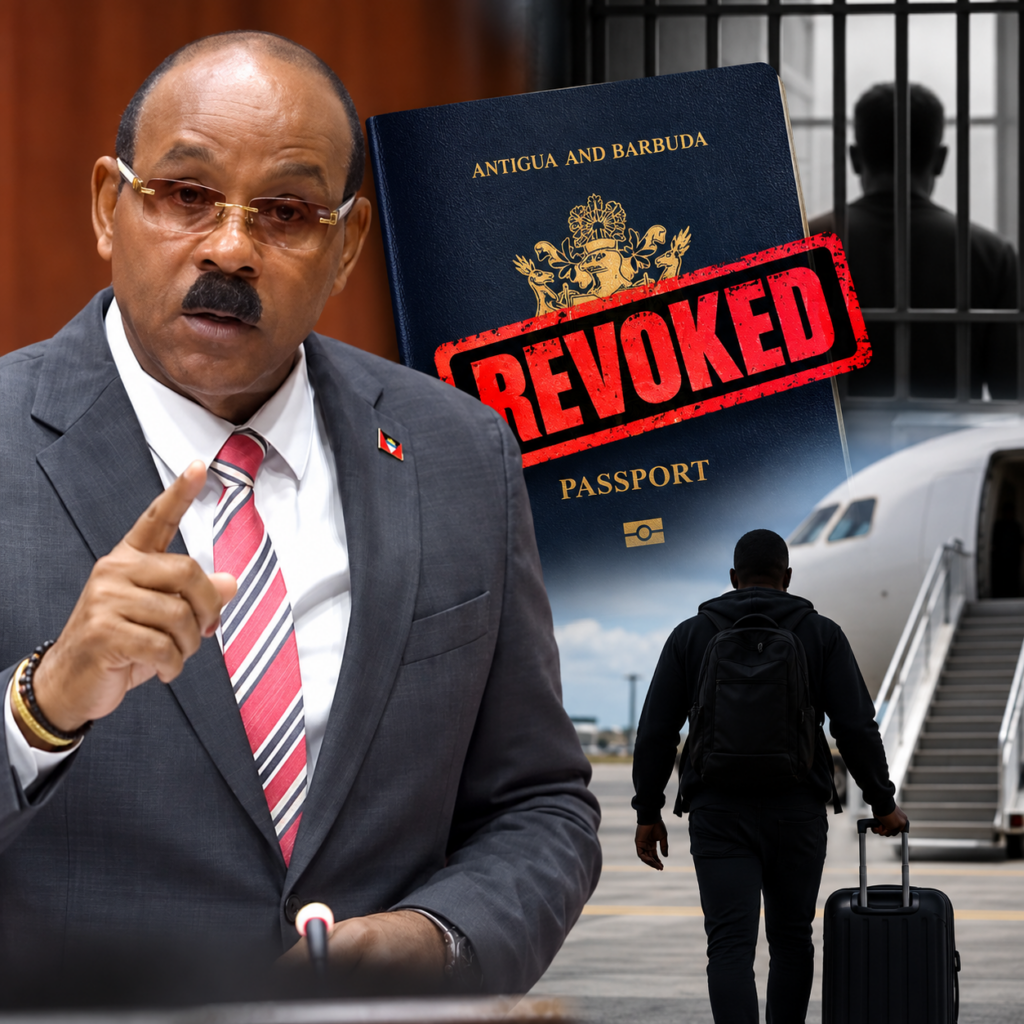
In a bold policy shift announced on Monday during parliamentary debate over sweeping firearms legislation, Prime Minister Gaston Browne of Antigua and Barbuda outlined plans to strengthen the country’s crime response by targeting naturalized citizens convicted of serious offenses. The new measure, already approved by the Cabinet, will allow the government to revoke citizenship granted through naturalization after offenders complete their prison sentences, followed by immediate deportation.
Browne made the announcement while speaking in the House of Representatives about the 2026 Firearms (Amendment) Bill, a piece of legislation designed to introduce harsher mandatory sentences for gun-related crimes. Opening his remarks, the prime minister emphasized that all foreign residents and naturalized citizens are expected to abide by the nation’s laws, noting that immigration authorities already operate under standing orders to deport non-citizen felons once their sentences are finished. Now, the government intends to extend this enforcement framework to cover people who have gone through the naturalization process to become citizens.
Initially referencing the policy as applying to “heinous crimes,” Browne later clarified that the revocation power will apply to any serious crime committed by naturalized citizens. “Those who naturalise and become citizens and commit crimes, certain crimes in this country, cannot commit any serious crime in this country. We will revoke citizenship and deport them,” he stated during the parliamentary session. The prime minister stressed that his appearance during the debate was intended to publicly notify communities, particularly immigrant populations, of the new regulation that has already been formalized by the Cabinet. “That decision has been taken by the Cabinet already, and I’m sensitising the public, especially our immigrants, because they must know the reason behind it,” he added.
To counter any perception that the policy targets immigrant groups, Browne highlighted the inclusive track record of his administration, pointing to past government amnesty programs that allowed thousands of undocumented immigrants to regularize their immigration status and ultimately pursue citizenship. “We’re not targeting immigrants,” Browne said, noting that his government has long maintained an open and accommodating approach to immigrant communities. “Where they become a threat to public safety, we are duty bound to do whatever is necessary to keep this country safe,” he explained, adding that citizenship revocation will remain a core tool in the government’s crime prevention strategy, alongside the existing routine deportation of convicted non-citizens.
The policy announcement came as part of the government’s broader push to combat rising crime and violence across the twin-island nation. The 2026 Firearms (Amendment) Bill at the center of the parliamentary debate proposes mandatory minimum prison sentences for a range of firearms offenses: five-year minimum sentences for cases heard in the Magistrates’ Court, 15-year minimums for cases tried in the High Court, and maximum penalties of up to 30 years for the most severe offenses. Browne told parliament that violent crime, particularly offending involving young people, has emerged as one of the most pressing challenges facing Antigua and Barbuda, and that solving the crisis requires coordinated action from government, law enforcement agencies, households, and all segments of civil society. Debate on the firearms bill is ongoing in the House of Representatives as legislators work to advance the government’s public safety agenda.