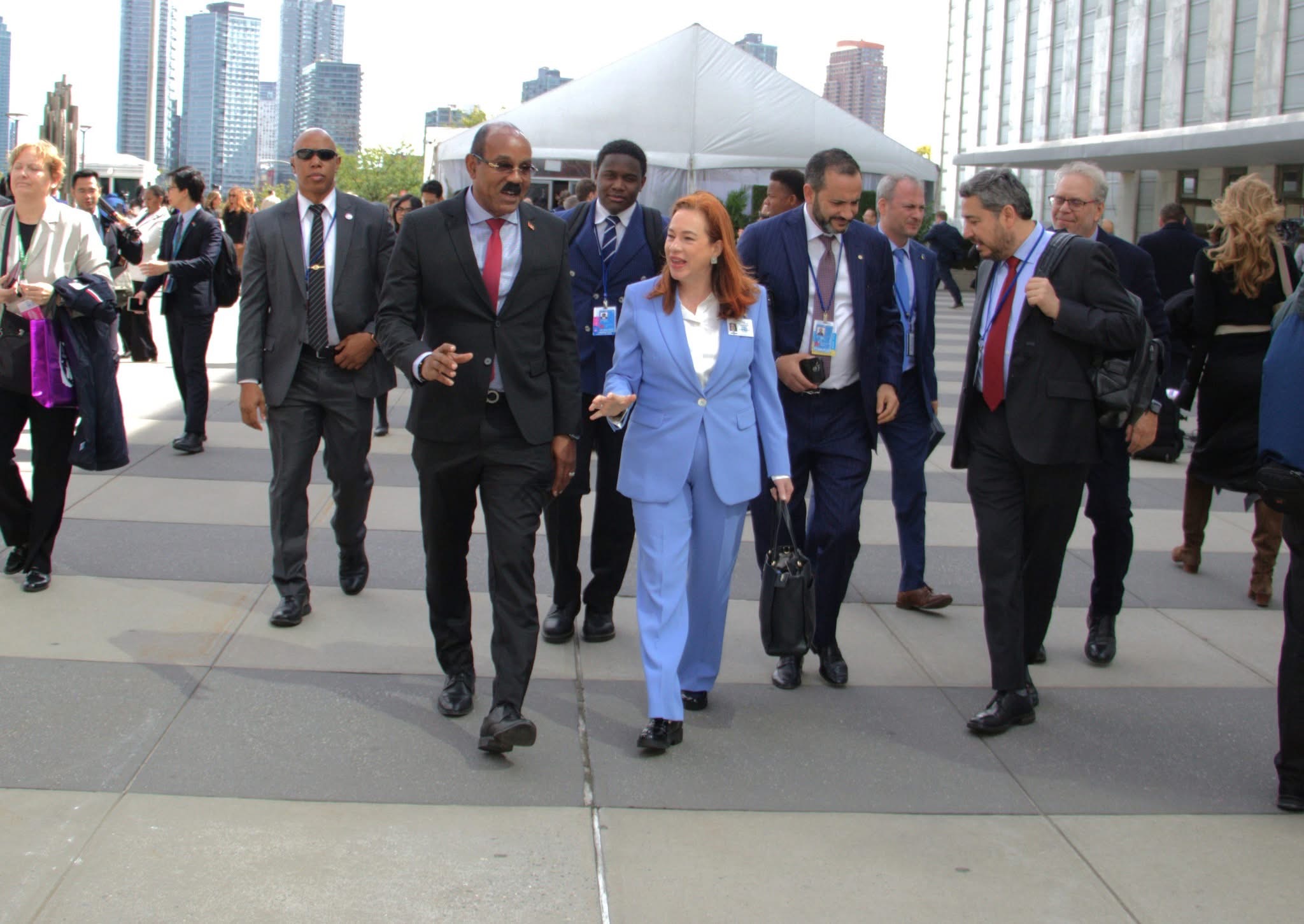
The race for the next United Nations Secretary-General has developed a notable regional split in the Caribbean, as Antigua and Barbuda’s Prime Minister Gaston Browne has publicly reaffirmed his government’s unwavering support for Ecuadorian candidate María Fernanda Espinosa, rejecting widespread calls to switch backing to the Caribbean Community’s preferred nominee Carolyn Rodrigues Birkett of Guyana.
Speaking during an appearance on Pointe FM’s *Browne and Browne Show* Saturday, Browne laid out his administration’s steady stance on the contest, revealing that Antigua and Barbuda recently hosted a high-profile reception for Espinosa during her visit to New York and is actively courting additional pledges of support from other U.N. member states. Despite growing pressure from across the region to pull its endorsement of Espinosa and align with most Caribbean governments that back Rodrigues Birkett, Browne said his small island nation has refused to back down.
“Under no circumstances,” Browne stated, recalling his blunt response to requests that Antigua and Barbuda withdraw its nomination. “We stand by our candidate.”
Antigua and Barbuda first formally put Espinosa, a former president of the U.N. General Assembly, forward as a candidate back in May. Rodrigues Birkett, Guyana’s experienced former foreign minister and current permanent representative to the United Nations, joined the race a month later in June. Both candidates are officially recognized and listed on the United Nations’ official register of contenders for the top post.
Browne also made a significant unconfirmed claim during the interview: he alleged that Washington has already decided it will veto Rodrigues Birkett’s candidacy if she advances through the selection process. If accurate, he argued, this veto intention would clear a path and boost Espinosa’s chances of securing the role. To date, however, there has been no independent verification of Browne’s claim about a potential U.S. veto.
The Antiguan prime minister acknowledged that even with his country’s backing, Espinosa still needs the support of the Security Council’s five permanent members to move forward in the selection process. He framed Espinosa as a uniquely skilled consensus-builder, capable of forging collaborative connections between nations with divergent interests, adding that her long-standing working relationship with Antigua and Barbuda was the core reason the country chose to nominate her. Browne also noted that representatives from multiple unspecified governments attended the recent reception for Espinosa and offered informal pledges of support, though he declined to name the countries or detail the exact nature of their commitments.
The U.N. Secretary-General selection process follows a clear established framework: the Security Council is tasked with recommending a single nominee to the full General Assembly, which then votes on the appointment. While Antigua and Barbuda’s continued endorsement keeps Espinosa active in the contest, it does not guarantee she will be the candidate put forward by the Security Council for the final General Assembly vote.