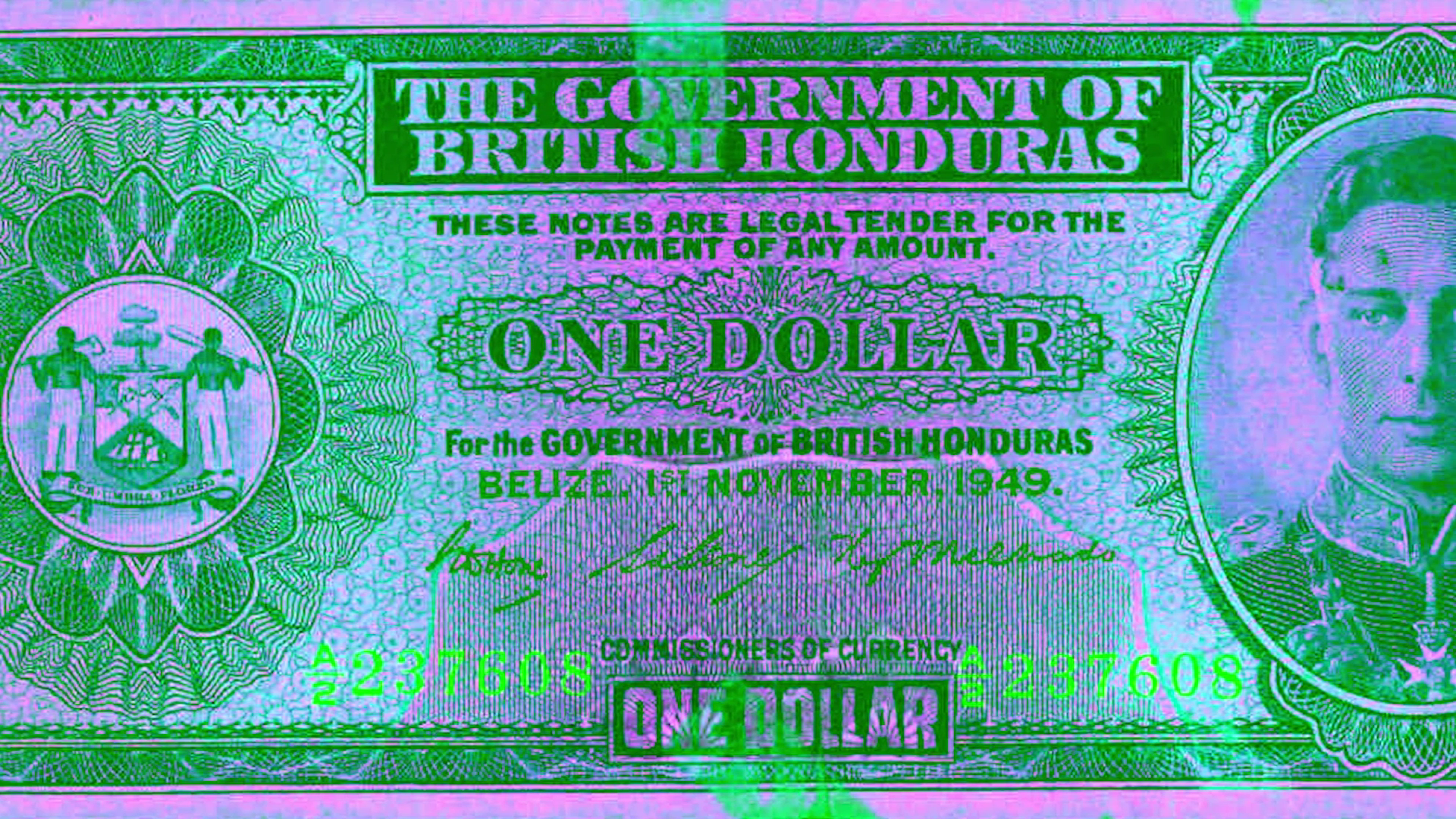
As the Belize dollar’s fixed two-to-one exchange rate against the U.S. dollar marks its 50th anniversary in 2026, this long-standing monetary anchor that has shaped the small Central American nation’s economy and national identity carries a century-long history of colonial shifts, economic crises and intentional policy choices.
Long before Belize gained full independence, the territory existed as the British colony of British Honduras, and its monetary system faced early chaos. Prior to 1894, a patchwork of foreign currencies circulated freely across the colony, with values shifting wildly alongside global silver price fluctuations. This constant volatility created crippling uncertainty for domestic and cross-border trade, prompting colonial officials to pass the landmark Coinage Ordinance that October. The reform replaced the fragmented currency system with a unified monetary framework, tying the new British Honduras dollar directly to the U.S. gold dollar as the official standard and creating a single unit of account for all commercial activity.
For more than half a century, the currency held a one-to-one parity with the U.S. dollar, aligned with the colony’s growing trade ties to its northern neighbor. That stability ended abruptly on December 31, 1949, when the colonial government made the decision to re-peg the currency to British sterling instead. The move devalued the British Honduras dollar by 30% against the U.S. dollar, sparking widespread public anger that fueled the rise of Belize’s nationalist movement and gave birth to the People’s Committee, the precursor to the country’s first major independence political party. Joseph Waight, a longtime Belizean financial secretary, notes that the 1949 exchange rate crisis is widely recognized as the catalyst for modern Belizean nationalism, making currency policy a near-sacrosanct issue in national politics.
A second major shift followed the collapse of the Bretton Woods international monetary system between 1971 and 1973, when the U.S. ended the dollar’s direct convertibility to gold. The global shake-up sent most major currencies into a floating rate period, and by the end of 1975, the British Honduras dollar had depreciated to just 50 U.S. cents per unit. By this point, Belize’s trade and financial flows were overwhelmingly oriented toward the U.S. market, even as links to sterling bloc nations remained relevant. On May 11, 1976, Belizean policymakers made the deliberate decision to formalize the market rate, officially devaluing the currency by roughly 29% from 70 U.S. cents to 50 U.S. cents per Belize dollar. The historic move cemented the two-to-one peg to the U.S. dollar, cutting the decades-long tie to sterling and returning Belize’s monetary framework to the U.S.-centered standard first established in 1894, explains Emory Ford, chief economist at the Central Bank of Belize.
For 50 years, this fixed exchange rate has remained unchanged, emerging as both a cornerstone of Belize’s financial system and a core part of national identity. Veteran Belizean banker Stephen Duncan breaks down the peg’s enduring national value: for the public, it delivers consistent stability that simplifies daily life and smooths household financial planning; as a defensive bulwark against external economic volatility, it helped Belize withstand the spillover effects of Mexico’s 1982 debt crisis when much of the region faced financial collapse; and as a check on governance, it forces national leaders to maintain disciplined fiscal and monetary balance to preserve the peg.
The peg also delivers outsize benefits to Belize’s largest industry: tourism. The fixed two-to-one ratio eliminates exchange rate uncertainty for millions of U.S. and international visitors, simplifying trip planning and spending calculations. Combined with Belize’s reputation as a scenic, welcoming destination, that currency stability makes the country an even more attractive travel option, notes Dr. Carolyn Gentle-Genitty, a regional economic analyst. “Tourism and a large share of our national income rely on the stability this peg provides,” she explains.
Fifty years on from that 1976 policy decision, Belize’s two-to-one currency peg has stood the test of global economic shifts, regional crises and domestic change, emerging as one of the country’s most successful and prudent long-term national economic policies.