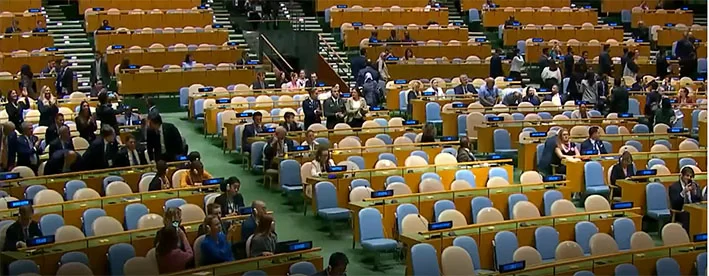
On Thursday, as Israeli Prime Minister Benjamin Netanyahu approached the United Nations General Assembly podium to deliver his address, a near-total walkout of diplomatic delegations sent a wordless but stark rebuke – a public demonstration of refusal to listen to his speech. This form of quiet protest is a well-established right for diplomats, and in many cases, a visible, dramatic gesture carries more weight than a lengthy written statement. However, such a symbolic act only holds moral and political legitimacy if it is rooted in clear, consistently applied principles that apply equally to all actors on the global stage. The United Nations cannot maintain its credibility if it stages public walkouts to condemn one leader for grave actions, while remaining seated and silent when another perpetrator commits comparable violations.
To be clear, this is not a defense of Netanyahu or current Israeli policy. The catastrophic suffering inflicted on the Palestinian people cannot be dismissed or justified through appeals to national security, historical context, or political circumstance. That same standard holds for violence targeting Israeli civilians, too. Even amid the long fight for Palestinian statehood and amid the occupation and oppression that frame their struggle, Palestinian armed groups cannot legitimize attacks on civilian lives. No stated political goal, however sympathetic, can make violence against innocent civilians acceptable.
Empty seats as a protest against offending leaders only carry substantive meaning if guided by a single, consistent moral and legal metric. The United Nations, an organization founded explicitly to advance global peace, should deny a platform to any actor that targets civilian populations, violates fundamental human rights, infringes on national sovereignty, and flouts international law – this principle must apply regardless of who the perpetrator is. Whether the violation is committed by Israel, a Palestinian armed group, the United States, or any other nation or non-state actor, the identity of the offender should never change the universal norm that is being violated.
The 2025 incursion into Venezuela illustrates why this consistency is non-negotiable. In January of that year, U.S. military forces entered Venezuelan territory, killed dozens of civilians, and detained democratically elected President Nicolás Maduro and his wife, transporting them to the United States to face criminal prosecution. While the White House defended the operation as legitimate, international legal experts have raised widespread and serious questions about its legal foundation. Core international law strictly prohibits the use of military force against another sovereign state, except in very limited circumstances such as self-defense or when explicitly authorized by the UN Security Council. No one is required to defend Maduro’s domestic governance to condemn the U.S. incursion as a violation of international order. A person’s view of Maduro’s administration does not alter the core problem: when a major global power unilaterally decides it can invade another nation, abduct its leader, and bring them to its own territory for trial, the entire foundation of the post-WWII international rules-based order is put at grave risk. If this precedent stands, might will replace right as the governing principle of global relations.
This week, U.S. President Donald Trump himself spoke from the UN podium, where he highlighted American military power and cited the Venezuela operation as proof of Washington’s willingness to take aggressive action in the Western Hemisphere. During his address, the Cuban delegation staged a walkout, but the large-scale, visible protest that greeted Netanyahu did not materialize on the same scale against Trump. This discrepancy exposes the double standard that the United Nations cannot afford to tolerate. Who receives a forceful moral rebuke should never depend on political alliances, great power protection, military strength, or selective historical interpretation. Those who claim to defend universal principles must uphold those principles even when doing so is politically inconvenient.
This standard applies equally to the Israeli-Palestinian conflict. Israel cannot justify all its actions by citing national security needs, just as Palestinian armed groups cannot justify attacks on civilians by pointing to their decades-long struggle. Historical context can help explain how the conflict emerged, but it cannot serve as a free pass for actions that violate universal norms today. Even a goal deemed politically just does not justify every method used to achieve it.
The United Nations was specifically created to clarify this distinction and enforce consistent standards. The organization was not founded to treat allies more leniently than enemies, nor was it designed to grant greater rights to powerful nations than small, vulnerable states. An ally should not face less scrutiny simply because it is a strategic partner.
An empty seat can be a powerful symbol of moral outrage, but only if that symbol is applied consistently across all cases of violation. Without that consistency, supposed moral outrage devolves into political selectivity. It is not principle that determines who gets condemned, but the temporary power dynamics and political interests of the moment.
The core message the UN should send is far broader than simply walking out on one leader it opposes. It should send a clear, unified message that violence against civilians, gross human rights violations, and disregard for international law are judged the same way no matter whether the perpetrator is a friend or foe, a great power, a sovereign state, or an armed movement. An empty seat must mean the same thing for everyone. Because once rules are only strictly applied to political opponents, those rules lose all credibility. We stop talking about universal principles and start accepting power politics as usual – and the United Nations was founded to stand above that corrosive double standard.