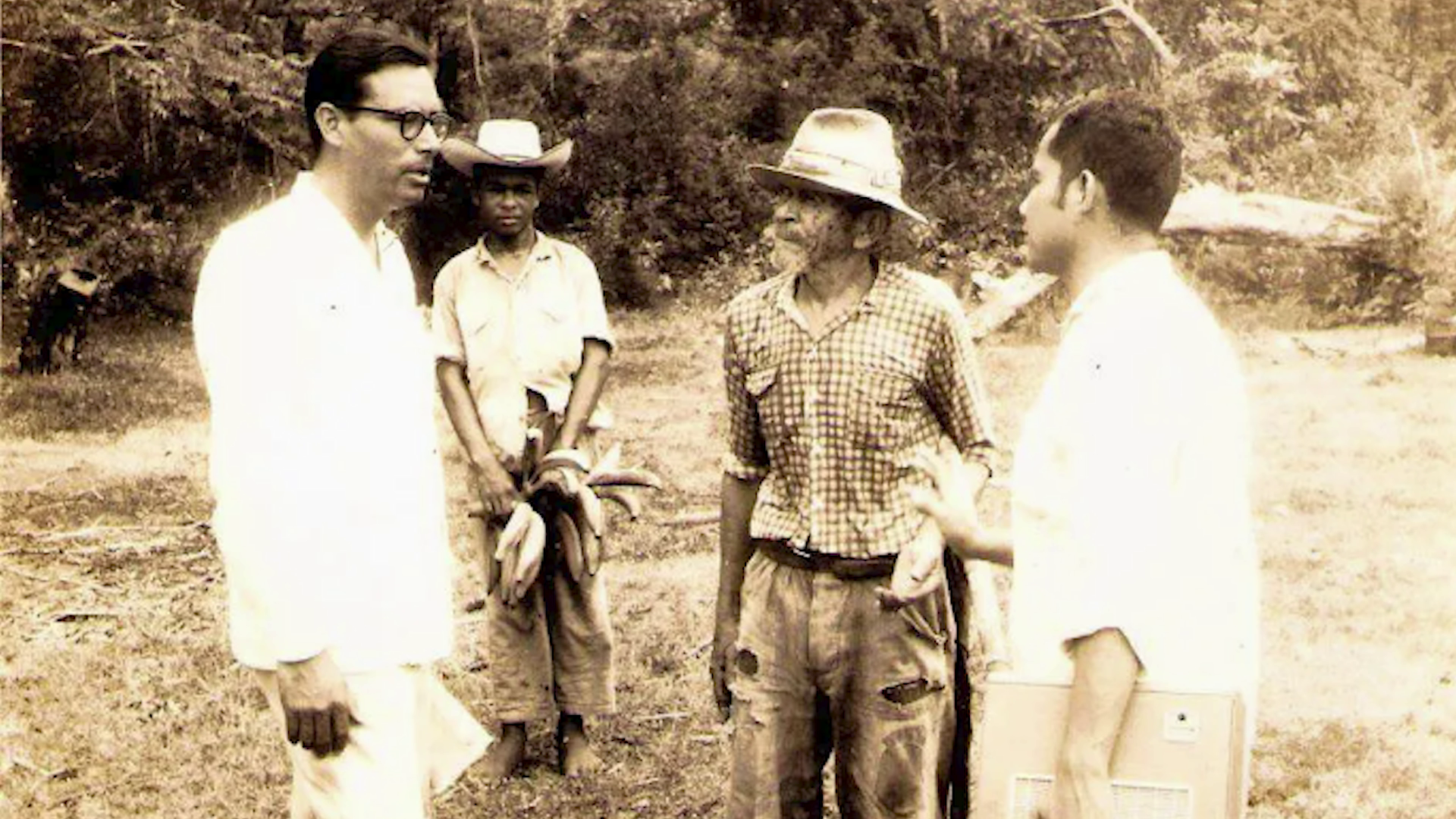
Seventy years after its founding, Belize’s iconic People’s United Party (PUP) finds itself mired in growing internal and public debate over whether it has strayed from the core social justice vision etched into its foundation by party patriarch George Price. For Price, the PUP was never merely a political organization — it was a movement built to champion poor, marginalized, and working-class Belizeans, prioritizing people over profit and extending opportunity to every corner of the nation, not just wealthy elites and well-connected insiders.
Hector Silva, a historian and early PUP organizer who stood beside Price as the movement took shape, is among the most vocal critics arguing that today’s party has abandoned that foundational mission. In an interview with News Five, Silva aligned with recent public comments from Cabinet Minister Julius Espat, who openly acknowledged that social justice is lacking in the current PUP’s governance. Silva says that across Belize, widespread public discontent over systemic inequity is impossible to ignore. “We are seeing it at the moment that some people are becoming very prosperous yet some people are becoming very poor,” Silva explained. “It is not that we want to take away from the rich, but we want to give more to the poor — that is the social justice promise this party was built on.”
Price’s original framing of social justice was rooted in his Catholic faith, which guided his belief that the role of government is to lift up vulnerable communities, expand working-class opportunity, and ensure all development projects deliver broad public benefit rather than just private gain. Today, as ordinary Belizean families grapple with soaring cost of living, barriers to land ownership, and controversial, top-down development decisions, that framing has become a benchmark critics use to measure the current government’s performance.
The debate over the PUP’s identity has spilled into open conflict within the party’s own ranks, exposing deep rifts between top officials. Prime Minister John Briceno, who leads the current administration, has forcefully pushed back on claims of abandonment, insisting that the PUP remains inherently tied to its founding values. “We are for social justice. The PUP is based on social justice and the time we move from that; we cannot be the PUP,” Briceno said.
But even high-ranking members of Briceno’s own Cabinet acknowledge the party has lost its way. Deputy Prime Minister Cordel Hyde has openly called for a course correction, acknowledging that the current party does not match its original identity. “All is not well,” Hyde stated. “All cannot be well if we are experiencing the kinda crisis that we’re experiencing with the cost of living… We have to just be real. We have to get back to what we were before. We have to get back on track.”
The tension boiled over recently after Espat noted that only he and Hyde remained fully committed to Price’s original vision, a comment that drew a public rebuke from the prime minister. Briceno pushed back on the claim that only a small faction of the Cabinet prioritizes social justice, pointing to other ministers’ policy actions — including a move by Minister Chebat to remove the goods and services tax on electricity to ease household cost burdens — as proof of the entire Cabinet’s commitment.
Still, the public disagreement has laid bare a broader fundamental divide within the party: whether Price’s social justice vision needs to be preserved as a non-negotiable core, or adapted to fit the shifting pressures of modern Belize. Cabinet Minister Dr. Louis Zabaneh notes that the real divide is not over whether to support social justice as a goal, but over how to achieve it in a changing global and national landscape. “It is important to ask the question not whether or not someone say they support social justice, but really how that social justice is to be achieved,” Zabaneh explained.
For critics like Silva, the proof of the PUP’s commitment will never be found in political rhetoric — it will be seen in the daily lives of ordinary Belizeans. He recalled a striking final remark Price shared with him years ago, in which the founding leader called for a “second revolution” to cement justice and shared prosperity for all Belizeans. Ultimately, it will be the Belizean public that delivers the final verdict: asking one simple question that cuts through all internal party debate, who does this government actually serve?