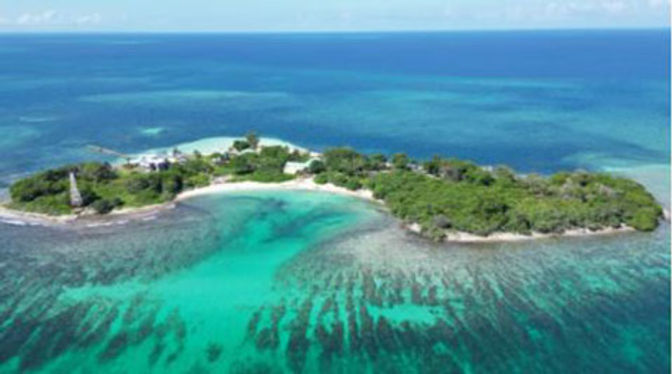
Decades of simmering territorial tensions over the Sapodilla Cayes, a cluster of ecologically valuable islands at the southern edge of the Belize Barrier Reef in the Gulf of Honduras, have moved another critical step forward in the United Nations’ highest judicial body. On September 21, both Belize and Honduras officially submitted their written observations to the International Court of Justice (ICJ), responding to the legal arguments filed earlier by Guatemala, which has staked an overlapping claim to the island chain that Honduras refers to as Cayos Zapotillos.
This deadline for the responses had been adjusted earlier in the year, after Honduras requested additional time to prepare its submission. Initially, the ICJ had set a July 20 deadline for Belize and Honduras to respond to Guatemala’s statement, with Guatemala required to file its arguments by May 19. Following the extension request approved by the court on April 16, the timeline shifted: Guatemala received a new deadline of June 19 to submit its written statement, while Belize and Honduras were given until September 21 to file their formal responses. Both countries met the adjusted deadline.
Belize’s submission to the ICJ Registry totals two volumes: one containing its formal written observations responding to Guatemala’s claims, and a second volume holding supporting annexes and documentary evidence. The filing was led by Mariana Verde, Chief Operations Officer of the Office of Belize’s Agent to the ICJ within the Ministry of Foreign Affairs and Foreign Trade, alongside Catherine Drummond, a member of Belize’s legal team.
The core dispute originated in November 2022, when Belize initiated the formal ICJ case against Honduras, asking the court to issue a binding ruling on which country holds legal sovereignty over the cayes. The process grew more complex just over a year later, in December 2023, when Guatemala filed an application to intervene in the proceedings. Guatemala argued that its core legal interests in the territory would be directly impacted by any ruling the court issued on sovereignty.
After public hearings on Guatemala’s intervention application held at the Peace Palace in The Hague in November 2025, the ICJ issued a unanimous ruling in March 2026 approving Guatemala’s participation, but strictly limited its role to that of a non-party intervener. The court restricted Guatemala’s involvement solely to questions of sovereignty over the Sapodilla Cayes, including related fishing rights in the surrounding waters, and clarified that the country would not gain full party status in the existing case between Belize and Honduras.
In its June 2026 written statement, Guatemala reiterated that it claims the Sapodilla Cayes as part of its broader territorial, insular, and maritime claims against Belize. It also emphasized that its involvement in this specific case remains legally distinct from its wider ongoing territorial dispute with Belize, which is also being adjudicated separately at the ICJ.
Thursday’s filings do not bring the dispute to a close, but instead formally place the parties’ responses to Guatemala’s arguments on the court’s record as the proceedings advance toward the oral argument phase. The ICJ has already scheduled the next major milestone: public oral hearings on the substance of the Sapodilla Cayes sovereignty dispute will take place from March 1 to 5, 2027. These hearings will follow immediately after separate oral proceedings for the broader Guatemala-Belize territorial dispute, which are set to run from February 22 to 26, 2027.
Headquartered at the Peace Palace in The Hague, the ICJ serves as the United Nations’ primary judicial body, tasked with resolving inter-state legal disputes in accordance with established international law.