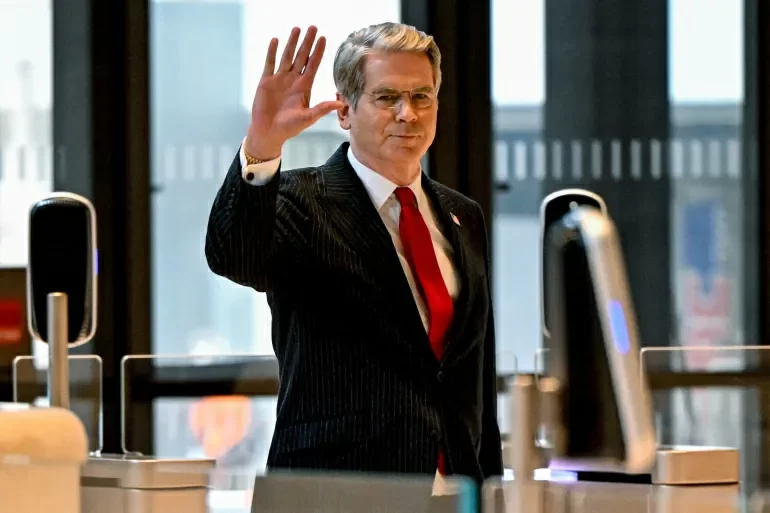
Top economic officials from the United States and China have launched high-stakes discussions in New York on Sunday, covering three core areas: bilateral trade, artificial intelligence governance, and critical mineral supplies. These talks are explicitly designed to lay diplomatic and policy groundwork for the much-anticipated upcoming summit between US President Donald Trump and Chinese President Xi Jinping, scheduled to take place later this week in Washington D.C.
Hosted at JPMorgan Chase’s global headquarters in Manhattan, the meeting is led by US Treasury Secretary Scott Bessent and Chinese Vice Premier He Lifeng, with US Trade Representative Jamieson Greer also participating in the negotiations. The session forms part of a sustained series of bilateral engagements aimed at managing the complex economic relationship between the world’s two largest economies. In opening remarks upon his arrival, Bessent emphasized that the US side looked forward to “focused, substantive and constructive discussions that can lay a solid foundation for the meeting of our two national leaders.”
One of the most urgent agenda items is the future of the temporary bilateral trade truce, which is set to expire on November 10 under current terms. This existing arrangement has played a key role in preventing a fresh escalation of long-running trade tensions between Washington and Beijing, making its extension or replacement a top priority for negotiators.
Critical raw material supply chains, particularly for rare earth metals and other strategically vital minerals, also take a central spot in the talks. These resources are foundational to the production of a wide range of high-tech goods, from consumer electronics and electric vehicles to advanced semiconductors. Washington has long pushed for guaranteed, stable access to these supplies, while Beijing has increasingly framed control over key mineral exports as a core economic and strategic tool. Reuters sources confirm that securing reliable rare earth supply chains ranks among the US’s top negotiating priorities. Additional trade-related topics on the table include potential tariff reductions for selected non-strategic goods, and discussions around Chinese purchases of American agricultural commodities and Boeing commercial aircraft.
A new addition to the bilateral negotiating agenda is governance of artificial intelligence, a sector where both countries are global leaders in advanced system development, even as they maintain sharp competition over technological supremacy and national security. Bessent has confirmed that Washington is open to discussing shared AI risks, including potential regulatory frameworks for both open-weight and closed-weight AI models. Open-weight models allow users to download and modify core model parameters, while closed-weight models keep core system architecture fully controlled by their developers. In recent years, Chinese open-weight AI models have grown in popularity among US businesses, in large part due to their lower cost compared to comparable American-developed alternatives. This growing adoption has, however, reinforced Washington’s ongoing concerns over potential national security risks stemming from access to advanced Chinese AI technology.
Beyond economic and technological issues, the talks also touch on geopolitical matters with global ramifications, specifically US policy toward Iran. China maintains extensive economic ties with Iran and is one of the largest importers of Iranian crude oil, putting Beijing in a critical position for US efforts to ramp up economic pressure on Tehran. This inclusion of the Iran issue underscores how modern US-China negotiations now extend far beyond the original bounds of their bilateral trade dispute, touching on interconnected global geopolitics.
Despite the broad range of topics up for discussion, analysts and policymakers broadly do not expect a sweeping, comprehensive breakthrough agreement to emerge from the New York talks. Over the past several years, the two countries have prioritized stabilizing their economic relationship without resolving their broader structural strategic rivalry, leading most observers to anticipate only limited incremental agreements or extensions of existing arrangements rather than fundamental progress.
Anna Ashton, a leading analyst specializing in China and trade policy, argues that the most likely outcome is that both sides will prioritize preserving the status quo. Kurt Campbell, former US Deputy Secretary of State, has echoed this assessment, noting that the immediate core goal of the talks is to prevent a new escalation of bilateral tensions, rather than achieve a grand resolution. The New York discussions are ultimately aimed at refining and aligning positions to prepare for deliverables at the upcoming Trump-Xi summit in Washington, where the two leaders will address the full scope of economic and strategic relations between the United States and China.