Three hundred years ago, a 19-year-old born into chattel slavery would have been raised to accept exploitation as an unchangeable fact of life. Taught from childhood that their fate was to serve the whims of slave owners—who faced zero consequences for atrocities ranging from brutal whippings to death—they internalized the corrupt hierarchical idea that some people were inherently ‘more equal than others’, a dynamic famously explored in George Orwell’s *Animal Farm*.
This system of exploitation was rooted entirely in profit, and it produced a cruel hypocrisy among slaveholding classes: many publicly claimed to uphold devout, moral Christian values while inflicting some of the worst human rights abuses in modern history. Critically, slavery was originally authorized and expanded by government policy, only to be banned by the same institutions centuries later. To this day, debate continues over whether the abolition of slavery stemmed from genuine moral outrage, or a shifting economic landscape that made the practice unprofitable—a move framed as virtue signaling rather than principled action, despite the lifelong advocacy of abolitionists like William Wilberforce who decried slavery as inherently immoral from its inception. Many supporters of slavery even dehumanized enslaved African people to justify their oppression, claiming they were ‘savages’ in need of ‘civilizing’.
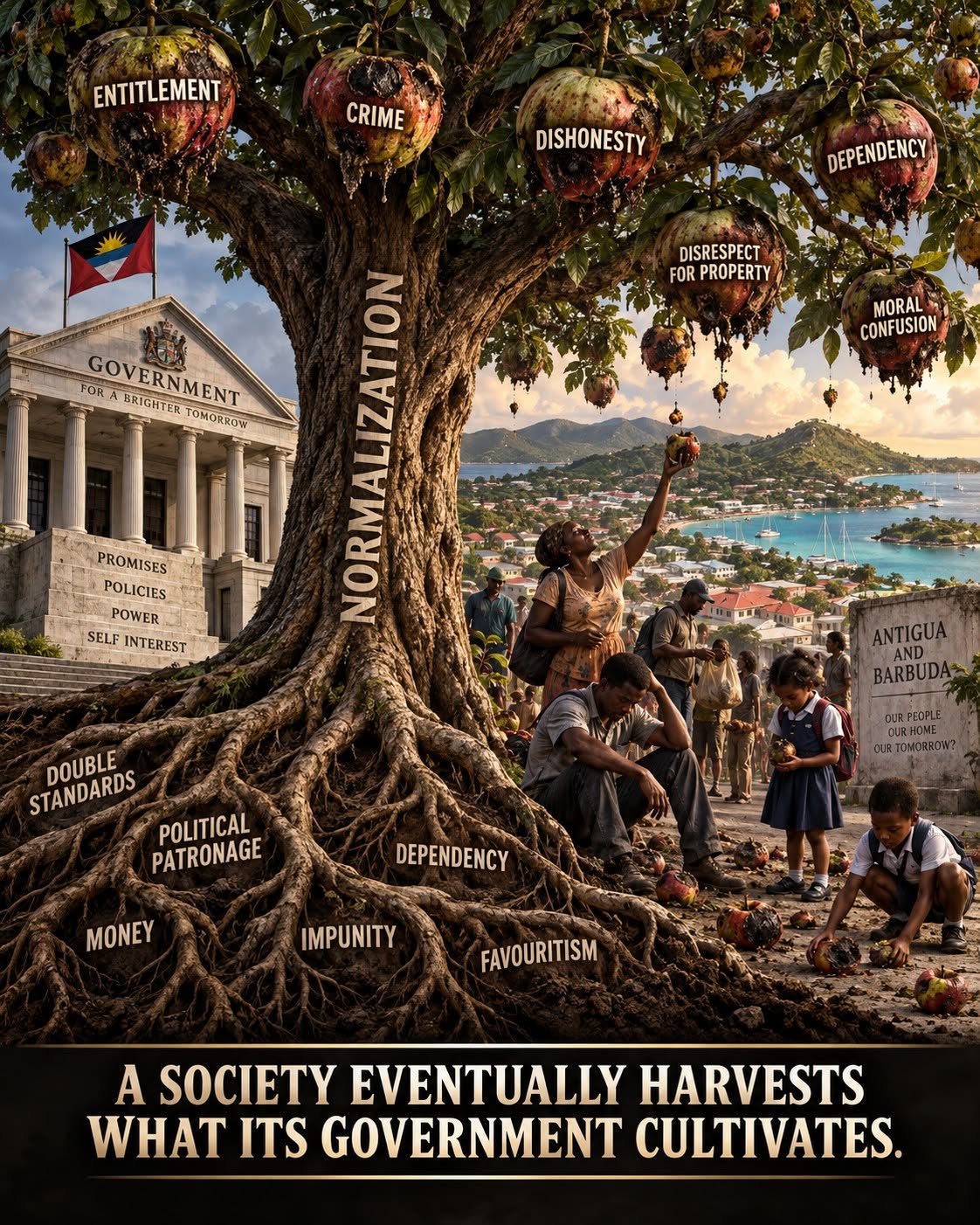
Decades of observing public life in Antigua and Barbuda have led writer Yves Ephraim to a provocative, controversial conclusion: the national government has become the central hub of moral decay in the country, a claim that many may dismiss as outlandish or politically motivated, but one he says is backed by clear evidence. Just as the corruption of slavery became embedded in the collective psyche of generations born into the system, the corrupting influence of modern government is subtle, insidious, and normalized from birth—making it nearly impossible for many, especially younger generations, to recognize that widespread patterns of behavior are inherently immoral.
Ephraim points to a series of everyday examples to illustrate this moral shift. Public profanity is no longer stigmatized: radio stations broadcast unbleeped curse words in popular music that young children consume daily, and politicians freely use abusive language in public without facing any consequences. Where public indecency and foul language once carried legal penalties, these offenses have seemingly vanished from the statute books.
A more profound moral double standard, he argues, surrounds government seizure of private property. Most citizens accept that the government has the right to forcibly seize private property against an owner’s will if it claims a public benefit, for example through windfall taxes on wealthy families. Yet if a private citizen robbed a wealthy household and donated 100% of the proceeds to feed poor, elderly community members, no one would defend the action. Both acts involve taking another person’s property through coercion for a stated public good—so why is one lauded and the other condemned? If a small group or even a crowd of private individuals cannot justify theft for charity, Ephraim asks, how can a government do so with moral impunity?
This willingness to set aside morality for financial gain extends across multiple policy areas. For marijuana consumption, the government tolerates small personal use, but criminalizes unlicensed commercial sales—once the state gets a cut of profits, large-scale sales are permitted, even marketed as legitimate medicinal cannabis. The same logic applies to prostitution: unregistered, un-taxed sex work is a crime, but once sex workers register and pay government fees, the activity is rebranded as a legitimate, certified profession.
Further double standards apply to use of force. If a homeowner uses a licensed firearm to kill an armed intruder who breaks into their property in the middle of the night, they must prove they did not use excessive force to law enforcement. But if a police officer shoots an unarmed, fleeing suspect in the back and kills them, there is rarely any accountability for excessive force, despite public calls for investigation—even though police receive formal training in use of force that should hold them to a higher, not lower, standard than ordinary citizens.
Development policy also reflects selective enforcement of rules, Ephraim argues. The government will bulldoze small, informal sheds built by poor young entrepreneurs to earn a living, citing environmental or public aesthetic concerns. But the same government allows well-connected foreign investors to pursue development projects on Barbuda that risk damaging the island’s lagoon and displacing local residents. While officials claim beaches are public property for all, they regularly allow favored investors to block public beach access without consequences.
Echoing the biblical teaching that the love of money is the root of all evil, Ephraim argues that the same profit-obsessed corruption that drove historical slavery now drives modern government graft. The relentless pursuit of revenue and foreign investment has led the government to sell off large swathes of national land, leaving the country at risk of losing enough arable land to maintain food self-sufficiency.
On the social front, government policy has eliminated longstanding social taboos around having children outside of wedlock. Ephraim, who was himself born out of wedlock, acknowledges this stance will draw criticism from feminist advocates, but argues the policy shift has led to a surge in children being raised in single-mother households. While the state operates a formal child support system, collecting payments from absent fathers is plagued by costly delays. Worse, he claims, many of these law changes were enacted specifically to accommodate the extramarital lifestyles of powerful political leaders.
Public debate around child abuse and poverty often ignores the role of unregulated age of consent laws that allow older men to impregnate teenage girls, trapping both young mothers and their children in cycles of intergenerational poverty. If policymakers want to reduce national poverty, Ephraim argues, addressing teenage pregnancy must be a first step. Data shows a disproportionate share of young violent criminals come from single-mother households, yet the government has no interest in promoting traditional family structures. In fact, Ephraim claims, the current political system actively benefits from broken homes: politicians pander to single mothers facing financial hardship with cash gifts and welfare handouts in exchange for votes, creating permanent dependency that allows ruling parties to hold onto power indefinitely. What is effectively bribery is rebranded as ‘targeted assistance’ for vulnerable communities.
This normalization of corruption also seeps into the public sector: government employees who cut corners and accept favors for political allies are rewarded, while civil servants who follow the rules are sidelined and marginalized. When corruption becomes a core part of national culture, young people cannot navigate the contradictory moral standards, and many turn to anti-social behavior. In the lead-up to the 2026 national elections, hundreds of young people were hired for temporary Ministry of Works roles, where many were allowed to collect monthly paychecks without showing up for work. This has reinforced a growing sense of entitlement among youth: many now expect free government salaries rather than seeking stable work, and those who cannot access these no-show jobs turn to armed robbery of private citizens—imitating the government’s own pattern of taking what they want by force. While Ephraim emphasizes that not all young people adopt this mindset, the current cultural environment breeds far more of this behavior than was common decades ago.
Most recently, Ephraim highlights the blatant conflict of interest involving the ruling Antigua and Barbuda Labour Party (ABLP) and the University of the West Indies (UWI). The ABLP, which controls the national government that holds significant influence over UWI, has allowed the university to rent party-owned facilities, generating direct rent income for the ruling party. The arrangement is not an arms-length transaction, yet there has been no significant public outcry or professional condemnation, even from the national Bar Association. Ephraim compares the arrangement to a Barclays Bank general manager approving a mortgage for a client who has already hired the manager’s side construction business to build their home—this would clearly be considered insider trading and white-collar corruption, yet the Office of the Director of Public Prosecutions (ONCDP), tasked with policing this type of crime, has taken no action. It is a critical distinction that the ABLP as a political party and the national government are separate legal entities, making the arrangement clearly unethical.
Many citizens assume that elected government leaders will be morally upright, but the current trend in Antigua and Barbuda leans toward electing openly immoral politicians who have already been corrupted by the existing system. This makes meaningful moral reform far more difficult to achieve. It is no coincidence, Ephraim concludes, that putting immoral people in power produces corrupt laws, corrupt policies, and a corrupt national culture—changes that require a full collective reckoning to reverse.