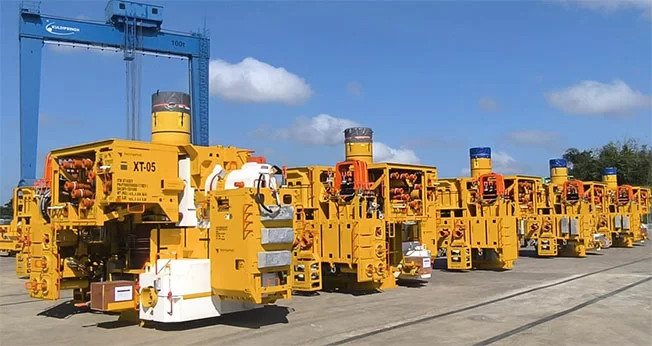
On the docks of Suriname’s Kuldipsingh Port Facility, a sprawling collection of massive steel structures, specialized pipelines, reinforced cables, and custom-built components currently sits assembled in plain view — a rare public preview of the technical backbone of Suriname’s landmark GranMorgu offshore oil project, most of which will eventually be hidden thousands of meters below the Atlantic Ocean floor.
Once fully integrated and installed off Suriname’s coast, this network of subsea equipment will form the core production system that pumps crude oil from deep underwater reservoirs up to a floating production, storage and offloading (FPSO) vessel. Every piece of the system plays a non-negotiable role: without this specialized infrastructure, not a single drop of oil can reach the surface production vessel.
Among the most critical components is the 32 Christmas trees manufactured for the project. Despite their festive name, these units are high-precision subsea control systems mounted directly on top of each offshore oil well. Made up of an interconnected array of valves, regulators, and monitoring sensors, Christmas trees regulate, measure, and secure the flow of oil and other reservoir fluids out of the wellbore. Often called the “gatekeeper” of the subsea well, the Christmas tree controls whether, how much, and under what conditions fluids flow into the broader production network. Once installed at depth, the entire system is operated and monitored remotely from the surface FPSO, out of human sight permanently.
Not every well requires a dedicated pipeline running directly back to the FPSO. Instead, output from multiple wells is consolidated via specialized large-scale subsea manifolds, or distribution hubs. These heavy, extremely robust structures gather production flows from separate wells and route them through the larger subsea pipeline network, operating much like onshore electricity distribution stations — with the key difference that they must function under thousands of meters of crushing water pressure, where routine maintenance is prohibitively complex and costly. This extreme operating environment is why every manifold is built with thick, reinforced steel to withstand decades of harsh subsea conditions.
From the manifolds, an extensive network of custom-engineered subsea pipelines acts as the “arteries” of the entire production system, connecting wells and distribution hubs to the FPSO. These pipelines are built to withstand a host of extreme stressors: extreme water pressure, wide temperature fluctuations, corrosive saltwater, seabed movement, and constant internal pressure from flowing crude. A failure at depth cannot be fixed quickly or cheaply, so material durability and precision engineering are non-negotiable requirements for every segment of pipe.
To connect the surface control systems on the FPSO to subsea equipment, the project relies on specialized umbilicals, often referred to as the project’s “umbilical cord to the seabed.” These are bundled cables and hoses that carry electrical power, control signals, hydraulic pressure, and treatment chemicals from the FPSO to subsea valves and sensors. Where pipelines carry oil, umbilicals act as the nervous system of the entire subsea network, enabling remote operation and real-time monitoring of all equipment thousands of meters below the surface.
A defining feature of the GranMorgu project is the extreme depth where most of its infrastructure will be installed — too deep for human divers to carry out installation, inspection, or maintenance work. Instead, all on-site subsea work will be completed by remotely operated underwater vehicles (ROVs), which is why every component is engineered to extreme precision standards, with specialized subsea connectors designed to enable secure, reliable connections without human intervention. Once installed on the seabed, every piece fits together perfectly to form a single integrated production system.
Public attention around the GranMorgu project has largely centered on its multi-billion-dollar investment price tag, projected output, expected state revenue for Suriname, and economic opportunities for local businesses and workers. But behind these high-level economic expectations lies a highly complex, engineered supply chain and technical network. A single oil reservoir does not deliver commercial production on its own; it requires an interconnected system of wells, control systems, manifolds, kilometers of pipeline, umbilicals, and subsea connectors to safely bring crude from the seabed to the surface.
For now, these massive steel components laid out on Suriname’s port docks tell a larger, underreported story: this is the invisible technology that will enable Suriname’s first large-scale offshore oil production, operating deep below the Atlantic Ocean, out of sight for almost all of society.