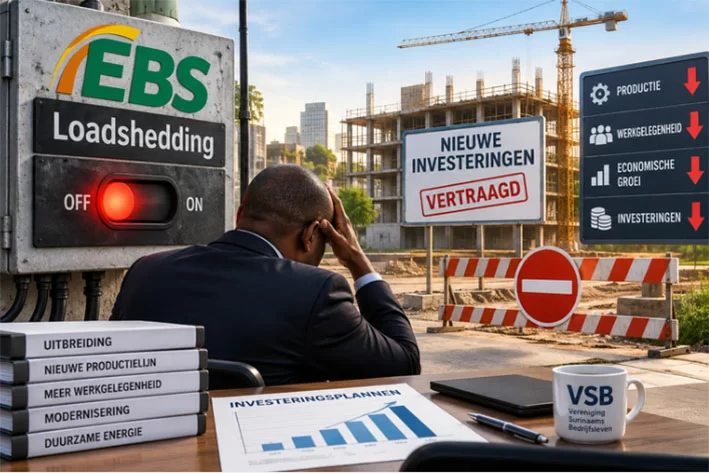
Suriname’s leading business advocacy group, the Vereniging Surinaams Bedrijfsleven (VSB), has sounded the alarm over the growing risks that persistent planned power outages, known as loadshedding, pose to the stability of domestic business operations and the country’s ability to attract new foreign and local investment. The organization stressed that addressing the current energy shortage is only a short-term fix, arguing that policymakers and energy providers must prioritize expanding generation capacity to support long-term economic growth.
The concerns were formally raised during a high-level consultation held September 15 between VSB representatives, leadership from N.V. Energiebedrijven Suriname (EBS), the national energy utility, and delegates from other organized business sectors across the country. The talks were triggered by widespread feedback from local business owners reporting significant disruptions to daily operations caused by recurring power cuts.
VSB officials emphasized that for businesses of all sizes, a reliable and predictable energy supply is non-negotiable to plan production schedules and deliver consistent services to clients. While the association acknowledges that controlled loadshedding may be technically necessary to prevent total collapse of the national power grid, it says enterprises require clear, advance notification of when outages will occur and how long they will last to minimize productivity losses.
During the negotiations, particular focus was placed on the disproportionate impact of loadshedding on small and medium-sized enterprises (SMEs), the tourism sector, and small-scale manufacturing operations. Alternative power solutions such as private backup generators carry high upfront investment costs that are out of reach for many smaller operators, the group noted. Attendees discussed a range of potential mitigation measures, including subsidized emergency power infrastructure, shifting non-critical business operations to off-peak hours when energy demand is lower, and adopting solar power paired with battery storage systems. Business representatives pushed for solution frameworks that prioritize affordable, accessible options for small and medium-sized businesses that cannot absorb large unexpected energy-related costs.
VSB also asked whether EBS could prioritize power access for economically critical operations when scheduling outages, sparing key business facilities from disconnections. In response, EBS explained that its current technical infrastructure only allows for disconnections on a per-feeder basis, rather than per individual customer connection. While the utility already works to avoid outages for hospitals and other critical public services, and attempts to account for the economic profile of local areas during outage planning, full separation of business and residential connections is not currently feasible as most share the same distribution infrastructure.
Beyond the immediate crisis, VSB highlighted that the larger, long-term challenge lies in meeting future energy demand as the Surinamese economy expands. New economic activities and incoming investment projects will only increase the country’s overall need for electricity, requiring timely development of new generation capacity and operational reserve infrastructure to avoid persistent shortages. EBS confirmed during the meeting that current available capacity is already insufficient to meet peak demand during certain periods, a problem rooted in a years-long backlog of investment in new energy infrastructure.
Participants also discussed the prospect of allowing independent third-party energy producers to enter the market to expand total capacity. EBS reported that the required legal framework to enable private power generation is mostly finalized, but still remains subject to a final regulatory review.
VSB has rejected framing the current energy shortage as a temporary supply-demand imbalance, arguing that investment in new generation capacity and energy infrastructure must grow in lockstep with broader national economic development. To that end, the association plans to continue holding regular structured consultations with EBS, the national government, and other business groups to push for long-term reform. VSB also called for full and timely implementation of existing prior agreements related to energy infrastructure investment, energy sector regulatory reform, and long-term demand planning.