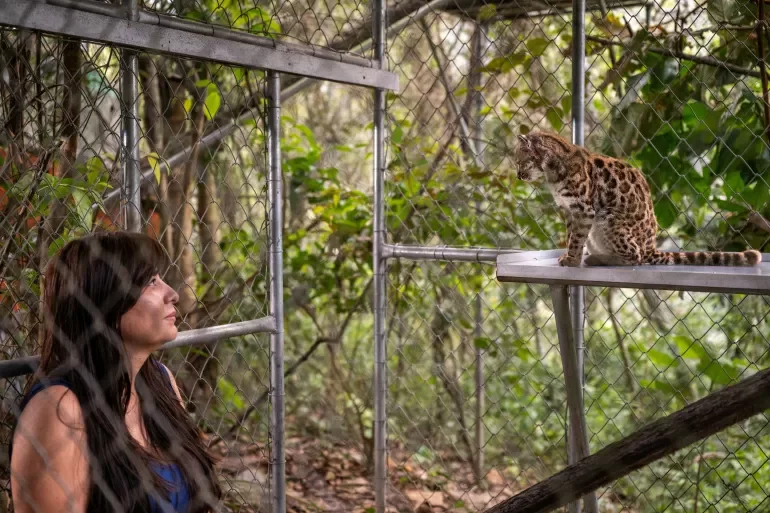
For most major scientific discoveries, researchers must trek deep into uncharted jungles, spend decades excavating fossils, or deploy cutting-edge equipment to probe the depths of the world’s oceans. But the story of *Leopardus tilcayo* — the first new living species of wild cat identified by science in more than 100 years — began with a far more ordinary chain of events: a lost kitten, a local family’s mistake, and an attentive biologist’s quiet suspicion.
The small, spotted feline was found alone as a kitten on the edge of forestland in Bolivia’s Yungas region. A local resident took the animal in and cared for it for roughly a year, assuming it was just an ordinary domestic cat. As it grew, however, the animal began to display wild behaviors, including hunting the neighborhood’s chickens, making it clear this was no house cat. In 2016, the animal was transferred to Senda Verde, a local wildlife rescue center, where staff reached out to biologist Paola Nogales-Ascarrunz with a simple, curious note: they had a “strange cat” that didn’t match any known local species.
That single phone call launched nearly a decade of international collaborative research, whose results were published this week in the peer-reviewed scientific journal *Current Biology*. Led by Nogales-Ascarrunz, a National Geographic researcher, the study has upended existing understanding of small South American wild cats, and added an entirely new species to the world’s taxonomic records.
The newly named tilcayo is a remarkably small feline: it grows to roughly 46 centimeters in body length and weighs an average of just 1.4 kilograms, smaller than the average adult domestic house cat. Its light brown coat is marked with dark, irregular rosette spots, it has proportionally small, rounded ears, and a longer, fuller tail than its closest genetic relatives. At first glance, the tilcayo closely resembles other small spotted cats native to South America — a similarity that hid it from formal scientific identification for centuries.
The *Leopardus* genus, commonly called tiger cats, is what researchers call a cryptic species group: its members can look nearly identical to the naked eye, but genetic analysis reveals they are evolutionarily distinct lineages separated by millions of years of independent development. “You need full genetic analysis to uncover the meaningful differences between these groups,” explained Jonas Lescroart, an evolutionary biologist at the University of Antwerp and a co-author of the study. For this research, the team sequenced and analyzed the full genome of 38 *Leopardus* individuals, including DNA samples from century-old museum specimens to build a full evolutionary history of the group.
The results were surprising: what was long classified as a small group of just a few species is actually five genetically distinct species, one of which was the unrecognized Bolivian cat. Genetic dating confirms the tilcayo’s evolutionary lineage split from other tiger cats roughly 1.4 million years ago — meaning the species has roamed South America’s forests for millennia before it ever received a formal scientific name. Notably, the name *Leopardus tilcayo* is not a new coinage created in a laboratory: “tilcayo” is the traditional name that Indigenous and local communities in the Yungas have used for generations to distinguish this cat from other small spotted felids in the region. By retaining the traditional name in the formal scientific classification, researchers centered the long-held local knowledge of the species that predated modern scientific discovery by centuries.
As the research team emphasizes, the story of the tilcayo’s discovery is almost a story that never happened. When Nogales-Ascarrunz first examined the rescued cat in 2016, she too initially assumed it was a known species, *Leopardus tigrinus*. But she noticed subtle differences in the shape and size of its coat spots that did not match the known profile of the species. That small, nagging suspicion ultimately grew into a full international research collaboration that brought together genetic data from across the world and compared it to hundreds of archived museum specimens. “Once we combined all our data sets, all the pieces of the puzzle fell into place,” Lescroart said.
Now that the species has been formally identified, the work to understand it is only just beginning. Researchers still do not know how many tilcayo individuals live in the wild, nor the full extent of their geographic range. To date, the species has only been genetically confirmed in Bolivia, and it remains unclear if populations also exist in neighboring Peru or Argentina. Very little is known about the species’ behavior and ecology: preliminary camera trap data suggests the tilcayo is primarily nocturnal, and analysis of fecal samples confirms small rodents make up part of its diet, but almost nothing is known about its breeding patterns, territorial range, natural predators or social behavior. Teams have already begun deploying camera traps across the Yungas to collect more data on the elusive species.
While the identification of a completely new mammal species is widely being celebrated as an exciting scientific breakthrough, it also comes with an urgent new conservation responsibility. The Yungas, the humid montane cloud forest that is the tilcayo’s known habitat, is under severe threat from deforestation, industrial agricultural expansion and unregulated mining. Smaller geographic ranges automatically put a species at greater risk of extinction, and the new classification means the entire tiger cat group will require re-evaluation by conservation scientists. Currently, the IUCN Red List classifies tiger cats as a single vulnerable group; with the confirmation of five distinct species, each lineage will now be assessed individually for conservation status. The research team has already shared their full findings with the International Union for Conservation of Nature (IUCN) to support this updated evaluation, meaning a species that did not exist in formal scientific literature just weeks ago could soon receive targeted endangered species protection.
The discovery of the tilcayo comes at a moment when many people assume all terrestrial megafauna have already been documented by science. In an era of high-resolution satellite mapping that can image every corner of the globe, and DNA sequencing technology that can reconstruct evolutionary history with unprecedented precision, many assume there are few large, new species left to find. But the tilcayo’s story proves the natural world still holds hidden secrets: it walked the forests of Bolivia for 1.4 million years, was known to local communities for centuries, and only revealed itself to formal science when a curious biologist stopped to question a seemingly obvious identification. The small spotted cat now roaming the cloud forests between the Andes and the Amazon basin is a reminder that even on our well-explored planet, there are always new discoveries waiting to be made.