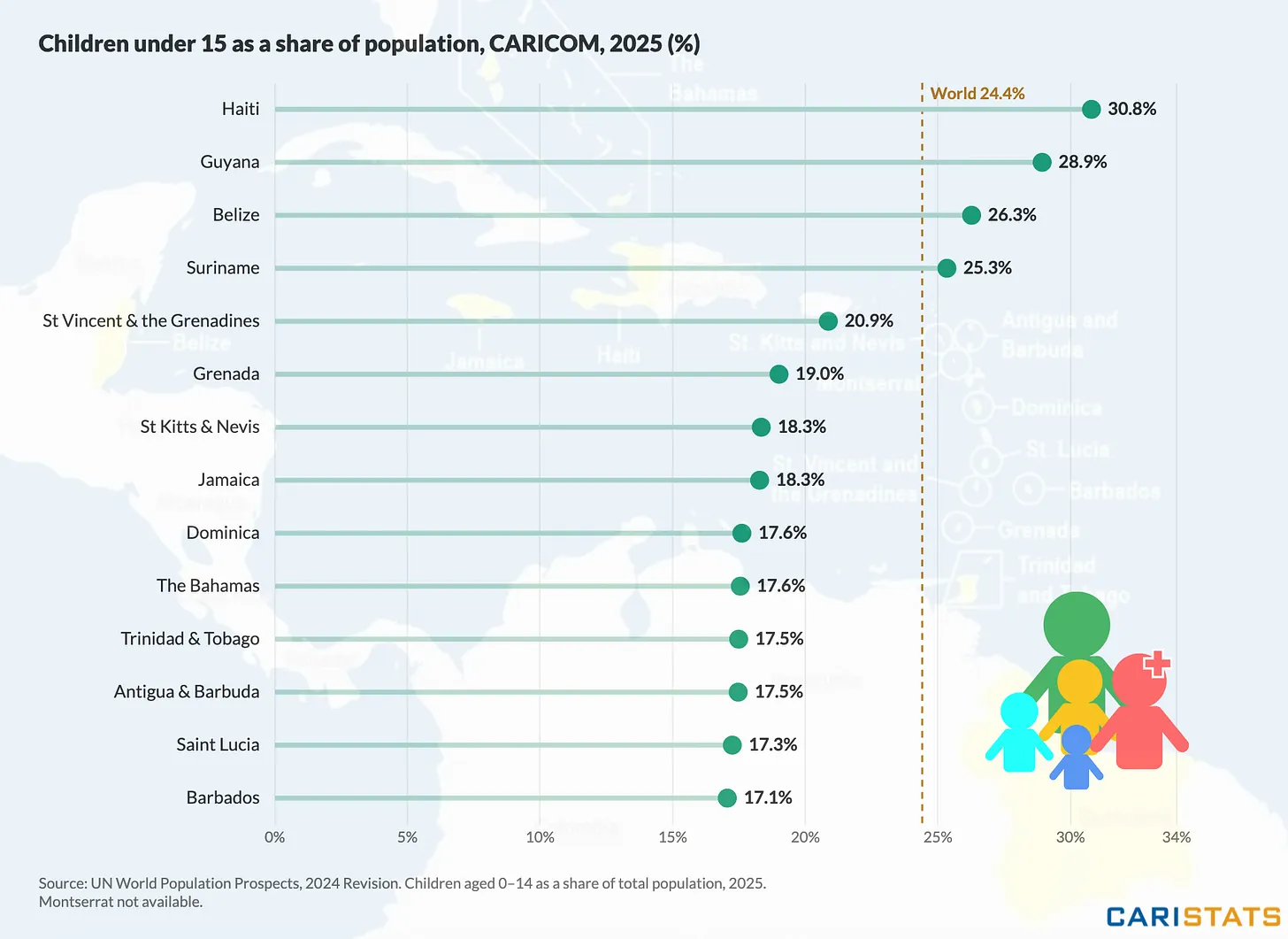
Across the Caribbean Community (CARICOM), shifting age demographics are increasingly dividing member states into two distinct groups, each facing fundamentally different economic challenges and opportunities in the coming decades, new demographic data from the 2024 Revision of the UN World Population Prospects shows. A country’s age distribution acts as a quiet but powerful predictor of its economic trajectory: it shapes whether a nation can expect a growing, expanding workforce to drive growth or a rising share of dependent populations that will strain public resources, and this divide is becoming far more pronounced across CARICOM’s 15 member states.
By 2025, the youngest CARICOM nations will retain a large youth share of their total population. Haiti will see children under 15 make up 30.8% of its total population, while neighboring Guyana will hit 28.9%. Belize and Suriname fall just behind this group, with under-15 shares landing in the mid-20% range. For these four nations, a large existing youth cohort is steadily transitioning into working age over the next decade, creating a potential demographic dividend if policy frameworks can support their integration into the economy.
At the opposite end of the spectrum, nine CARICOM members have under-15 population shares hovering between 17% and 19%, a profile that matches the age structures of much more developed, aging economies like the United Kingdom and the United States. This group includes major Caribbean economies such as Barbados, Trinidad and Tobago, and Saint Lucia. Saint Vincent and the Grenadines sits as a clear middle case, with an under-15 share of 20.9% that places it between the young and aging blocs. Montserrat demographic data was not included in the analysis.
The policy and economic implications of this divide are sharp and immediate. For member states where children make up 25% or more of the total population, the core policy priority over the next decade will be expanding access to high-quality education and building enough formal job capacity to absorb the large incoming wave of working-age people. If these investments are made successfully, these nations can unlock strong growth from their growing population.
For the aging group of CARICOM members, the trajectory plays out very differently. Declining youth shares will first translate to falling school enrollment numbers, followed a decade later by a much smaller cohort of new workers entering the workforce. For these aging economies, traditional growth driven by a expanding labor force is no longer a viable path. Instead, long-term sustainable growth will depend entirely on three key adjustments: raising worker productivity, scaling up automation to offset labor shortages, and implementing targeted immigration policies to refill shrinking workforces.