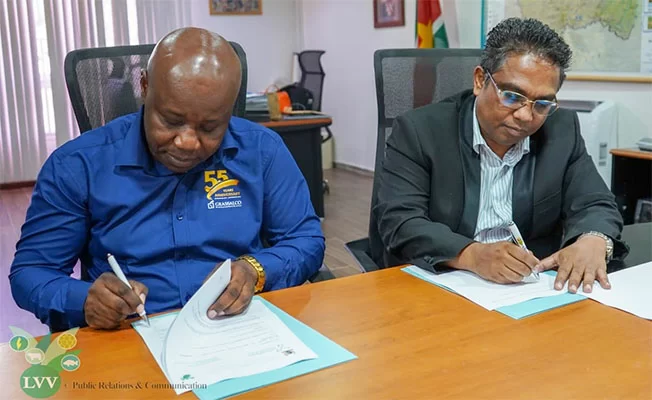
A new strategic three-year partnership has been struck between Suriname’s Ministry of Agriculture, Livestock and Fisheries (LVV) and Invitroplants Grassalco N.V., aimed at scaling up national agricultural production and strengthening the sector’s long-term competitiveness. The collaboration, formalized via a signing ceremony attended by LVV Minister Mike Noersalim, acting Invitroplants Grassalco director Iwan Winson, Grassalco president-director Johan Seymor and relevant staff members, sets out multiple core priorities to transform Suriname’s agricultural landscape, with an option for extension following a mid-term performance review.
Central to the partnership is expanding access to consistently high-quality planting material across the country. Invitroplants Grassalco brings existing advanced laboratory capacity, specialized technical expertise and established operational infrastructure to the table, enabling large-scale local production of standardized, quality planting material that was previously less accessible for Surinamese producers. The collaboration also targets support for medium-sized agricultural operations, with tailored programming for each of Suriname’s districts designed to help these businesses transition to larger-scale, market-focused production models. Joint project development and investment proposal drafting will be a core ongoing activity to deliver on this goal.
Another key pillar of the agreement is the joint development of a national gene bank, a critical initiative for long-term agricultural conservation and innovation. The gene bank will work to preserve genetic material from both cultivated and native wild crop varieties, protecting Suriname’s unique agricultural biodiversity for future research and development.
The partnership also includes a regional trade focus, with commitments to identify and resolve logistical bottlenecks that currently hinder regional agricultural trade and export growth. A specific highlighted priority is improving trade connectivity between Suriname and Barbados, to unlock new market opportunities for Surinamese agricultural producers.
Ultimately, both parties aim to build a more diversified, competitive agricultural sector through this collaboration. Beyond just increasing total production volume, the partnership is structured to create the foundational conditions for Suriname’s agriculture industry to better meet the needs of local and regional markets over the long term.