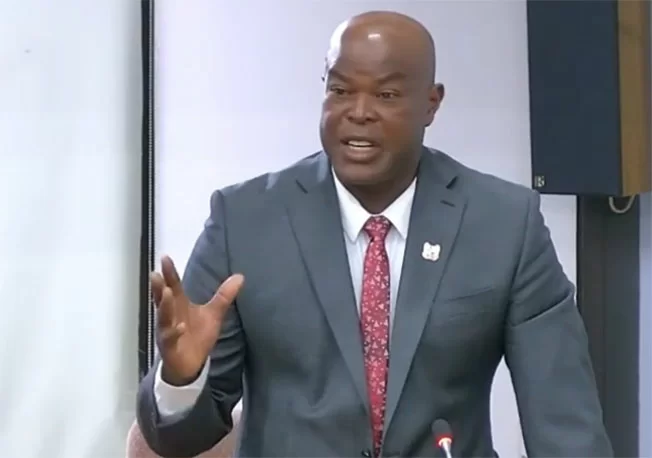
On Monday, Suriname’s National Assembly became the stage for a sharp political confrontation, as Ronnie Brunswijk, leader of the ABOP party faction, raised heated criticism over what he claims is a sustained campaign to pressure and criminalize senior officials tied to his political bloc. The trigger for Brunswijk’s public outcry was an ongoing leadership dispute at the Telecommunicatie Autoriteit Suriname (TAS), Suriname’s national telecommunications regulator, where the body’s supervisory board of commissioners recently tabled a formal proposal to suspend TAS Director Wendy Jap-A-Joe. That proposal has since been rejected by Suriname’s Council of Ministers, which refused to advance the disciplinary action.
Brunswijk used the debate to call on the national government to issue a full, transparent explanation for the developments unfolding at TAS. He told the assembly that an intractable personal and professional conflict between Emanuel Scheek, TAS’s president-commissioner, and Jap-A-Joe has driven the push for suspension, arguing that the director is facing unsubstantiated allegations with no credible evidence to back the claims of wrongdoing.
Beyond the immediate TAS dispute, Brunswijk framed the incident as part of a broader systemic pattern targeting ABOP across Suriname’s state-owned enterprises. He claimed that similar conflicts between executive leadership and supervisory boards have emerged at multiple other state agencies, all following the same script: every director appointed by ABOP is being publicly targeted and smeared as a criminal, without due process.
The ABOP leader made clear that the ongoing situation has taken a personal toll, telling lawmakers bluntly that he is growing tired of the repeated targeting. He added that he himself is facing mounting external pressure over the issue, intensifying his call for the government to clarify the full facts of the case to the public and the assembly.
Responding to Brunswijk’s remarks on the floor of the National Assembly was Vice President Gregory Rusland, who confirmed the basic details of the dispute: the supervisory board did formally submit a request to suspend the TAS director, but the Council of Ministers ultimately declined to approve the measure. Rusland pushed back on the framing of the situation as a political witch hunt, emphasizing that regular internal oversight is a necessary and legitimate function for all public sector institutions and state bodies. “Oversight is not an act of hostility,” Rusland stated, noting that routine accountability checks should be allowed to proceed at any time. However, he added that based on the information available to the Council of Ministers when the proposal was reviewed, approving an immediate suspension of the director was deemed unreasonable. For the time being, Rusland concluded, that rejection remains the final standing position of the Suriname government.