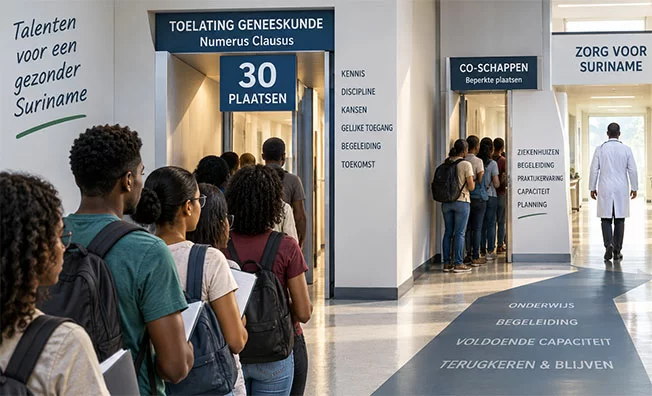
For years, public debate around the medical degree program at Suriname’s Anton de Kom University has centered on one restrictive number: 30. Only 30 aspiring physicians are granted admission each academic year, despite overwhelming demand from qualified applicants. New data from a recent independent study of the program reveals just how stark this gap is: in the 2025-2026 intake cycle alone, 117 candidates applied, and just 30 secured a spot. Between the 2020-2021 and 2025-2026 cycles, the university received 873 total applications but offered admission to only 301, meaning on average just one out of every three applicants can begin their medical training at the domestic institution.
This chronic under-admission has sparked widespread frustration among young Surinamese. For applicants whose families can afford the high cost of studying abroad, the only option is to pursue their degree outside of Suriname, with many heading to Cuba, Serbia, the Netherlands and other nations to train. But the recent study makes clear that the crisis facing Suriname’s medical education sector extends far beyond limited intake slots—it is rooted in deep, unaddressed systemic failures that require structural reform.
A key conceptual clarification at the heart of the study is the critical distinction between two core policy metrics that are rarely aligned in current practice: Numerus Fixus and Numerus Clausus. Numerus Fixus refers to the total number of new physicians that Suriname’s healthcare system actually needs each year to meet public demand. Numerus Clausus, by contrast, sets the maximum number of students the university can reasonably train given its current resources: available teaching staff, classroom space, laboratory facilities, practical training opportunities and clinical placement slots. The study’s core recommendation, shared in a formal presentation to Suriname’s president, is that these two figures must be reviewed and aligned on an annual basis—a step that current governance structures have consistently failed to implement.
Intake caps at the program have shifted dramatically in recent years. Through the 2023-2024 academic cycle, the university admitted roughly 60 students annually, before cutting the number nearly in half to the current 30-student cap. Counterintuitively, the study found that training a cohort of 30 students actually results in higher per-graduate costs than training a regulated cohort of 60. For each graduating general practitioner, the program’s mid-range cost estimate sits at roughly 7.7 million Surinamese dollars per graduate with a 30-student intake. That cost drops to just 3.9 million Surinamese dollars per graduate when intake is set to 60. This disparity stems from the large share of fixed operating costs that remain consistent regardless of cohort size, meaning underutilized capacity drives up per-student expenses unnecessarily.
However, the study emphasizes that this data does not mean the university can immediately raise intake back to 60 students. A second major bottleneck stands in the way: a crippling shortage of available clerkship placement slots, which form a non-negotiable part of clinical medical training. All medical students must complete hands-on practical training in hospitals and other healthcare facilities under the direct supervision of practicing physicians. Currently, the country only has between 30 and 40 active clerkship slots available, but 79 clinical clerks are already training, with another 24 candidates waiting for an opening. A large additional cohort of students is approaching the clinical phase of their degree, creating a growing backlog that will only worsen without intervention. The presentation to the president explicitly warns that expanding intake without first expanding clerkship capacity will only increase waiting times for students and put the overall quality of medical training at serious risk.
This creates a paradoxical, broken system for medical training in Suriname. At the front end, thousands of talented young applicants are locked out of the program entirely due to limited training capacity. At the back end, admitted students face years of costly delays simply because there are not enough practical placement slots to let them progress. Beyond capacity issues, the study also highlights deep equity gaps that prevent many groups of young Surinamese from accessing the medical program in the first place.
Crucially, the study explicitly rejects calls for ethnic quotas or lowered academic standards as a solution to these inequities. Instead, it traces gaps in access back to systemic barriers that emerge long before students apply to university. Disparities in access stem from uneven quality of secondary education, limited access to required pre-medical course tracks, gaps in access to science coursework, language barriers, inadequate academic guidance, unequal financial resources, and barriers related to transportation and housing that disproportionately impact students outside urban centers. Instead of lowering standards or implementing quotas, researchers recommend early intervention: identifying where talented students are being blocked from the pathway to medical school starting in secondary education, and removing those barriers proactively.
This emphasis on early intervention is well-founded, the study notes: government cannot wait to address access gaps until a student submits their university application. Targeted guidance and preparation must begin in secondary school, so all students understand what coursework is required to qualify for medical training, and secondary schools across all districts are able to offer the rigorous science education that is a prerequisite for admission. Without targeted policy intervention, entire groups of students are effectively excluded from the program not for lack of talent, but for lack of opportunity along the pathway.
The study also calls for stronger tracking and support for students after they are admitted to the program. Institutions need to systematically identify which students are facing delays, which are dropping out, which face unaddressed financial barriers, and which are stuck waiting for clerkship placements. Retaining students through to graduation, researchers argue, is just as important as fair admissions policy.
Ultimately, the study argues that public debate has wrongly fixated on the single question of whether intake should be 30 or 60 students. The real solution requires a full systemic overhaul: first, the Surinamese government must clearly define how many physicians the country actually needs, and where those practitioners are most needed to address gaps in care. Only then can the country build out sufficient training capacity, expand clerkship placements, implement early guidance starting in secondary school, and put support systems in place to help admitted students complete their training and join the domestic workforce. As the report concludes: when talented students are locked out of the program, lose their place along the pathway, or face years of delay due to insufficient capacity, the failure is not with the students—it is with a system that has not kept up with the country’s needs.