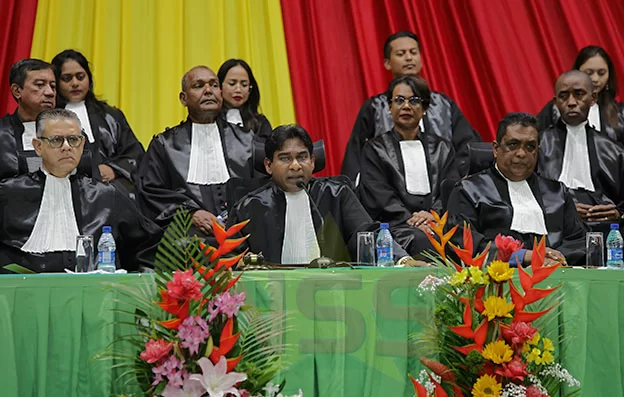
Paramaribo, 24 October – The head of Suriname’s Court of Justice, President Iwan Rasoelbaks, has laid out sweeping new operational standards for the nation’s judiciary, as he formally inducted 15 new substitute judge members during an official ceremony held this past Friday. Delivering a direct, firm address to the newly appointed judicial officers, Rasoelbaks issued a non-negotiable “comply or explain” directive: any judge who sets a scheduled verdict date must ensure the full finalized ruling is issued on that exact timeline, with mandatory, clear explanations provided to all involved parties if any delay occurs. Failure to adhere to this rule, he warned, will almost certainly lead to formal public complaints and recusal motions filed against the presiding judge.
Rasoelbaks emphasized that two longstanding systemic flaws – persistent breakdowns in communication between judicial staff and parties to legal proceedings, as well as unaccountable, unexplained delays in releasing finalized verdicts – have steadily eroded public trust in the nation’s justice system for years. “Unwarranted, avoidable backlogs will no longer be accepted as a normal, inherent feature of our judicial organization,” he stated in a stern address during the swearing-in event, which was also attended by Suriname’s Minister of Justice and Security Harish Monorath, who personally extended official congratulations to all 15 newly appointed judges.
To ease the unsustainable workload that has driven widespread case backlogs, the Court of Justice is rolling out a multi-pronged capacity expansion strategy. The planned reforms include establishing multi-judge first-instance chambers for both civil and criminal cases, creating permanent dedicated appellate judge roles, launching a specialized tax court division, and rolling out decentralized judicial service points to reduce caseload pressure on central court facilities. Rasoelbaks noted that full implementation of these reforms will proceed gradually, pending review and formal approval of the required legislative amendments by the national parliament. The court also plans to expand access to court-supported mediation and formal arbitration services to divert lower-stakes disputes away from the formal judicial case queue, further reducing judge workloads.
Beyond speed of rulings, Rasoelbaks outlined that the court’s 2026–2030 strategic policy framework is anchored to two core foundational goals: delivering timely, efficient justice, and issuing expert, well-reasoned decisions communicated in clear, accessible language for all parties. He instructed new judges to prioritize thorough pre-hearing case preparation, full respectful hearings for all involved parties, timely responses to all formal legal correspondence, and fully transparent, clearly articulated justifications for every ruling they issue.
The court president also highlighted growing external threats to the rule of law and national democratic stability, ranging from rising global geopolitical tensions, emerging new categories of transnational crime, and increasing targeting of judicial infrastructure by cyberattacks. He paid special attention to the harms posed by unregulated social media use, noting that anonymous bad-faith actors hiding behind pseudonymous accounts routinely launch coordinated reputational attacks against judges, who are bound by judicial ethics rules and cannot publicly defend themselves against false claims. Under these unprecedented pressures, he stressed, judges must not only uphold strict standards of independence and personal integrity, but also demonstrate consistent prudence, emotional resilience, and impartiality at all times. Rasoelbaks closed his address by noting that public scrutiny of judicial decisions is a legitimate, expected feature of a functioning democracy, as losing parties to cases will almost never express full satisfaction with rulings – making transparent communication and respectful engagement with all process parties the single most critical tool for preserving and rebuilding public trust in the justice system.