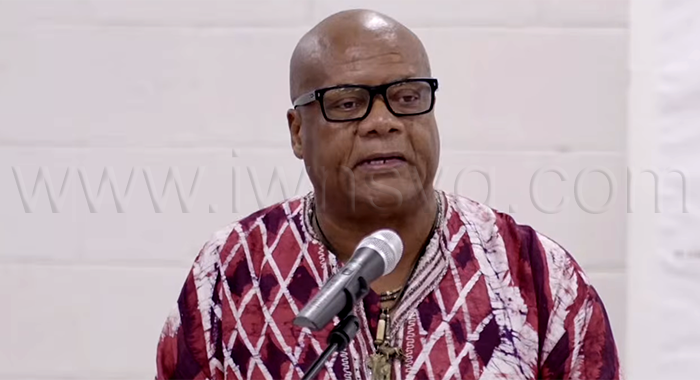
Kingstown — At the 2026 Oscar Allen Memorial Emancipation Lecture held in Kingstown, prominent Vincentian educator and climate resilience specialist Andrew Simmons has delivered a urgent call for a radical reimagining of Caribbean education, framing lifelong learning as a core tool to advance the region’s unfinished journey toward full emancipation from structural colonial legacies.
Simmons, who holds a doctorate in climate change and sustainable development, centered his address around the theme “We want to be wise: Education, identity, and liberation in a post-colonial Caribbean,” tying his arguments closely to the lifelong work of Oscar Allen — the late beloved community organizer, lay theologian, and writer whose legacy the annual lecture honors. Allen, Simmons explained, chose education, grassroots organizing, literature, and faith as his tools for collective change, rejecting the pursuit of personal wealth to dedicate his life to empowering poor and marginalized communities across St. Vincent and the Grenadines (SVG) and the broader Caribbean. Echoing the perspective of legendary musician and activist Bob Marley, Simmons noted Allen’s commitment to revolutionary change, summarized by the lyric: “It takes a revolution to make a solution.”
Opening his analysis with a pair of timeless metaphors — that the longest river begins with a single drop, and a great fire starts with one small spark — Simmons emphasized that individual acts of service and organizing, like Allen’s, can ripple outward to create transformative change far beyond what one person could achieve alone.
Digging into the core theme of his lecture, Simmons broke his argument into three interconnected pillars: wisdom, education, and liberation, all rooted in the unique lived realities of Caribbean societies. Drawing on sacred texts to ground his definition of wisdom, he argued that wisdom is not merely the accumulation of raw knowledge, but a deliberate way of living. This way of being includes practicing radical empathy, acknowledging gaps in one’s own understanding, prioritizing listening over speaking, learning from missteps, reflecting before acting, and relying on empirical evidence rather than unexamined assumptions. Simmons added that Allen perfectly embodied this approach: while deeply knowledgeable, he always centered one critical question: is this knowledge useful to the people it is meant to serve? “Knowledge in itself doesn’t make much sense unless people can use that for their own development,” Simmons told the audience.
Turning to education, Simmons pushed back against the dominant model that frames learning as limited to formal schooling or job certification, insisting that education must be a lifelong, inclusive journey “from the womb to the tomb.” At its best, he argued, liberatory education cultivates critical knowledge, practical skills, shared values, and sound judgment; it empowers people to ask better questions, understand how systems of power operate, act with greater autonomy, and equip local communities to analyze their own challenges and lead collective action to address them. Citing the work of iconic Brazilian liberatory educator Paulo Freire, Simmons aligned Allen’s grassroots work with the model of education for liberation, which positions learners as active agents and partners in knowledge-building, rather than empty vessels to be filled with pre-determined content.
Simmons stressed that this fully realized model of liberatory education has not yet been implemented in SVG, calling for a comprehensive re-evaluation of the region’s education systems through the lenses of climate change and sustainable development. Education, he noted, is both a fundamental human right and a critical tool for building community and regional climate resilience. It is essential for helping Caribbean populations understand climate risks, adapt to climate shocks, leverage emerging sustainable technologies, and meaningfully participate in decisions that shape their land, livelihoods, health, collective identity, and citizenship.
On the topic of Caribbean identity, Simmons described the region’s identity as a layered, dynamic tapestry shaped by Indigenous histories, African survival and creative innovation, European colonial rule, Asian migration, centuries of resistance, diverse religious traditions, unique cultural and linguistic practices, labor movements, and ongoing intra-regional and diaspora community movement. He warned against framing this diversity as a barrier to development, emphasizing instead that “We should not see our diversity as a barrier to development; it is part of our heritage and one of our strengths.” The critical question, he argued, is whether regional institutions create space for all people to participate fully as citizens, while honoring their diverse identities and backgrounds. He specifically called for the development of a collaborative framework to formally integrate the more than 800,000-strong Garifuna diaspora across Latin America and the globe into the citizenship and development agenda of SVG.
In his discussion of liberation, Simmons drew a clear distinction between the two concepts of freedom and liberation: freedom is the end condition that societies work to achieve and sustain, while liberation is the ongoing, active process of confronting and dismantling unjust structural barriers. He emphasized that while Caribbean nations have achieved formal political independence, this step has not automatically resolved deep-seated challenges inherited from colonial rule, including economic vulnerability, systemic inequality, external dependence on wealthy global powers, weak institutional capacity, and entrenched colonial ways of thinking.
Small Caribbean states, Simmons noted, still operate within global systems they did not create, systems shaped by unsustainable debt burdens, unequal trade dependence, and ongoing geopolitical pressure from large global powers. He recounted his firsthand experience as part of a Caribbean delegation to 2015 global climate negotiations, where he witnessed wealthy nations dividing Caribbean delegates with targeted funding offers, undermining regional unity at a critical moment for global climate action.
Simmons called for open reflection on the quality of regional governance within the Caribbean Community (CARICOM), arguing that external pressures do not excuse domestic policy failures. “Outside pressures cannot excuse poor decisions at home… When our own development choices increase vulnerability, damage ecosystems, or exclude communities, our governments and institutions must also be held accountable,” he said. The path forward, he argued, is not isolation from global affairs, but “informed, coordinated, and principled engagement” grounded in the unique values and history of Caribbean civilization, paired with honest accountability for domestic shortcomings.
Closing with a reflection on climate vulnerability, Simmons cited recent extreme weather events like Hurricane Beryl, which can erase decades of hard-won development progress in just a few hours. He emphasized that the core challenge facing the region is proactively building resilience at the household and community level — a goal that a reimagined, liberatory, lifelong education system is uniquely positioned to advance.