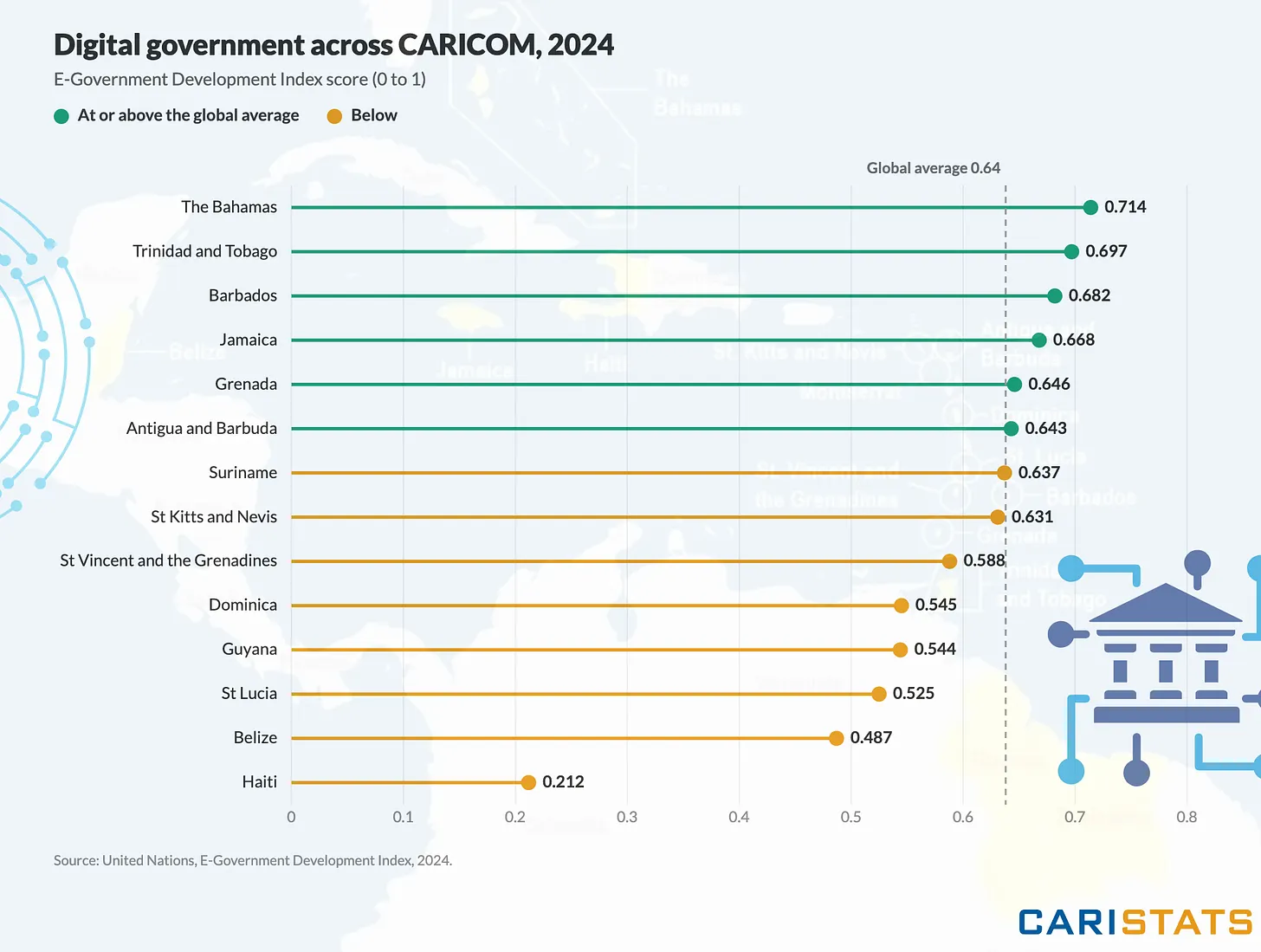
The United Nations’ E-Government Development Index, a leading global benchmark for digital public service delivery, assesses how easily citizens and businesses can access government offerings online – from business registration and tax filing to official document requests – instead of waiting in in-person lines at government offices. Rankings are calculated on a 0 to 1 scale, based on three core pillars: the scope and quality of online public services, the robustness of national telecommunications infrastructure, and the level of digital human capital across the population. The 2024 iteration of the survey reveals that the Caribbean Community (CARICOM) has posted a generally solid performance in digital public service advancement. Of the 14 CARICOM member states evaluated in the index, six managed to score above the 2024 global average score of 0.64. The Bahamas leads the regional pack with a score of 0.71, with Trinidad and Tobago, Barbados, and Jamaica recording scores just slightly lower to round out the region’s top four performers. The majority of the bloc’s remaining member states fall within a tight mid-tier ranking range, reflecting relatively consistent baseline digital capacity across most of the region. Haiti stands out as a notable outlier, posting the region’s lowest score at just 0.21, far behind the rest of the CARICOM bloc. Despite the broad progress across most of the region, the most critical takeaway from the 2024 data is the existing regional performance ceiling. The UN categorizes nations with scores above 0.75 into its “Very High” e-government development tier, the group that includes the world’s leading digital public service innovators. As the 2024 data makes clear, no CARICOM member state has managed to cross this threshold to join the ranks of global digital leaders. While the region has successfully built widespread basic digital public service capacity across most of its member states, it has not yet produced a single nation that can compete as a true global front-runner in e-government development.