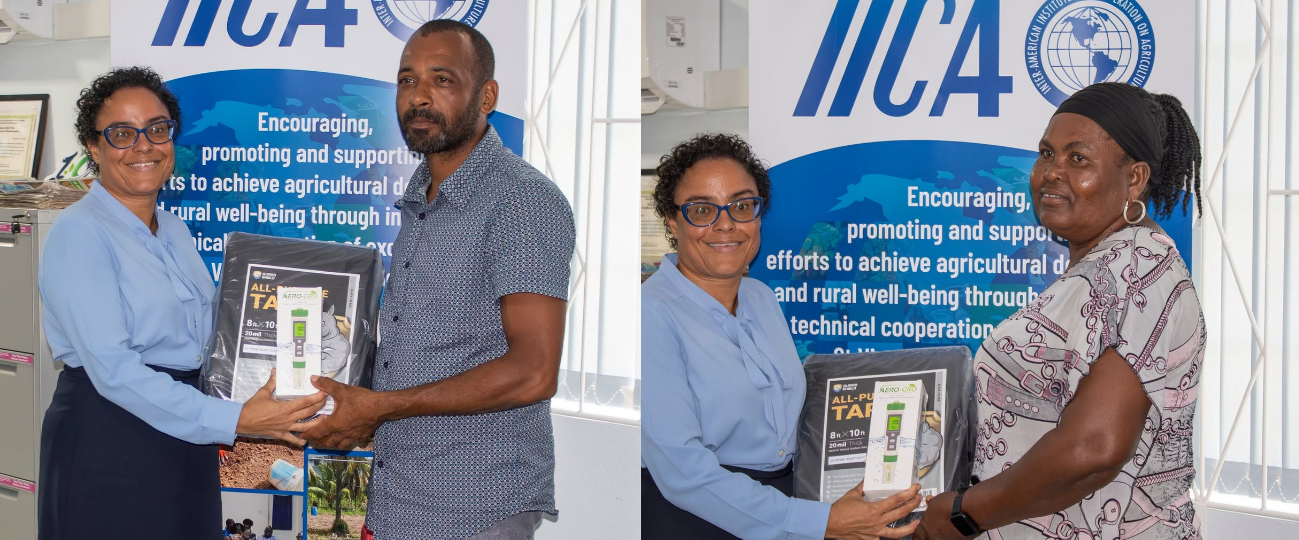
Two months after the conclusion of a landmark regional climate adaptation project for Caribbean agriculture, two smallholder farmers in St. Vincent and the Grenadines have received specialized agricultural tool kits to extend the impact of the program’s work building climate-resilient farming systems. The handover marks a final phase of support for on-the-ground testing under the ADOPT Caribbean – Soil Health for Climate-Resilient Agriculture Project, an initiative focused on transforming regional farming practices through improved soil management.
The project, which ran across three Caribbean nations – Guyana, Jamaica, and St. Vincent and the Grenadines – set out to address the growing vulnerability of regional agriculture to climate volatility by scaling climate-smart farming techniques. Through hands-on technical training, public field demonstrations, and cross-institutional partnerships, the program worked to expand farmer knowledge across critical areas including evidence-based soil health management, advanced agronomy, efficient irrigation systems, and a suite of other low-carbon, adaptive farming practices.
In St. Vincent and the Grenadines, the two beneficiary farmers, Hazzard Joseph and Vito Connell, partnered with the Caribbean Agricultural Research and Development Institute (CARDI) to run on-farm trials of sustainable soil health techniques, including compost application and organic mulching to improve soil fertility and water retention. The recently delivered tool kits equip the farmers to continue and expand their work, with a comprehensive set of supplies ranging from crop protection inputs (fungicides and insecticides) and vegetable seeds to precision agricultural monitoring tools: rain gauges, tensiometers, pH meters, water meters, hand lenses, sticky traps, and thermometers. The handover also included large equipment: a gasoline-powered chaff cutter and silage machine to support forage management, alongside protective tarpaulins for crop and equipment storage.
The handover ceremony, held at the local office of the Inter-American Institute for Cooperation on Agriculture (IICA), was carried out by IICA’s St. Vincent and the Grenadines delegation in coordination with the country’s Ministry of Agriculture, Forestry and Rural Transformation. IICA Representative Gregg Rawlins explained that the ongoing support forms part of a holistic, integrated strategy to boost climate resilience across every stage of agricultural production, from initial land preparation and soil restoration to water management, crop monitoring, pest and disease control, forage cultivation, and final crop output.
For the participating farmers, the project has already delivered transformative changes to their approach to farming. Joseph, who has been part of the program since its launch, noted that the training and resources have made her a more skilled and confident producer. “I can say that I am a better farmer today than I was when the project started,” she said. “I am grateful for the equipment and the other items. I am willing and will continue doing farming so that I can help with the food security of my country, so that we can make things better for all farmers.”
Connell echoed that sentiment, adding that the initiative reshaped his entire outlook on agricultural sustainability and profitability. “I am grateful to be part of this project. It has changed my perspective of agriculture,” he said. “Agriculture is very expensive, we cannot be spending money and not getting any returns, we have to chart the path for those behind, for productivity, food security and economic efficiency.”
Acting Chief Agricultural Officer Marcus Richards framed the handover as more than just a transfer of equipment – it is a long-term investment in the capacity of Caribbean farmers to withstand climate shocks, boost output, and strengthen national food security. The ADOPT Caribbean project is funded by the Government of New Zealand through its Climate Smart Agriculture Initiative for Latin America and the Caribbean (NZCSA-LAC), as part of New Zealand’s contribution to the Global Research Alliance on Agricultural Greenhouse Gases (GRA). The initiative is administered through the Ag Emissions Centre, with IICA leading on-the-ground implementation across participating Caribbean nations.