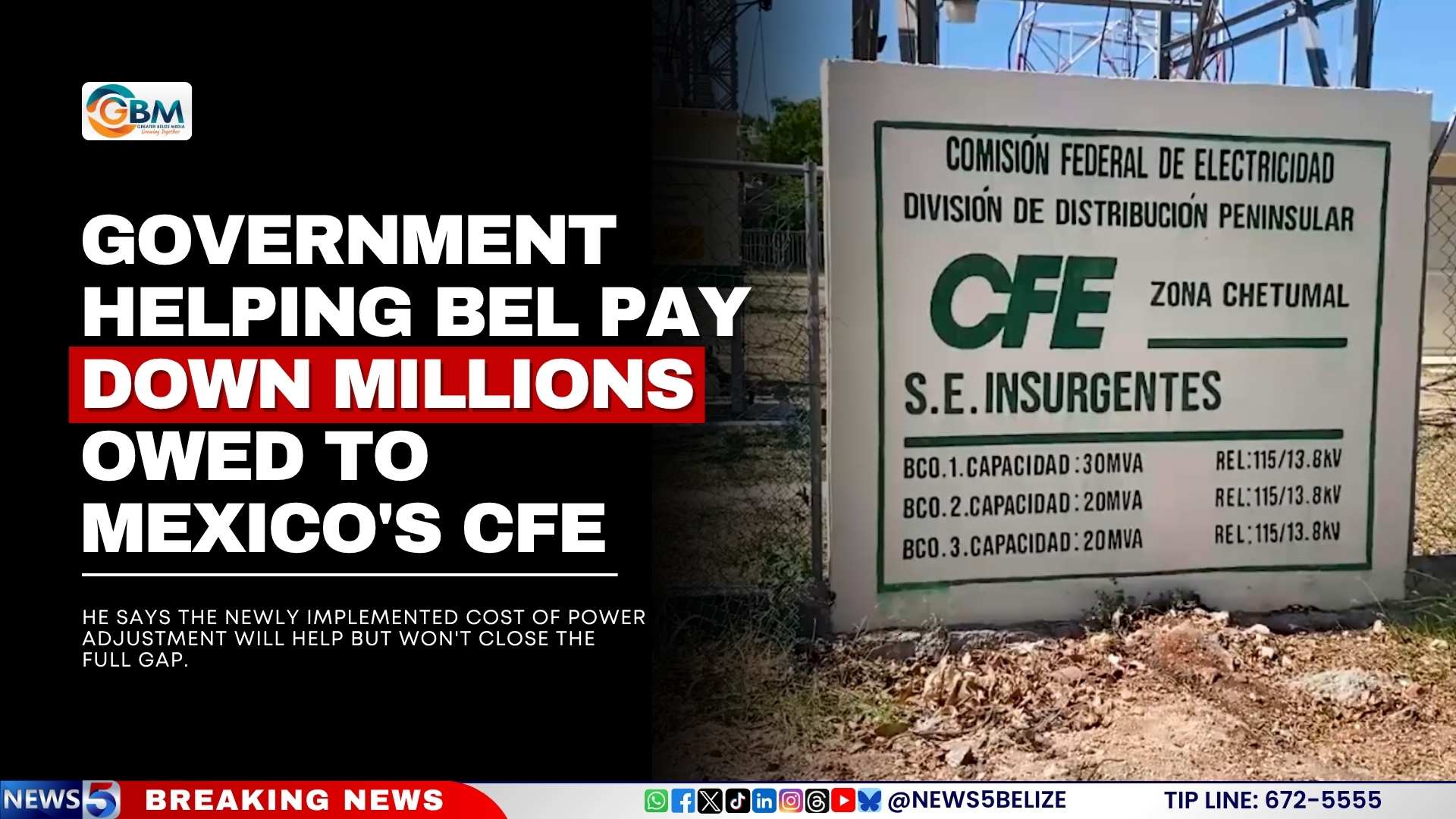
As of August 25, 2026, Belize Electricity Limited (BEL), the country’s primary power provider, is facing a pressing financial crisis, with tens of millions of dollars in unpaid debt owed to Mexico’s state-owned national energy utility Comisión Federal de Electricidad (CFE) – a gap the utility cannot close on its own, according to BEL leadership.
Lynn Young, BEL’s Executive Chairman, confirmed that the Briceño administration has intervened to help the utility meet its critical financial obligations to CFE, bringing the total outstanding debt down significantly from its peak earlier this year. “In early January, the total debt sat at roughly $55 million,” Young explained in a recent public briefing. “The last figure I reviewed put it at $30 million, around $20 million of which is currently overdue. With consistent government support, we have chipped away at the total balance steadily through 2026, and we remain in ongoing dialogue with CFE leadership about our repayment schedule.”
Young outlined that the root of the utility’s financial strain is a fundamental mismatch between the rising cost of energy generation and the rates BEL charges residential and commercial customers. Currently, the utility brings in approximately $6 million in total weekly revenue, but diesel fuel alone – a key input for power generation – costs $3 million per week. After accounting for mandatory payments to CFE, domestic hydropower provider Hydro Belize, fuel suppliers, full-time staff, and contracted vendors, all of the utility’s operating revenue is exhausted, leaving no buffer to pay down accumulated debt.
A recently implemented Cost of Power Adjustment (COPA) mechanism is designed to partially offset rising generation costs, but Young noted that the adjustment is not large enough to close the entire gap. For example, last month’s unplanned extra generation cost hit 4.5 cents per kilowatt-hour, while the COPA only adds a 1.5 cent per kWh surcharge to customer bills. This 3 cent per kWh gap left BEL with a $5 million shortfall for the month alone, requiring additional government support to cover outstanding obligations to CFE.
When questioned about the policy decisions that led Belize’s energy sector to this point, Young defended earlier choices to rely heavily on CFE for imported power, noting that current challenges were unforeseeable based on available information at the time. “No one could have predicted that CFE would face operational instability,” Young said. “It is a massive system serving an energy-rich nation, so relying on cheap, reliable power from CFE looked like a sound decision when we made it, especially given that Belize had not added new domestic generation capacity in years. We make decisions based on the information we have at the time; there’s no use rehashing past calls now. As the saying goes when playing dominoes, you have to play the hand you’re dealt. Our focus now is moving forward to fix the system.”
In addition to BEL’s immediate debt crisis, a major $77 million solar energy project designed to boost Belize’s domestic power generation capacity and reduce reliance on imported energy remains stalled three years after the Briceño administration signed a development agreement with Saudi partners in 2023. Public Utilities Minister Michel Chebat explained that the delay stems from lengthy domestic procurement requirements and strict conditions imposed by Saudi stakeholders. “Unfortunately, Saudi Arabia’s procurement approval process is far longer than ours, and they have additional mandatory conditions that we have to satisfy,” Chebat explained. “One key requirement is that Saudi engineers must lead a large portion of the project’s work, which adds layers of coordination that slow progress. That said, I can confirm that our government is prioritizing this project and pushing to move it forward as quickly as possible.”
Chebat also highlighted a separate new initiative to lower long-term power costs for Belizeans: the government recently signed a $125 million compact with the Millennium Cooperation, earmarked specifically for energy cost reduction programs. “All of these ongoing investments are aligned with our core goal of bringing down power costs across the country,” Chebat added. “Of course we want these improvements in place today, and we agree they should have been delivered by now – but we are working steadily to get them across the finish line.”
In a separate update, Young also addressed growing customer complaints about high power bills, confirming that rising seasonal temperatures driving increased energy use – not the rollout of new smart meters – is the primary cause of higher monthly statements.