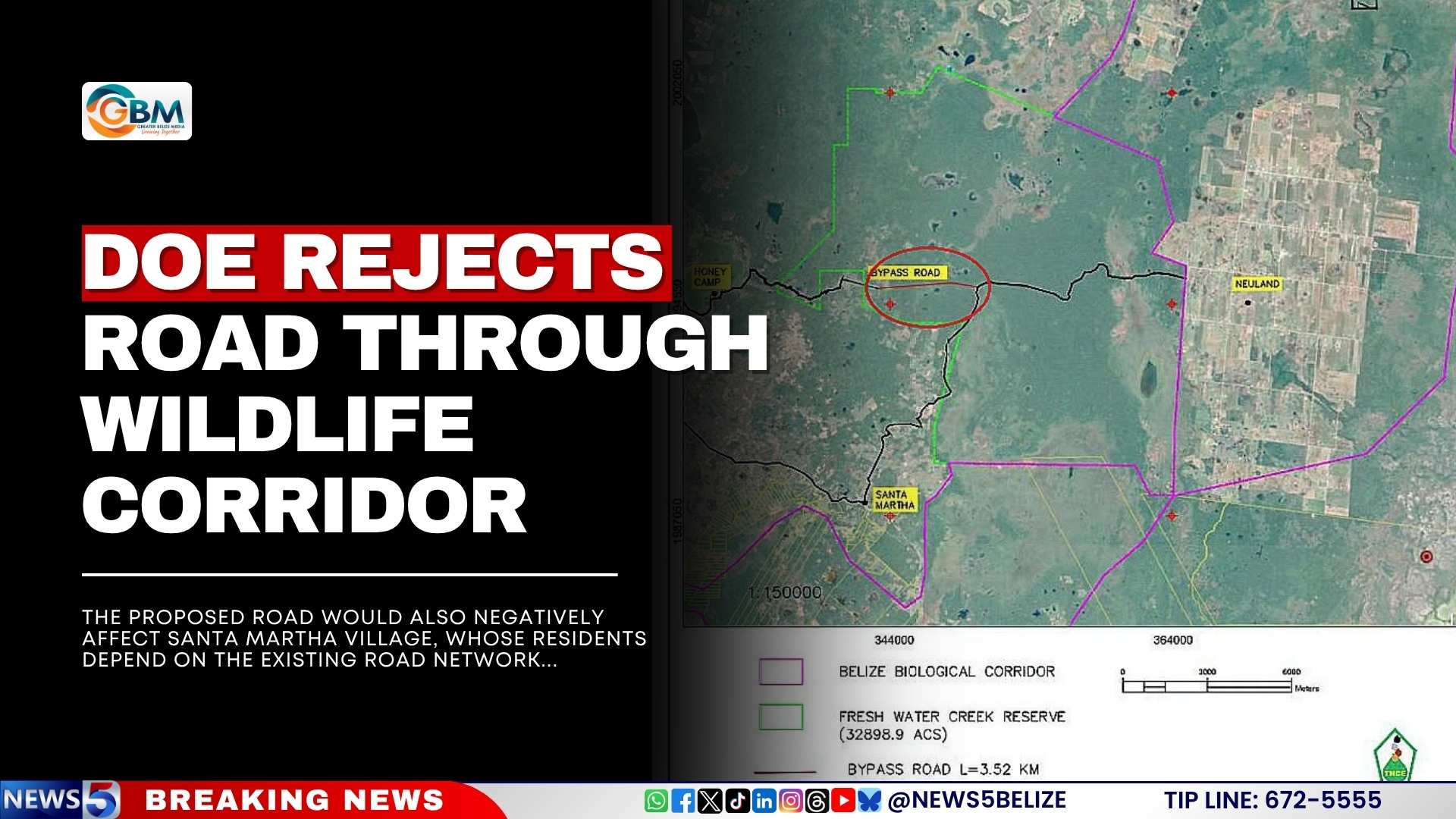
In a landmark decision released on August 25, 2026, Belize’s Department of the Environment (DOE) has formally rejected a proposal to construct a 2.2-mile paved road cutting through the ecologically critical Northeastern Biological Corridor, a protected green space spanning the country’s Corozal and Orange Walk Districts. The project, led by local developer Honey Hub Limited, sought to connect the Honey Camp area to the existing Neuland community road, promising a five-mile reduction in local travel times for residents in the region.
The rejection came after a rigorous July 30 assessment conducted by the National Environmental Appraisal Committee (NEAC), which reviewed an Environmental Impact Assessment (EIA) prepared by Tunich-Nah Consultants and Engineering on behalf of the developer. After a comprehensive evaluation, the NEAC advanced a formal recommendation to the DOE to deny environmental clearance for the project, a position the department ultimately adopted.
Central to the committee’s opposition was the protected legal status of the Northeastern Biological Corridor, a key habitat linkage designed to connect fragmented forest ecosystems and support safe migration for native Belizean wildlife. The proposed construction would have required clearing approximately 13 acres of old-growth forest, a change that NEAC experts warned would split apart critical wildlife habitat, dramatically increasing the likelihood of wildlife-vehicle collisions and raising the long-term risk of injury or death for vulnerable species that rely on the corridor for movement.
Beyond direct ecological harm, the assessment also identified major gaps in the developer’s EIA documentation. The report failed to verify that sufficient, environmentally compliant fill material was already secured for the road construction, leading experts to warn that additional unplanned land clearing would likely be required to source extra materials if the project moved forward. This would expand the project’s ecological footprint beyond what the developer had originally disclosed.
The proposed route also raised significant concerns for nearby Santa Martha Village, whose residents depend on the region’s existing road network to carry out daily transportation and support their livelihood activities. While the project proponents highlighted the five-mile reduction in travel distance as a key benefit for the community, the EIA failed to provide evidence that this convenience would outweigh the tangible social and ecological harms the construction would bring to local residents and the protected ecosystem.
Following its final decision, the DOE has formally notified Honey Hub Limited of the rejection. Department officials have encouraged the developer to revise their plans and explore an alternative route for the proposed connection that avoids the boundaries of the protected biological corridor, balancing infrastructure needs with the country’s commitments to environmental conservation.