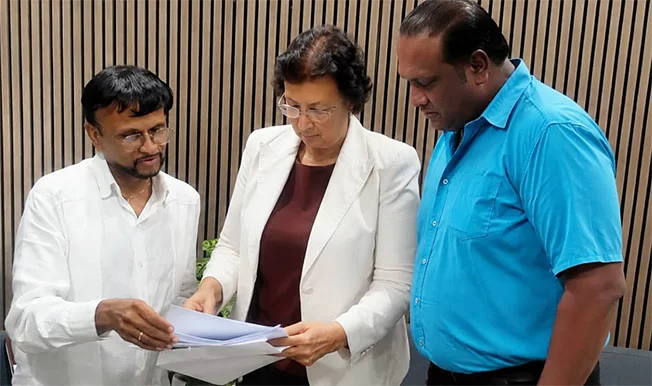
On August 25, the extra-parliamentary Surinamese political party De Nieuwe Leeuw (DNL) formally delivered three interconnected draft pieces of legislation to Suriname President Jennifer Geerlings-Simons, outlining a framework for more equitable and sustainable management of the country’s lucrative natural resource sectors. The proposals cover the establishment of a national sovereign wealth fund, mandatory local content requirements for large investment projects, and updated regulations on transfer pricing to protect national tax revenue.
DNL chair Dharmvir Mungra and vice chair Yerry Khoesial presented the full set of drafts to the president during an official meeting. While the sovereign wealth fund proposal is new, the two remaining drafts on local content and transfer pricing had previously been shared with relevant cabinet ministers and the speaker of the National Assembly, Suriname’s legislative body.
The cornerstone of DNL’s policy package is the proposal for a Sovereign Wealth Fund, which would create a binding legal framework for managing revenue generated from Suriname’s core natural resource exports, including oil, gas, and gold. Under the proposal, a portion of annual resource revenue would be professionally managed and invested as a long-term national asset, designed to deliver benefits to both current and future generations of Surinamese. DNL argues that the fund would also strengthen the country’s overall financial stability by reducing the economy’s exposure to volatile global commodity price swings, a longstanding source of economic instability for resource-dependent developing nations like Suriname.
The second proposal, focused on mandatory local content, seeks to expand opportunities for domestic Surinamese businesses and workers in large-scale resource and infrastructure projects led by foreign investors. The draft would require foreign firms to prioritize engagement with local suppliers, hire domestic workers, and invest in knowledge transfer to local partners. DNL says the policy will boost national employment rates, accelerate the spread of technical expertise across the domestic economy, and grow the footprint of local business activity in high-value sectors.
The third proposal targets transfer pricing practices among multinational corporations operating in Suriname. Transfer pricing, the mechanism that sets prices for transactions between affiliated entities of a global company, is often used to shift profits generated in one country to low-tax jurisdictions to reduce overall tax liability. DNL’s draft legislation aims to close existing regulatory gaps to prevent profit shifting out of Suriname, ensuring that profits generated within the country are taxed domestically. The party estimates that stronger rules on transfer pricing will protect and expand Suriname’s national tax base, increasing government revenue for public investment.
DNL chair Mungra emphasized that the three proposals are designed to work as a cohesive policy package, not standalone initiatives. The overarching goal of the draft laws, he explained, is to align Suriname’s natural resource governance with the country’s long-term sustainable economic and social development goals. Mungra also noted that the regulatory framework is not limited to the country’s fast-growing emerging oil and gas sector: both the local content and transfer pricing rules would apply to all sectors with large domestic and foreign corporate operations, including mining, agriculture, and infrastructure.
According to DNL, President Geerlings-Simons expressed public appreciation for the party’s proactive policy initiative. Even as an extra-parliamentary party without representation in the National Assembly, DNL notes that it developed the three proposals to contribute to the ongoing national debate about responsible resource management and inclusive economic growth in Suriname.