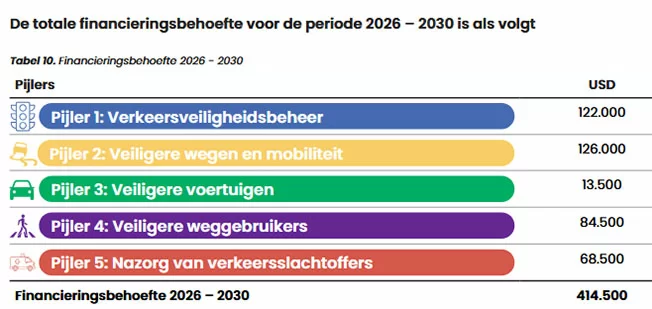
Suriname has laid out an ambitious five-year strategic plan to cut road traffic fatalities and severe injuries in half by 2030, compared to 2021 levels, with an initial indicative funding estimate of at least $414,500 for core coordination activities. However, government planners have cautioned that the total cost of full implementation will be significantly higher, as major expense categories such as large-scale infrastructure upgrades, police enforcement operations, staff salaries, and direct victim care are excluded from the initial baseline estimate, and will need to be covered separately by relevant ministries and public agencies.
The $414,500 figure outlined in the plan represents only the minimum core financing required for the country’s Road Safety Institute (VVI), which will be reorganized into the future Road Authority, to coordinate and support cross-agency execution of the plan’s initiatives. Broken down by priority area, the largest allocation of $126,000 is earmarked for advancing safer road infrastructure and mobility systems. A further $122,000 is budgeted for integrated road safety management, $84,500 for programs targeting safer road user behavior, $68,500 for post-crash victim care coordination, and $13,500 for measures to improve vehicle safety standards.
To advance the goal of safer roads, the plan outlines a series of targeted infrastructure improvements. First, comprehensive safety audits will be conducted for the 25 roads and intersections that recorded the highest number of traffic collisions over the past five years. School zones will also be assessed and upgraded to create protected travel routes for children and youth. The plan calls for annual speed reduction interventions to be rolled out in 10 selected high-risk streets each year, alongside the creation of a national digital database to track the structural condition and safety rating of all paved roads across the country. Regular scheduled maintenance is also mandated for high-traffic corridors in the districts of Paramaribo, Wanica, Para, Commewijne, and Nickerie.
Vehicle safety is another key focus of the new strategic framework. Planners have proposed a full evaluation and targeted upgrade of the national vehicle inspection system, alongside amendments to the 1957 Road Decree to align domestic regulations with updated national and international safety standards. A verifiable mandatory technical inspection procedure will also be developed specifically for mopeds and motorcycles. To raise overall fleet safety, new regulations will ban the import of any motor vehicles that do not meet established national safety standards. Mandatory installation of GPS and tachographs is proposed for all passenger buses and heavy freight trucks. For moped users, a formal national certification system will be introduced, and imports of safety helmets that do not meet legal or international standards will be prohibited, with existing regulations on helmet use strengthened.
The plan also prioritizes more intensive, targeted enforcement of existing traffic laws. It calls for expanded police presence and road checkpoints, with a focus on the high-population, high-traffic districts of Paramaribo, Wanica, Para, Nickerie, and Commewijne. Additional traffic officers will be recruited, trained, and deployed at high-risk locations during peak travel periods. More frequent inspections are planned for public transport vehicles, freight trucks, and logging trailers, with strict enforcement of regulations covering cargo weight, height, and length limits. The plan also introduces a new requirement that cyclists, moped riders, and motorcyclists must wear reflective safety vests when traveling after dark. Stricter qualification rules are proposed for bus drivers, truck drivers, and driving instructors, including mandatory periodic medical examinations, regular alcohol and drug testing, defensive driving training, and mandatory fatigue monitoring.
A standout component of the plan is its focus on improving post-crash emergency response and victim care. To reduce response times and improve survival outcomes, the proposal calls for the deployment of additional first aid stations and ambulance services along major national highways, distributed to ensure fair geographic coverage and decentralized access. The performance of the national 115 emergency hotline will also be evaluated, including a review of response times for police, fire, and ambulance services. Training in basic first aid will be rolled out not only for first responders but also for taxi drivers, bus drivers, and ordinary members of the public to enable immediate intervention after crashes. The Victim Care Bureau under the Ministry of Justice and Police will receive institutional, professional, and financial strengthening to support long-term victim support. The plan also includes provisions to draft a new damage compensation fund law and introduce legal protections for Good Samaritans who provide emergency first aid at crash sites.
As it stands, the $414,500 indicative budget only covers core coordination and planning activities carried out by the VVI. Salaries for VVI staff are not included, as these personnel are seconded by the government, and all costs for frontline implementation led by other agencies are excluded from this baseline estimate. The final total cost of the plan will depend on the level of funding individual ministries allocate to infrastructure upgrades, enforcement, emergency care, and other required initiatives. The overarching 50% reduction target for traffic deaths and severe injuries by 2030 remains the plan’s core guiding policy goal.