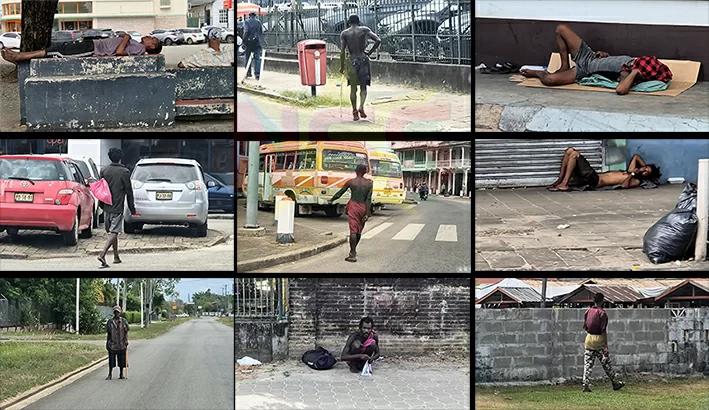
Recent calls for increased security at two major markets in Paramaribo, Suriname’s capital, have sparked a broader public reflection on how society discusses and treats people experiencing homelessness. Vendors at the Centrale Markt and Vreedzaammarkt have formally submitted complaints to police chief Melvin Pinas, highlighting persistent issues of harassment, petty theft, and physical assaults targeting both vendors and shoppers that they attribute to unhoused people currently living on the city’s streets. These safety concerns are widely recognized as legitimate: no one should feel unsafe while working to earn a daily income in their place of business. But as columnist Indra Toelsie points out, the conversation around this issue has revealed a troubling pattern in how Surinamese society categorizes and judges unhoused people.
Over the past decades, Suriname has cycled through a series of different labels for people living on the street. What were first called vagrants, then often categorized as drug addicts, then referred to as unhoused or homeless, are now increasingly described by the collective term “street wanderers” (landlopers in Dutch). While each of these terms carries a slightly different meaning, Toelsie notes that society often slaps new labels on the same group of people in the hopes that a new name will bring more clarity to who these people are and how they ended up without stable housing. But in practice, these labels more often serve as oversimplified boxes that erase the individual circumstances behind each person’s situation.
When passersby see someone sleeping on a sidewalk, panhandling, or acting in a way that feels disruptive, it is easy to jump to a quick judgment and slap on a pre-made label. Few stop to ask what led that person to life on the street. The causes can range widely from drug addiction and untreated mental illness to generational poverty, family breakdown, job loss, and the absence of a functional social safety net. In many cases, people end up homeless because of a toxic combination of overlapping challenges, and outsiders rarely have the full context to understand what a person has experienced.
This nuance does not mean that harmful behavior should be excused. Vendors have an undeniable right to work in safety, customers have the right to shop without fear of violence or harassment, and law enforcement has a clear responsibility to intervene when laws are broken. But Toelsie draws a critical line between holding individuals accountable for harmful actions and reducing an entire group of people to a single collective problem. The harmful actions of one unhoused person do not justify stigmatizing every person living on the street.
Suriname’s government has previously reported that 503 people categorized as “street wanderers” are registered in the Greater Paramaribo area. Minister Harish Monorath has explained that the term was deliberately chosen because it is recognized in existing national legislation, and officials have stressed that unhoused people should not automatically be labeled as vagrants or drug addicts. That distinction is important: a legal or administrative term may be necessary to implement policy, but it does not give society a full understanding of the individual people behind that label.
For Toelsie, the most critical unanswered question in this debate is what happens after homeless people are removed from public streets. What support systems are available to them? Are there tailored assessments to identify what each person needs to get back on their feet? Is there sufficient long-term shelter for people who have nowhere else to go? What ongoing support is available for those struggling with addiction, mental illness, or other chronic challenges that require long-term care?
Existing reports on homeless support services in Paramaribo already highlight a major gap: without sustained structural shelter and support, it is nearly impossible to help people leave street life for good. Many unhoused people receive one-time donations of food, clothing, or basic care, only to end up back on the streets shortly after. This reality forces a hard question: are current policies actually solving the problem of homelessness, or just temporarily moving unhoused people out of public view to appease frustrated communities?
Societies can spend endless time registering people, changing their labels, and announcing new enforcement measures, but little will change until the underlying conditions that force people to live on the street are addressed. It is far easier to judge unhoused people from a distance than it is to investigate how they ended up homeless, and it is even harder to accept that society may never fully understand every person’s story. This does not demand pity for every unhoused person, but it does require humility and restraint in how we judge others. Humanity does not require society to accept harassment or put public safety at risk, but it does require that we do not strip people of their inherent human dignity just because their circumstances make us uncomfortable.
Even if a person has made bad choices or committed harmful acts for which they must be held accountable, they remain a full human being, and cannot be reduced solely to their mistakes, their addiction, their behavior, or the place they sleep. Society is often very quick to decide what to call unhoused people, but it rarely pauses to ask what they actually need to build stable lives.
The public discussion about homelessness in Paramaribo should not stop at the question of what to call unhoused people or how to remove them from public view. It must also center on what shelter, care, and long-term support is available to prevent people from cycling back onto the street over and over again. This is not a simple challenge: it requires coordinated collaboration between government agencies, homeless support nonprofits, healthcare providers, and local communities. It also demands an approach that takes both the public safety needs of vendors and shoppers and the human dignity of unhoused people equally seriously.
The vendor who feels threatened deserves protection, and the customer who has experienced harm deserves justice. But the person living on the street also deserves more than to be seen solely as a source of public nuisance. Maybe that means we all need to be a little more careful about the labels we assign to other people. Words do not solve all problems on their own, but they shape how we see people and how we choose to treat them. Suriname has cycled through vagrants, addicts, homeless, and now street wanderers: the label changes, but the human beings behind the word stay the same. As long as we focus more on the label than the story behind it, one core question will remain unanswered: do we actually know who these people are, or have we only decided what we want to call them?