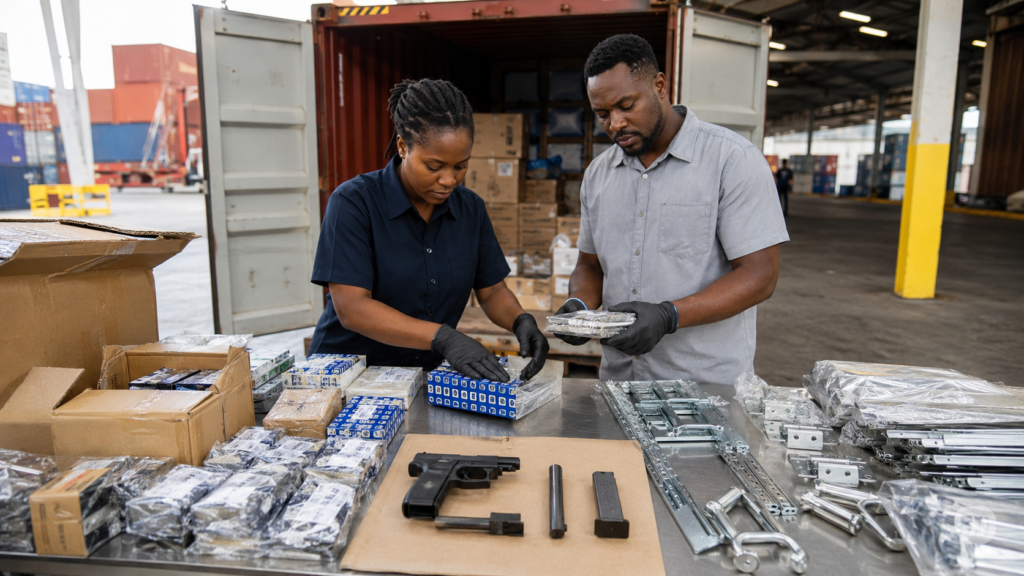
Security officials in Antigua and Barbuda have uncovered a evolving smuggling tactic used by criminal networks to traffic illegal firearms into the country, prompting the government to roll out a series of urgent security upgrades to counter the threat.
Investigators now suspect that illegal guns are no longer being shipped into the nation as fully assembled weapons. Instead, traffickers are disassembling firearms into separate components, disguising individual parts as common, everyday objects to evade routine border inspections. Once all components arrive through separate shipments, the parts are assembled into working weapons locally.
Maurice Merchant, Director General of Communications, outlined the new findings during a post-Cabinet media briefing held on Thursday. “The entire guns are not coming on any shipment,” Merchant confirmed, explaining that the split-shipment strategy is intentionally designed to fly under the radar of standard inspection protocols. He used a striking example to illustrate the deception: a single component of a firearm could be shaped and marketed to look like an ordinary pen, but when combined with other pre-smuggled parts, it becomes a functional, dangerous weapon.
In response to this growing threat, the Antigua and Barbuda government has already taken concrete action to strengthen border security. The cabinet recently approved the procurement of new high-capacity X-ray scanning machines built to examine full shipping containers and entire cargo pallets at the country’s main port. Funding for the equipment has been fully allocated, and the acting comptroller of customs has received formal instructions to move forward with the acquisition process without delay.
Merchant noted that security officials are confident the upgraded scanning technology will significantly improve detection rates for these disguised smuggling operations. “With the new X-ray machines at the port, it is believed that some of these illegal shipments will be captured,” he said.
Beyond new equipment, the government is also launching targeted training programs for frontline customs officers. The specialized training will focus on building officers’ ability to identify disguised firearm components and other unusual, high-risk cargo that falls outside standard smuggling patterns.
Merchant emphasized that security agencies recognize the dynamic nature of organized criminal activity: traffickers continuously adapt their smuggling methods to outpace enforcement, so regular upgrades to equipment, staff training, and operational strategies are a permanent requirement for effective border protection. The government is also evaluating additional surveillance equipment to expand the maritime monitoring capabilities of the Antigua and Barbuda Defence Force, which is tasked with guarding the nation’s extensive coastal borders.
Officials across government agencies agree that coordinated improvements to three key areas—expanded maritime surveillance, advanced port scanning technology, and enhanced intelligence gathering—will be critical to curbing the flow of illegal firearms into Antigua and Barbuda and reducing the associated risks of violent crime.