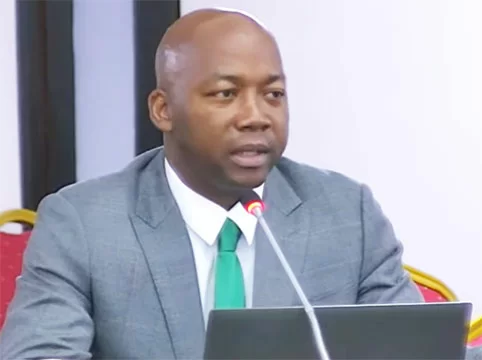
After decades of unregulated, unpaid river sand extraction in Suriname’s Klaaskreek and Nieuw-Lombé regions, Minister of Natural Resources David Abiamofo has announced a definitive end to the long-running illegal activity that has cost the state millions in lost revenue over 25 years.
Speaking before the National Assembly (De Nationale Assemblee, DNA), Abiamofo detailed the scope of the problem: for more than two and a half decades, multiple mining barges operated simultaneously in the region without the required government permits, and no royalties were ever paid to the state for the extracted sand. What is more, the minister confirmed that political leaders, administrative officials, and even segments of traditional local authorities had been aware of the unauthorized operations throughout this entire period, allowing the illegal activity to continue unchecked and rob public coffers of consistent revenue.
Efforts to regulate the sector and formalize legal operations have been underway for several years, but the process has faced significant legal hurdles. After the ministry revoked one previously granted mining right, the license holder filed a legal challenge. In a May 12, 2026 ruling, the court sided with the claimant, ordering the state to reverse the revocation within two months and imposing a penalty for non-compliance. Abiamofo confirmed his ministry has since honored the judicial ruling.
Following the court decision, the ministry facilitated closed negotiations with all involved stakeholders to resolve tensions and establish a clear framework for future operations, a process that has now reached a successful conclusion. Under the new agreed terms, the current mining right holder is barred from entering the two affected local villages. In exchange, village authorities have agreed to stop acting as unauthorized permit-issuing bodies for extraction activities, a practice that had long contributed to the region’s regulatory chaos.
To give local communities a formal stake in legal operations, Abiamofo announced that village groups will now be able to nominate legal entities to apply for official mining rights on their behalf. The Ministry of Natural Resources will provide full guidance through the application process, in partnership with local administrative services and the district commissioner. The new framework, the minister emphasized, will put a permanent end to the toleration of any extraction activity that falls outside official legal processes.
“Anyone who wants to engage in sand mining must apply for the appropriate permit through the official legal procedure,” Abiamofo told parliament. The core end goal of the reforms, he added, is to bring all extraction activity into full legal compliance and ensure the state receives rightful revenue from the exploitation of national natural resources.
During parliamentary questioning, the minister also faced questions about the role of traditional authorities in managing natural resources within their traditional territories. Lawmakers raised particular concerns about cases where revenue from community assets, including community forests and sand mining operations, fails to benefit the broader local population.
The discussion in the National Assembly made clear that the crackdown on illegal sand mining touches on a far broader national issue: beyond simply legalizing existing extraction operations, the debate forces a reckoning with two unresolved core questions—who holds the legitimate authority to approve natural resource exploitation, and how can the country ensure revenue from these public resources is distributed fairly and benefits all relevant stakeholders.