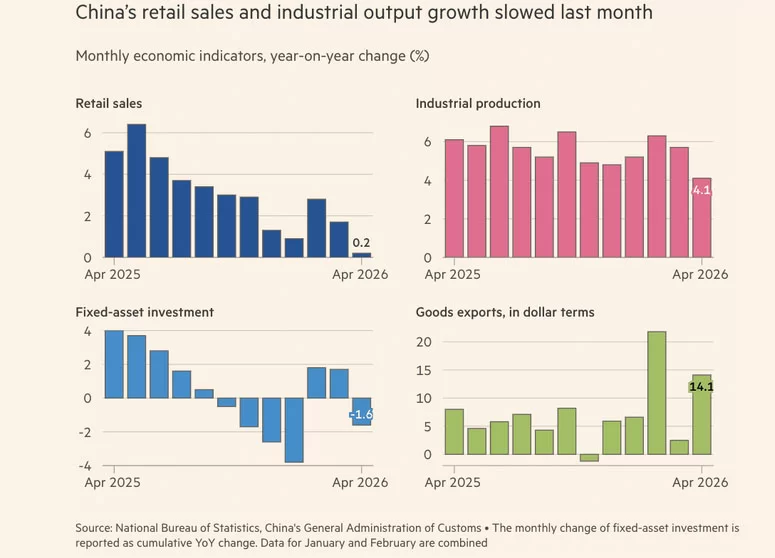
Fresh July economic indicators released by China confirm a broad-based weakening across key domestic segments, intensifying calls on Chinese policymakers to roll out targeted support measures to flagging domestic demand. Data published by China’s National Bureau of Statistics (NBS) shows industrial output expanded 4.5% year-on-year in July, down from 5.3% growth in June and falling short of the 4.8% growth forecast by a poll of economists surveyed by Reuters.
Consumer spending, one of the core pillars of domestic economic activity, also underperformed expectations. Retail sales, a key benchmark for household consumption, rose just 0.6% year-on-year in July, far below the 1.5% growth analysts had projected, indicating Chinese households continue to tighten spending amid broad economic uncertainty.
Fixed asset investment, another major driver of Chinese economic growth, also extended its downward trend. Official figures released on Monday show fixed asset investment dropped 6.7% year-on-year in the first seven months of 2026, accelerating from a 5.7% decline recorded in the first half of the year.
The persistent slump in China’s real estate sector remains one of the most pressing headwinds dragging on broader growth. New home prices edged down another 0.1% month-on-month in July, and are 3.2% lower than the same period last year. The ongoing weakness in the housing market has eroded household wealth and consumer confidence, creating a ripple effect that suppresses both private consumption and broader business investment across the economy.
China’s annual economic growth already slowed to 4.3% in the second quarter of 2026, and the July data has reinforced growing concerns that the post-pandemic economic recovery lacks solid, broad-based support from domestic activity. On the bright side, export performance has remained relatively resilient. As Reuters reports, Chinese exporters are benefiting from surging global demand for technology products and infrastructure goods tied to the global expansion of artificial intelligence capacity, helping to offset some of the drag from weak domestic demand.
However, this reliance on external demand carries significant long-term risks. Major trade partners have grown increasingly critical of China’s large trade surpluses and low-cost export goods, while ongoing international trade disputes and rising geopolitical tensions add layers of uncertainty to future export performance.
In response to the slowdown, Chinese Premier Li Qiang has outlined a policy priority of stabilizing external demand while boosting domestic consumption and investment. According to Reuters, the Chinese government is planning targeted measures to support employment and household incomes, as well as to incentivize greater private sector investment.
As the world’s second-largest economy and a top global importer of crude oil, metals and other core commodities, shifts in China’s economic trajectory are closely watched by policymakers and market participants around the world. A prolonged slowdown in Chinese industrial activity and consumer spending would dampen global aggregate demand, with ripple effects that impact global commodity prices and growth in other major economies.
The July data underscores the significant policy challenge facing Beijing: while exports and select industrial segments still provide some support for growth, the domestic foundation of the Chinese economy remains vulnerable without a robust recovery in consumption, fixed investment and the troubled real estate sector.