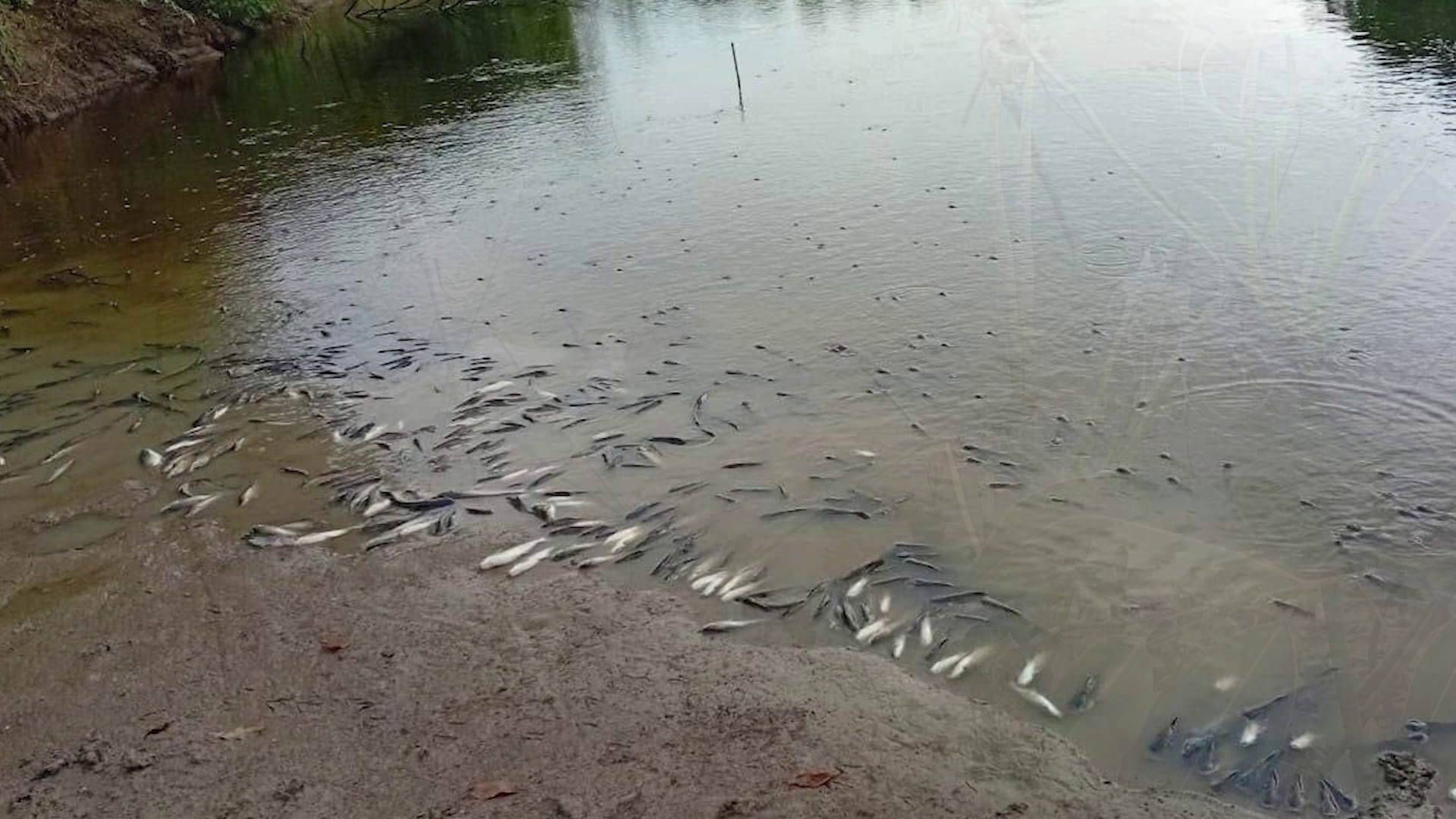
In the wake of a large-scale fish mortality event that struck the Belize River Valley last week, environmental regulators have turned their full investigative attention to an unapproved rice cultivation operation located adjacent to Labouring Creek, a tributary that feeds directly into the Belize River. Officials with Belize’s Department of Environment (DOE) suspect that floodwater runoff from the agricultural site may have contaminated the watershed before reaching the main stem of the Belize River, triggering the mass death of aquatic life.
Anthony Mai, Chief Environmental Officer at the DOE, told reporters that early investigative work has already uncovered clear red flags: the operation appears to have been developed without the mandatory environmental clearance required under Belize’s environmental protection regulations. “We have not released the landowner’s name yet because we have formally requested official land tenure documentation from the Lands Department,” Mai explained in a press briefing. “First we must confirm that the individual actually holds legal title to the property before we name anyone publicly. But our internal DOE checks confirm that, according to our existing records, no environmental clearance was issued for this development. That is an unambiguous violation of national regulations.”
Per Belizean rules, any agricultural project of the size of this rice farm is required to complete a full Environmental Impact Assessment (EIA) prior to breaking ground. Violations of the EIA mandate carry fines ranging from $50,000 to $100,000 Belize dollars, and Mai confirmed that regulators will move forward with enforcement action once land ownership is confirmed. “Once we get formal confirmation from the Lands Department, we will give the landowner an opportunity to produce any valid permits they may hold,” Mai said. “If they cannot produce the required documentation, they will be held fully accountable for this violation.”
The location of the rice farm, just steps from the Belize River watershed, creates unique environmental risks that have regulators particularly concerned. Traditional rice cultivation relies on flooding fields to suppress pests and diseases, and the used water is then discharged ahead of harvest. At this unlicensed operation, a central canal runs directly from the fields into Labouring Creek, which flows unfiltered into the Belize River – creating a direct pathway for agricultural contaminants to enter the main water system.
To date, investigators have already detected multiple chemicals of concern at sampling sites throughout the area: eight in the Santander field, 32 in the Santander canal, 15 in the site’s effluent pond, and 10 in upstream areas of Santander. While one trace of agrochemical and pesticide residue has already been confirmed in the site’s main canal, regulators are still conducting further testing to identify the source of all detected substances and measure their exact concentrations in the water system. Those results will be critical to determining whether these chemicals caused the mass fish kill.
Final laboratory results are expected by the end of next week, and DOE officials will present their full findings at a public community meeting scheduled for August 29 in the affected area. Mai emphasized that the incident has underscored the urgent need for stronger regulatory oversight of agricultural activities and agrochemical use across the entire Belize River watershed.
The Belize River is one of the country’s most critical natural resources, supplying water to the majority of Belize’s population, and Mai says the event highlights long overdue gaps in watershed management. A comprehensive Belize River watershed management plan has already been drafted but has not yet received formal cabinet approval. Mai says the fish kill makes formal adoption and implementation of this plan a top priority, as it clearly outlines role and responsibilities for all government agencies overseeing development within the watershed. Moving forward, the DOE is also partnering with local scientific experts to improve the accuracy of fish kill investigations and expand long-term monitoring of Belize’s rivers and aquatic ecosystems to prevent similar incidents in the future.