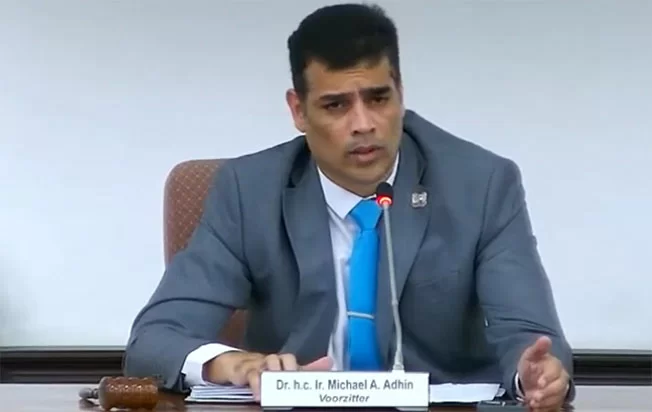
On August 15, correspondence from the High Court of Justice and the Public Prosecution Service (OM) regarding planned overhauls to Suriname’s judicial structure triggered a spirited debate during a plenary session of the National Assembly (DNA), bringing transparency and inter-branch communication into the spotlight.
VHP parliamentarian Krishna Mathoera raised the issue during the meeting, noting she had received information that new amendments affecting the judiciary and Public Prosecution Service had been drafted, and relevant letters had been delivered to Assembly Speaker Ashwin Adhin. However, these critical documents were not accessible in the National Assembly’s internal document system. Mathoera emphasized that lawmakers have already been receiving public and stakeholder inquiries about the planned changes, but without access to the full correspondence, they cannot provide informed, substantive responses, and called on Adhin to immediately make the documents available to all elected representatives.
Adhin confirmed he received the two letters on Friday, and stated the documents have already been forwarded to the Assembly’s clerk’s office and the committee of rapporteurs. He pledged to expedite the process of sharing the full correspondence with all assembly members. The Speaker also clarified that as of the session, he had not yet received any formal draft amendments from either the sitting government or parliamentary sponsors of the reform initiative, noting that multiple stakeholders – including the executive branch, parliamentary initiators, and judicial bodies that have outlined their concerns – are involved in the legislative process.
Ebu Jones, an NDP MP and the reform initiative’s lead sponsor, questioned the procedural timeline of the correspondence. Jones said he was unaware of any formally submitted amendments that the High Court and Public Prosecution Service could have responded to, raising questions about what exactly the two institutions’ feedback is based on. He stressed that major state bodies should only comment on official, formally tabled proposals, noting that standard procedure requires draft proposals to be submitted to the National Assembly first before being circulated to relevant institutions for public comment. Jones added that he will not be able to form a substantive judgment on the feedback until he has full clarity on the contents of the letters and what specific drafts they responded to.
Rabin Parmessar, NDP parliamentary group leader and chair of the committee of rapporteurs, confirmed that his committee had also not received any formal amendment documents for review up to the time of the debate. Taking a broader institutional perspective, Parmessar warned against allowing the confusion to escalate into a breakdown of communication between Suriname’s separate branches of government. He emphasized that healthy communication and cooperative relations between state branches are a foundational requirement for a functioning democratic constitutional state, noting that the nation gains nothing when branches of government fail to operate in constructive harmony. Parmessar called on Adhin to directly contact the president of the High Court of Justice to resolve existing communication misalignments.
Adhin responded that he had already considered direct outreach to judicial leadership, but plans to first conduct a thorough review of the received correspondence before moving forward. He also asked all assembly members to read the letters in full once they are distributed, before the body holds further discussions on the emerging situation. The current debate comes amid ongoing plans for sweeping restructuring of Suriname’s judicial organization, including major proposals to reshape the institutional structure of both the judiciary at large and the Public Prosecution Service.