When high-stakes post-election constitutional hearings resumed in Kingstown on September 29, 2026, two of Saint Vincent and the Grenadines’ top elected officials stepped into the witness box to defend their right to hold parliamentary office. Prime Minister Dr. Godwin Friday and Foreign Affairs Minister Dwight Fitzgerald Bramble faced hours of rigorous cross-examination before High Court Justice Gertel Thom, with the entire proceeding centered on a single explosive question: does their retention of Canadian citizenship violate the nation’s constitution and disqualify them from public office?
The challenge to the two leaders’ eligibility stems from the outcome of the country’s November 2025 general election, where the New Democratic Party (NDP) secured a historic landslide victory, claiming 14 of the 15 available seats in Parliament. Two defeated Unity Labour Party (ULP) candidates, Carlos Williams and Luke Browne, moved quickly to file the election petitions, arguing that Friday and Bramble’s dual citizenship runs afoul of Section 26 of the Saint Vincent Constitution, which bars candidates who owe allegiance to a foreign power.
On the witness stand, both men were grilled along near-identical lines of questioning from the petitioners’ legal team. Attorneys pressed Friday on a personal report he prepared outlining his nationality status and legal loyalty to Saint Vincent and the Grenadines, probing his understanding of constitutional requirements for parliamentary representatives, and asking for granular details on when he obtained his Canadian passport and why he had never chosen to renounce his foreign citizenship. The cross-examination also extended to Friday’s past public comments on holding dual citizenship while holding office, and his understanding of constitutional roles of heads of state in other Commonwealth nations. Bramble faced identical scrutiny, with legal teams questioning the voluntary nature of his choice to retain Canadian citizenship during his time in public office, and the practical benefits he derived from holding a Canadian travel document.
Adding expert context to the constitutional dispute, the proceedings also included virtual testimony from Professor Hamid Ghany, one of the Caribbean’s most respected scholars of constitutional law and parliamentary studies. Ghany appeared as an expert witness to present his analysis of Commonwealth constitutional frameworks and regional political governance, and he too faced cross-examination on the conclusions laid out in his specialised report.
The case has drawn a high-powered roster of legal talent from across the region and beyond. The respondents, Friday and Bramble, are defended by a team led by prominent Trinidadian Senior Counsel Anand Ramlogan, joined by UK barrister Kate Temple-Mabe, top local defence attorney Kay Bacchus-Baptiste, and additional team members Zhinga Horne-Edwards, Zita Barnwell, and Samantha Robertson. They face off against the petitioners’ legal team, which is headed by Trinidadian Senior Counsel Stuart Young, with support from Al Elliott and Carlos James.
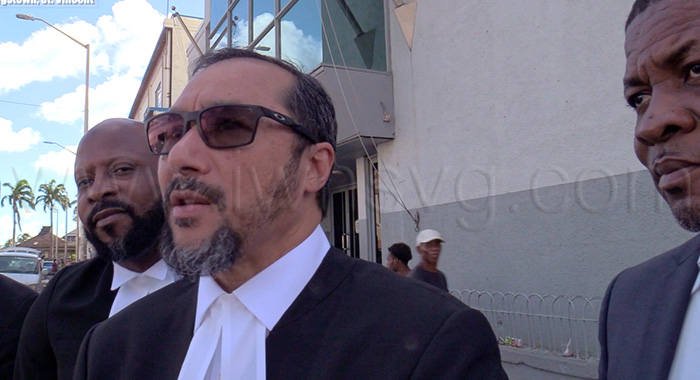
Speaking to reporters outside the Kingstown courthouse after Tuesday’s proceedings, Young expressed confidence in his team’s progress and laid out the core of the petitioners’ argument. Young stressed that both leaders had ample opportunity over their years in public life to renounce their Canadian citizenship, and that their intentional choice to retain the foreign nationality is a violation of the constitutional requirements for holding parliamentary office.
When asked whether the court battle itself was an unnecessary distraction for the sitting prime minister, Young placed full responsibility for the proceedings on Friday himself. “He chooses to be here. He chooses to hold a Canadian passport. That’s for the Prime Minister,” Young told reporters.
He declined to preview the full scope of the petitioners’ legal arguments, noting that the public will have to wait for closing submissions and the judge’s final ruling. But he confirmed that the question of why the pair chose to retain foreign citizenship while serving the Vincentian public will remain a central pillar of the case. Young also shared that his team raised additional questions during the proceedings around constitutional amendment bills that have previously been introduced in Parliament, touching on the question of why reform has not been advanced if dual citizenship eligibility is a priority for the current government.
Evidentiary hearings are scheduled to continue September 30, with the court set to hear testimony from additional expert witnesses who will provide further specialised analysis on the constitutional definitions at the heart of the dispute.