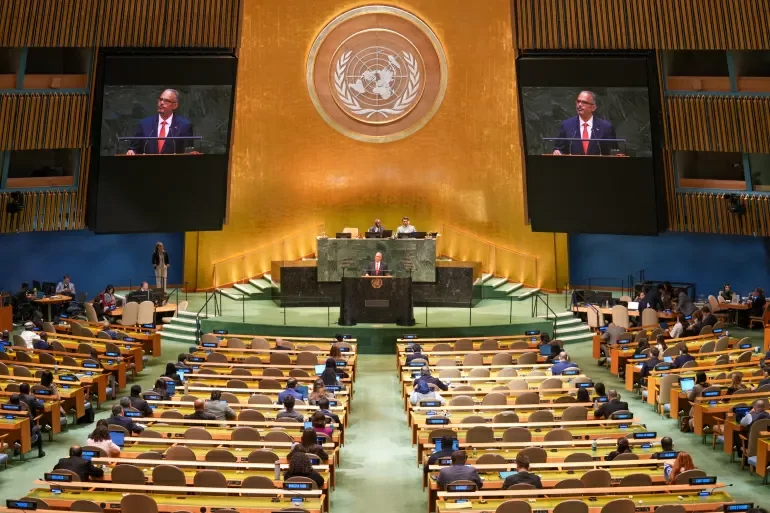
On Tuesday, the United Nations Security Council voted to extend the mandate of the international Gang Suppression Force (GSF) deployed in Haiti by an additional six months, allowing the mission to continue its work targeting armed gang groups and supporting local Haitian security institutions through March 31, 2027.
The resolution to extend the mission passed with 12 votes in favor and no votes against it, but three major powers – China, Russia, and Pakistan – abstained from the ballot. The three nations have previously raised public questions about the operational effectiveness, sustainable funding, and planned troop size of the international security deployment, echoing broader skepticism about the mission’s ability to resolve Haiti’s long-running instability.
The mandate extension comes at a critical juncture for Haiti, where gang-linked violence continues to spread across the country, and the GSF remains far below its originally planned troop strength. U.S. Ambassador to the UN Mike Waltz told the council that roughly 1,500 GSF personnel are currently active in Haiti, compared to the target deployment size of 5,500 troops. According to U.S. projections, the remaining thousands of required troops are expected to arrive in the coming months, though slow deployment buildup has already emerged as one of the mission’s most pressing challenges.
The GSF was launched one year ago, after an earlier Kenya-led multinational security effort, the Multinational Security Support Mission (MSS), failed to mobilize enough personnel and funding to meet its objectives. Unlike the previous mission, the GSF holds a broader operational mandate: it can partner directly with Haitian national police and armed forces, while also conducting independent operations within the scope of its authorization. Proponents of the new framework argue this more flexible structure will make the international intervention far more effective than earlier attempts to stabilize the country. Even so, Waltz acknowledged that past international missions in Haiti have produced little lasting progress, saying the current approach must break from that pattern to succeed.
Just one day before the Security Council vote, a new outbreak of deadly violence hit Haiti’s Artibonite province, underscoring the persistent threat armed groups pose across the country. Local authorities reported that at least 11 people were killed, and multiple residential and public buildings were set on fire in a retaliatory attack carried out by gangs Monday. The violence came after GSF forces killed three members of an armed faction during an operation targeting illegal gang checkpoints. The local mayor confirmed the direct link between the GSF operation and the subsequent attack, though full independent verification of all details remains limited by the dangerous security conditions on the ground.
Over recent months, Artibonite has become one of the central frontlines of Haiti’s gang conflict. Armed groups that first consolidated control in the capital Port-au-Prince have expanded their influence into outlying regions, including key agricultural areas that sustain the country’s food supply. Just this September, new waves of violence have displaced hundreds of local residents: the International Organization for Migration (IOM) recorded 904 newly displaced people after clashes in Saint-Marc and Verrettes between September 12 and 17.
The humanitarian fallout from Haiti’s ongoing crisis remains staggering. Updated IOM data shows nearly 1.5 million Haitians are currently internally displaced, with roughly 80 percent of those displaced people now living outside Port-au-Prince. That distribution confirms a dangerous geographic spread of violence beyond the capital. Between April and June of this year alone, the UN recorded 1,408 deaths and 656 injuries linked to gang violence across the country. The UN also documented 326 cases of sexual violence in that period, though the organization acknowledges the true number is almost certainly much higher, as most cases go unreported due to insecurity and stigma. In August, a gang attack in Kenscoff, a town just outside Port-au-Prince, killed at least 47 people including five children, further highlighting the ability of armed groups to extend their reach beyond the capital.
Beyond security and humanitarian challenges, the international intervention is closely tied to Haiti’s long-stalled political transition. After years of crippling political instability, Haiti is now preparing to hold its first national elections in nearly a decade. Haiti’s provisional electoral council has set December 13, 2026, as the date for the first round of presidential and parliamentary elections, with a second round scheduled for February 21, 2027, alongside local government elections. A national referendum on proposed constitutional amendments is also scheduled for December 13. However, the electoral council has warned that the entire timeline remains contingent on achieving sufficient security across the country and securing adequate funding for the vote. Voter registration is currently scheduled to close on October 13.
Haiti has not held a national election since 2016. The political transition that followed the 2021 assassination of President Jovenel Moïse failed to deliver a stable electoral process, and the Transitional Presidential Council ended its mandate earlier this year without organizing the long-promised vote. The new electoral timeline marks a key milestone for Haiti’s democratic transition, but holding the vote will depend entirely on whether the GSF and Haitian security forces can improve security conditions enough to allow voting to proceed safely.
Skepticism about the impact of extending the international mission remains widespread among some member states and independent observers. Beyond the three abstentions from the Security Council vote, human rights organizations and regional experts have repeatedly highlighted the risks of foreign security intervention in Haiti. The country has a long history of international interventions, many of which have been marred by documented accusations of human rights violations against civilian populations.
In response to these concerns, UN officials emphasize that military and police operations must be paired with long-term efforts to strengthen Haitian state institutions, reform the judicial system, expand access to basic public services, and protect civilian populations. UN Special Representative Carlos Ruiz Massieu has also called for targeted action to prosecute and sanction actors who fund, organize, or facilitate gang violence across the country.
The six-month mandate extension gives the GSF additional time to reach its full deployment strength and expand its operational capacity across Haiti, but significant time pressure remains. With the first round of elections scheduled just three months from now, insecurity still plagues most regions of the country, and armed groups have proven they can still launch large-scale deadly attacks even as the international mission scales up. The coming months will prove decisive for both the GSF and Haiti’s political transition: the mandate extension provides additional time to make progress, but it does not address Haiti’s underlying structural challenges, including weak state capacity, widespread gang control, a catastrophic humanitarian crisis, and a decade-long pause in democratic governance.
For the UN and Haitian authorities, the road ahead requires addressing two overlapping urgent priorities: improving security enough to create conditions for free and fair elections, while building up sustainable local institutions to reduce Haiti’s long-term dependence on international military support.