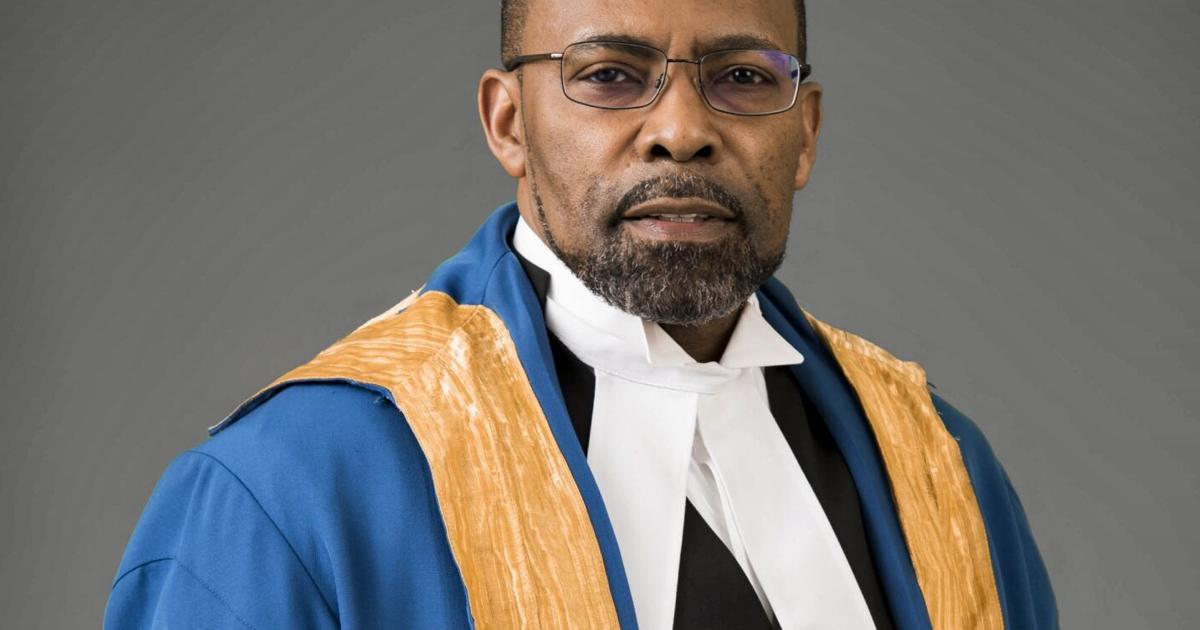
A simmering internal conflict over institutional governance and judicial attire has erupted into an open, high-stakes rift at the Caribbean Court of Justice (CCJ), pitting the court’s president against his judicial peers and raising urgent questions about the institution’s commitment to transparency, collegiality and cultural inclusion. The controversy first came to a head on July 3, 2026, when CCJ President Justice Winston Anderson sent a formal email to sitting Justice Chile Eboe-Osuji, demanding written assurance that Eboe-Osuji would wear a traditional European-style business suit and tie for two upcoming high-profile judicial hearings: *Fisher v Guyana Elections Commission* scheduled for July 16, and *Ramirez and Zabane v Attorney General of Belize* set for July 28. In his message, Anderson noted that a formal court-wide judicial dress code was still pending adoption, and that compliance with traditional business attire was the longstanding custom of the court and the wider Caribbean region. He set an ultimatum: Eboe-Osuji had to respond by 12:01 p.m. on July 6, or Anderson would reconfigure the hearing panels based on previous communications about Eboe-Osuji’s stance on dress. The demand drew a sharp, public rebuke from Eboe-Osuji, who identified as Nigerian and pushed back against what he framed as an overreach of executive authority and a rejection of his cultural identity. In a response sent the following day, July 4, Eboe-Osuji called Anderson’s directive “highly inappropriate behaviour towards a peer,” arguing that the CCJ’s founding agreement grants the court president no unilateral power to dictate the dress of sitting judges. He went further, accusing Anderson of pushing a Eurocentric standard of judicial professionalism that requires him to reject his innate cultural identity, a move he said would not hold up to scrutiny before global human rights bodies including the Inter-American Commission on Human Rights and the UN Committee on Human Rights. On July 5, Eboe-Osuji shared the full exchange with all sitting CCJ justices, opening the debate to the entire bench and detailing his desire to wear traditional Nigerian attire while on the bench. What began as a disagreement over clothing quickly ballooned into a broader debate over institutional authority, cultural decolonization, and judicial independence, with multiple judges weighing in to share their perspectives and voice solidarity with Eboe-Osuji. Guyanese-born Justice Arif Bulkan was the first to respond on July 6, noting that his home country had relaxed colonial-era dress rules for legal professionals as early as the 1970s, permitting Nehru-collar shirts in place of European suits and ties as a more culturally and climate-appropriate alternative decades ahead of neighboring Trinidad and Tobago. That same day, Belize-born Justice Denys Barrow added his voice, affirming that non-European judicial attire carries full dignity, and warned against unilateral rule-making by a single court leader without broader consultation. He also called on colleagues to maintain perspective as tensions rose over the panel reconfiguration controversy. By July 7, the conflict escalated further: Anderson followed through on his initial ultimatum, informing Eboe-Osuji that he would be removed from both hearing panels due to the lack of requested written assurance on attire. Eboe-Osuji immediately pushed back, calling the removal unlawful, a violation of the CCJ’s founding agreement and a breach of international human rights law, and urged Anderson to reverse the decision. After holding informal discussions with other judicial colleagues, Anderson backed down hours later, agreeing to reinstate the original hearing panels until the underlying dress code and governance dispute could be resolved. The detente did not end the broader institutional crisis, however. On July 8, Trinidad and Tobago-born Justice Peter Jamadar framed the conflict as a far more serious threat to the court’s core mission, warning colleagues that the dispute exposed broader threats to the rule of law, judicial independence, institutional integrity and impartiality that extended well beyond the question of attire. He also raised deep concerns about the mental health and well-being of non-judicial CCJ staff, noting the bitter irony that the court was potentially poised to deliver an advisory opinion to the Caribbean Community (Caricom) on good governance and procedural fairness, even as its own internal governance lay in chaos. Bulkan echoed Jamadar’s concerns, stating that he shared full solidarity with Eboe-Osuji and warning that the incident exposed a foundational governance crisis at the court. He questioned what less powerful non-judicial staff must experience if a sitting equal judge could be targeted and singled out in this way, noting that the court risks losing its moral authority to advise Caribbean governments on issues of natural justice, human rights and human dignity if it cannot uphold those values internally. Eboe-Osuji concluded the public exchange by reiterating his claim that Anderson was acting as “lord and master” of the institution rather than a public servant, framing the attack on him as an attempt to force all other court members into line with Anderson’s directives for the remainder of his six-year term, calling the power play a “tragic mistake.” Local media outlet *Trinidad Express* first obtained the full cache of internal email exchanges and reached out to Justice Anderson for comment on the full set of allegations via his personal email on August 5, but received no response. The CCJ’s official communications team issued a general statement two days later, reaffirming the institution’s commitment to judicial independence, integrity and public confidence in the administration of justice, but declined to address any of the specific allegations raised in the internal dispute, noting that claims could be “misunderstood or mischaracterised without the proper context.”