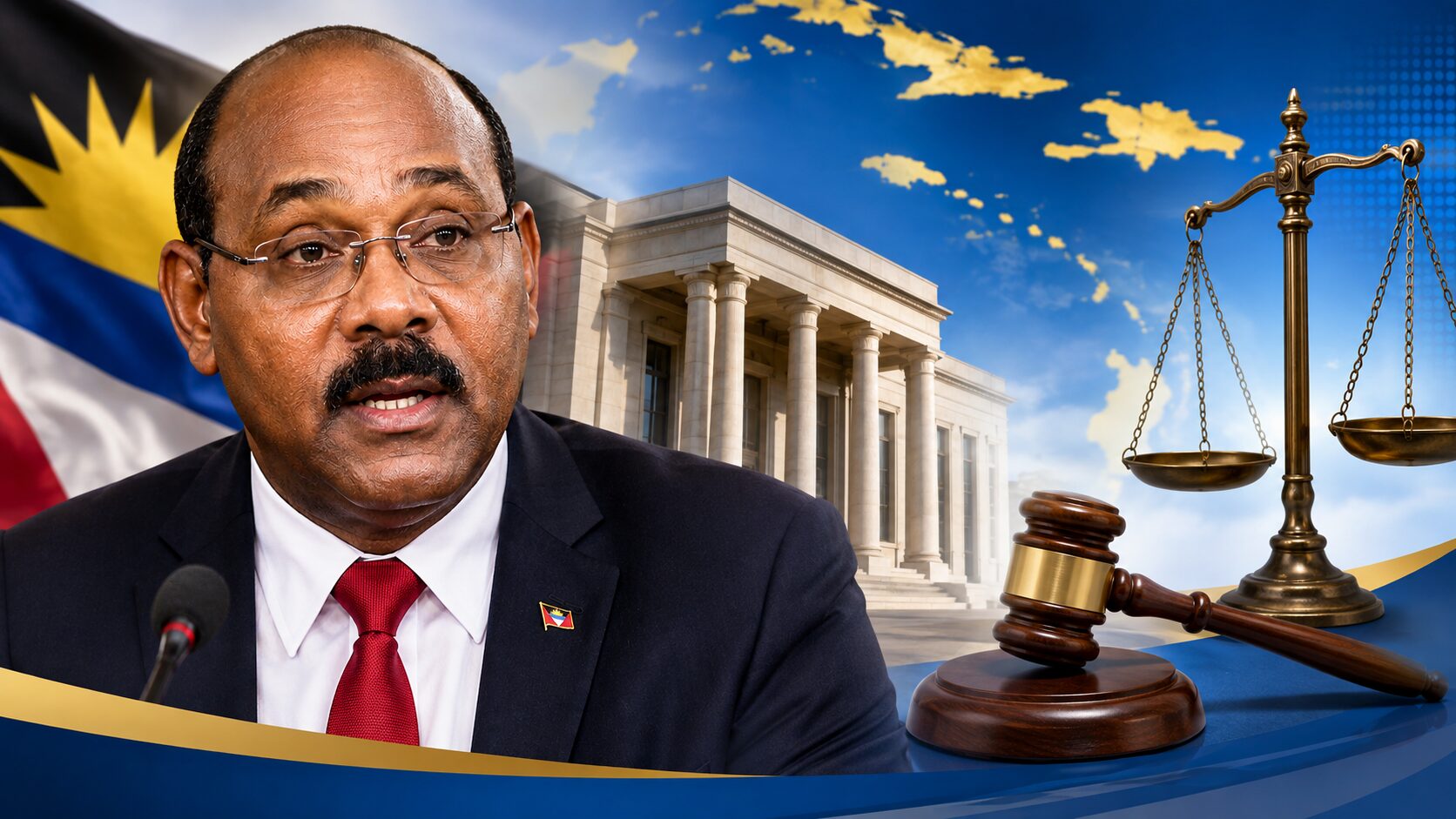
A growing regional constitutional dispute has emerged in the Caribbean after Antigua and Barbuda Prime Minister Gaston Browne pushed back against widespread condemnation from regional judicial leaders, rejecting claims that his public criticism of sentencing practices constitutes an attack on judicial independence. Instead, Browne has put forward a concrete, evidence-based proposal to establish an independent regional committee to examine systemic sentencing gaps for firearm-related and other serious violent crimes.
The conflict ignited after Browne made public comments on August 10 questioning what he and many members of the public and law enforcement community view as unduly lenient sentences handed down in some high-profile serious criminal cases, including firearm offenses and statutory rape. Those remarks drew a rare unified rebuke from the heads of judiciary across seven Caribbean jurisdictions: Barbados, The Bahamas, Belize, Guyana, Jamaica, Trinidad and Tobago, and the Eastern Caribbean Supreme Court. The regional judicial leaders also raised alarm over the unauthorized disclosure of confidential internal court correspondence, reaffirming their unwavering commitment to the independence of regional judiciaries and the institutional integrity of the Caribbean Court of Justice (CCJ), a foundational regional judicial body.
In their joint statement, the judicial heads stressed that public trust in the authority of courts depends entirely on widespread confidence in judges’ independence, impartiality, integrity and professional competence. While they declined to weigh in on the substance of allegations involving individual judges or internal administrative matters, they emphasized that breaches of judicial confidentiality pose a serious threat to institutional stability.
Responding publicly on Thursday, Browne pushed back against the regional pushback, clarifying that he fully upholds the core principles of judicial independence and separation of powers. He argued, however, that these foundational democratic principles do not grant judges immunity from reasoned, legitimate public scrutiny of sentencing outcomes.
“Judicial independence is essential to democratic government. However, it does not place judicial decisions or the administration of justice beyond reasoned public criticism,” Browne stated.
The prime minister emphasized that an elected government has a responsibility to address public concerns, noting that his comments were prompted by growing unease among residents and law enforcement over rising firearm violence and sentences that diverge from the penalties set out in national legislation. Antigua and Barbuda’s current law allows for custodial sentences of up to 15 years for serious firearm offenses, and Browne claimed some judicial officers have shown “indiscretion and deliberate disregard” for these statutory provisions. He stressed that his remarks were never intended to interfere in ongoing individual cases, reverse finalized rulings, or undermine court orders, nor has his administration ever taken steps to remove, reassign or deport any judicial officer in violation of constitutional rules.
Browne also rejected the argument that the judicial appeal process is the only legitimate avenue to address sentencing concerns. While he acknowledged that appeals remain the proper mechanism to correct improper sentences in individual cases, he noted that appeals cannot resolve broader systemic issues, including inconsistent sentencing patterns, gaps in statutory penalties, the lack of clear sentencing guidelines, failures to address repeat offending, systemic delays, and coordination breakdowns between police, prosecutors, courts and correctional services. He added that Antigua and Barbuda has granted the Director of Public Prosecutions the authority to appeal sentences since 2004, a power that has been used successfully, but all appeal decisions remain within the independent constitutional authority of that office.
To move the debate forward in a constructive, constitutionally compliant manner, Browne revealed he had written to Eastern Caribbean Supreme Court Chief Justice Margaret Price Findlay on August 12 to propose the immediate launch of an independent sentencing review committee. The panel will analyze sentencing data, assess whether there is a significant gap between the legislative intent of Antigua and Barbuda’s parliament and actual sentencing outcomes, identify root causes of inconsistencies, and recommend actionable reforms to the criminal justice system.
Browne has proposed former CCJ President Justice Adrian Saunders to chair the committee, pending his willingness to accept the role. He also confirmed that two other prominent regional judicial figures – former CCJ President Sir Dennis Byron and CARICOM High-Level Representative on Law and Criminal Justice Justice Godfrey Smith, SC – have already agreed to contribute to the review. The prime minister has invited regional judicial leaders to support the initiative and help launch it without delay.
Framing the review as a evidence-based response to a pressing national crisis, Browne warned that unaddressed firearm violence poses a multifaceted threat to Antigua and Barbuda: it endangers public safety, inflicts lasting harm on victims and their families, stretches law enforcement resources thin, erodes public trust in state institutions, and risks undermining the stable social and economic environment that attracts investment, supports employment and sustains the vital tourism sector.
While Browne acknowledged that sentencers must properly weigh a range of statutory and case-specific factors – including appellate guidance, guilty pleas, aggravating and mitigating circumstances, criminal history, time spent on remand, and the totality of offenses – he argued that legitimate public concerns about sentencing should be examined objectively rather than dismissed out of hand.
“Judicial independence and institutional accountability are not opposing principles,” Browne said. “Our Government seeks no control over the decision of any court. It does seek a criminal justice system that is lawful, proportionate, transparent, consistent and effective in protecting the public.”
He closed by noting that the people of Antigua and Barbuda are entitled to both core democratic pillars: an independent judiciary and a criminal justice system that responds credibly and effectively to the growing threat of serious violent crime.