As hurricane season brings heightened risk of extreme weather and flooding across Haiti, the country’s Ministry of Agriculture, Natural Resources and Rural Development (MARNDR) has ramped up targeted risk-reduction interventions in vulnerable rural communities in Haiti’s southern region.
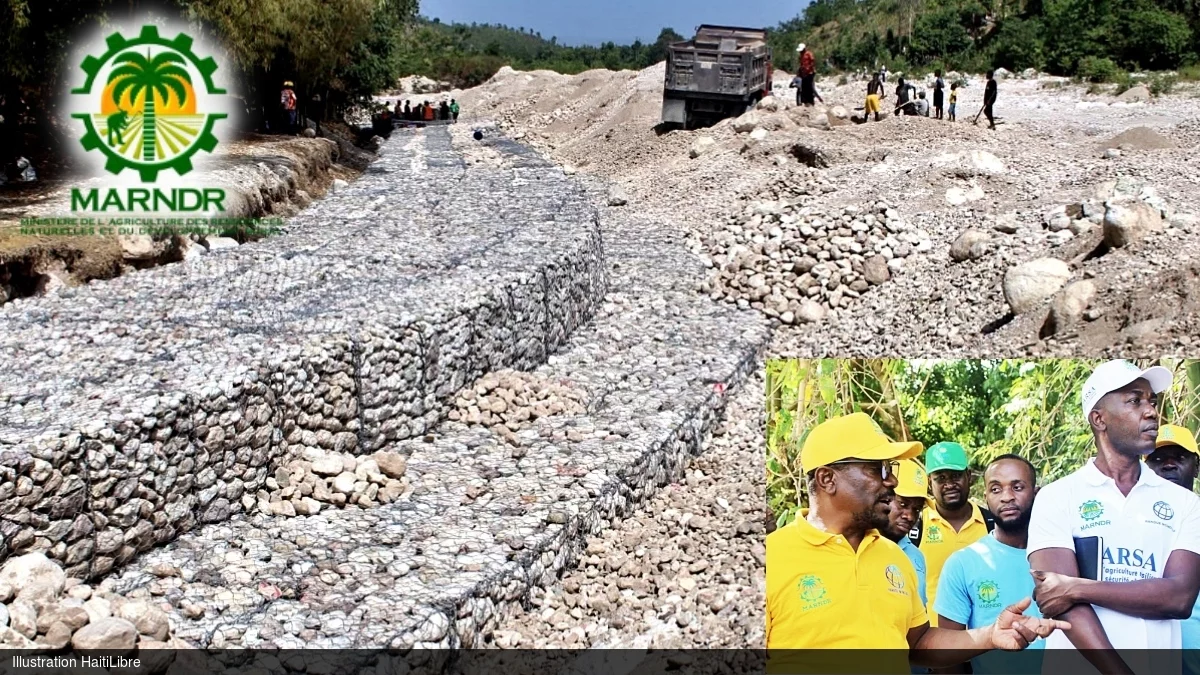
In the 4th communal section of Péan, located within the commune of Torbeck, MARNDR is leading riverbank stabilization work along roughly 750 linear meters of Ravine Sèche through the Resilient Agriculture for Food Security Project (PARSA), an initiative backed by World Bank funding. The core goal of the infrastructure upgrade is to shield local residents and protect critical agricultural land from destructive erosion and flooding triggered by heavy seasonal downpours.
Construction progress is already well advanced: project teams have installed more than 600 linear meters of reinforced gabion retaining walls, a structural solution designed to shore up eroding riverbanks, cut down on sediment loss, and lower the risk of catastrophic damage to adjacent farmland and local infrastructure.
During an official inspection visit to the construction site, Agriculture Minister Marcelin Aubourg stressed that the project directly responds to longstanding safety concerns raised by local residents of Péan. He went on to highlight the significant agricultural potential of the Torbeck region, calling out the nearby Leblanc farm as a particularly valuable high-productivity agricultural site. Aubourg expressed public satisfaction with the pace and quality of work completed to date, commended the contracting firm for its on-the-ground efforts, and reaffirmed that the finished infrastructure will substantially reduce the harm extreme weather events inflict on the local community.
Acknowledging the persistent threat that unregulated erosion of Ravine Sèche poses to the area, Aubourg also issued a public call for residents to remain vigilant and help protect the new infrastructure. He specifically warned against the removal or relocation of gabion stones by bad actors, a practice that would compromise the structural integrity of the riverbanks and put the entire community at risk.
For local families that have lived alongside the unprotected ravine for years, the ongoing construction has been met with widespread relief and cautious optimism. For generations, these communities have faced repeated disruption to their farming operations and livelihoods from annual flooding and erosion, and the riverbank protection project marks the first concrete intervention to address this chronic threat.
Beyond the long-term safety and food security benefits the finished works will deliver, the project has already generated immediate economic gains for local households. Dozens of area residents have been hired to support construction activities, giving them access to on-the-job income while the project progresses, creating a dual benefit for the rural community.